Texas Prediction Markets: Best Apps and What's Legal in 2026
Prediction markets are available in Texas in 2026, including Kalshi, Polymarket US, FanDuel Predicts and other federally regulated platforms. That gives Texans access to sports event contracts even though traditional online sports betting remains illegal in the state.
- Full list of all prediction market applications and live status
- Side-by-side comparables of sites with CFTC approval
- Liquidity sampled across 240+ live markets
- Interactive demos so you can calculate fees & trading
2026 Prediction Markets Landscape
5
TX Prediction Apps
Number of apps operating in Texas
14
Pending prediction apps
Application pending, no launch dat
100+
More than 100 different categories
active state-level challenges in 5+
3
Billion active markets
tracked by DeFi Rate
Best prediction market apps and promos in Texas
If you’re looking for where to trade on sports or upcoming US elections from Texas, Polymarket is our top recommendation. It offers the easiest new user promo and fastest onboarding. Following that comes Kalshi, which has the most extensive menu of Texas election markets, followed by Gemini.
| Platform Name | Sign-up Bonus | Promo Code | How to Claim | |
|---|---|---|---|---|
★ Best Bonus
Polymarket US |
Deposit $10 get a $50 trading bonus Polymarket US Risk Disclaimer 18+ Only. Restrictions and eligibility requirements apply. Not available in all jurisdictions. Trading is risky. 100% loss can occur. See polymarket.com/tos for more information. The Polymarket US App serves as an independent software provider and affiliate of Polymarket US and Polymarket Clearing, the CFTC-regulated exchange and clearing organization. |
RATE
| Use promo code RATE on sign up to be eligible. | Claim Now! |
★ US Approved
Kalshi |
Trade $10, Get $25 Kalshi Terms & Conditions Deposit and trade at least $10 on Kalshi within your first 90 days and get a $25 trading bonus. The bonus is available for trade only and is not cashable. Must be used within 7 days. Eligible US states only. |
RATE
| Deposit and trade at least $10 on Kalshi within your first 90 days to claim a bonus of $25. The bonus is available for trade only and is not cashable. Must be used within 7 days. Eligible US states only. | Claim Now! |
★ Crypto Traders
Gemini Predictions | Trade $10, Get $10 |
Not Required
| Claim Now! | |
|
Trade $5, Get $100 FanDuel Terms & Conditions Requires $1 trade over five days. The bonus itself is non-withdrawable, but winnings from bonus-funded trades are immediately withdrawable. If the bonus trade wins, you keep the winnings portion but not the original bonus stake. Must be 18+ |
Not Required
| Use our exclusive link and get exclusive bonus when you download the app and sign-up. | Claim Now! | |
|
Trade $10, Get $10 OG Predictions Terms & Conditions Your first trade must be $10 to qualify for the $10 offer within the first seven days of your account. 18+ only. | Automatically Applied | Follow our link for the free trade bonus | Claim Now! |
Are prediction markets legal in Texas?
Yes. Prediction markets are available in Texas if regulated by the CFTC. Exchanges such as Kalshi operate as federally regulated Designated Contract Markets (DCMs), where event contracts are traded as derivatives under the Commodity Exchange Act. There are currently 12 prediction market apps available in Texas. This includes DraftKings, FanDuel, Novig and Underdog.
Texas does not have legal online sports betting or commercial sportsbooks. Under Texas Penal Code 47.02, gambling can be prosecuted as a Class C misdemeanor, while the Texas Constitution generally prohibits lotteries outside specific exceptions including the state lottery, charitable bingo and raffles.
CFTC-regulated prediction markets operate under a different federal framework. Kalshi and other regulated exchanges argue that the Commodity Exchange Act gives the CFTC exclusive jurisdiction over contracts traded on DCMs, preventing states from applying their gambling laws directly to those markets.
That argument has and continues to be tested in federal court. In April 2026, the Third Circuit Court of Appeals upheld Kalshi’s preliminary injunction, allowing the exchange to continue operating in New Jersey while the case proceeds. The court concluded that Kalshi’s sports event contracts are swaps traded on a CFTC-regulated DCM and that the Commodity Exchange Act gives the CFTC exclusive jurisdiction over those transactions.
The ruling does not settle the issue nationwide. New Jersey has moved to take the dispute to the US Supreme Court, while courts and regulators in other states continue to wrestle with the same federal-versus-state question. Arizona, for example, was permanently blocked from pursuing criminal charges against Kalshi on preemption grounds.
Texas prediction site breakdowns
1. Polymarket US
Polymarket is the #1 choice for Texans that want more than sports markets. Its newly launched US beta includes politics and election contracts alongside sports, entertainment, economics and other events. For Texas users, this includes markets tied directly to Texas politics as well as the 2026 midterms, giving you a reason to use Polymarket beyond simply trading the Cowboys or Texans. Polymarket US is a CFTC-regulated exchange where trades are matched with other users rather than the house.
The app is also designed more like a modern trading product than a traditional sportsbook, with market prices front and center and the ability to buy or sell your position before settlement. The app design is clean and makes browsing different categories easy.
Polymarket is the world’s largest prediction market by global trading volume, processing $3.7 billion in November 2025 alone. But its US presence is still early. The site was banned from the US market from 2022 to 2025 under a CFTC settlement, and returned in December 2025 after acquiring QCEX (a registered DCM) for $112 million. ICE/NYSE invested up to $2 billion at an $8 billion valuation.
The US app currently offers sports, politics, economics, and crypto markets. What you can trade domestically is limited to single-game markets on the NFL, NBA, NHL, and college football and basketball. Moneylines, mostly, with no props, no combos, and no futures. Polymarket’s US app had no Super Bowl markets at all until the Thursday before the game, when a single game-winner contract appeared. The global version is a different story entirely: $699M in Super Bowl winner volume, $234M on the NBA Championship, and a full prop menu from halftime show bets to mention markets. But none of that is accessible from a US account. Polymarket offers the lowest fee structure in the industry at 0.10% on taker orders.
| Polymarket US | Details |
|---|---|
| Polymarket TX Bonus | Deposit $10 get a $50 trading bonus |
| Polymarket TX Promo Code | RATE |
| Markets Available | Elections · Politics · Sports · Culture · Crypto · Commodities · Climate · Economics · Mentions · Companies · Financials · Tech And Science |
| App Rating | App Store 4.7 (28k reviews) · Google Play 2.5 (7.1k reviews) |
| Terms and Conditions | 18+ Only. Restrictions and eligibility requirements apply. Not available in all jurisdictions. Trading is risky. 100% loss can occur. See polymarket.com/tos for more information. The Polymarket US App serves as an independent software provider and affiliate of Polymarket US and Polymarket Clearing, the CFTC-regulated exchange and clearing organization. |
2. Kalshi
Kalshi is the dominant prediction market in the United States and the one you should probably start with. It holds CFTC designation as a registered contract market, lists more than 4,000 active markets, and processes over $10B in monthly notional volume. Kalshi accepts Texas players without any restrictions. Every market category is available to you: sports, politics, economics, crypto and entertainment. In fact, there’s a dedicated page specifically for event contracts related to the state of Texas.
For sports, Kalshi covers every major league with a Texas franchise and goes deeper than just picking winners. NFL and NBA games offer moneylines, spreads, totals, team totals, player props (touchdown scorers, passing yards, receptions), and custom combos that function like same-game parlays through Kalshi’s request-for-quotation system. All Texas college and pro teams are covered. Beyond sports, Kalshi is the only site where you can access the 2026 Texas elections, the gubernatorial race, and state-specific political markets alongside national elections and economic indicators.
| Kalshi | Details |
|---|---|
| Kalshi TX Bonus | Trade $10, Get $25 |
| Kalshi TX Promo Code | RATE |
| Markets Available | Elections · Politics · Sports · Culture · Crypto · Commodities · Climate · Economics · Mentions · Companies · Financials · Tech And Science |
| App Rating | App Store 4.7 (22k reviews) · Google Play 4.5 (3.1k reviews) |
| Terms and Conditions | New users only. $15 trade requirement within 90 days. Bonus non-withdrawable until completion. Eligible US states only. |
3. Gemini Predictions
Gemini launched its prediction market on December 15, 2025, after a five-year DCM application process, one of the longer regulatory runways in the industry. The app is operated by Gemini Titan, LLC, an affiliate of the Winklevoss twins’ crypto exchange, and positions predictions as part of a “super app” strategy alongside crypto trading and staking.
Gemini covers NFL, college football, NBA, politics (2026 midterms), and economics. One unusual feature: Gemini uses official NFL and college football team logos in its interface, something no other CFTC-regulated site does without formal league partnerships.
| Gemini Predictions | Details |
|---|---|
| Gemini TX Bonus | Trade $10, Get $10 |
| Gemini TX Promo Code | Not Required |
| Markets Available | Elections · Politics · Sports · Culture · Crypto · Commodities · Economics · Companies · Financials · Tech And Science |
| App Rating | App Store 4.8 · Google Play 4.5 |
4. FanDuel
FanDuel Predicts is a separate app from FanDuel Sportsbook, an important distinction for Texas, where the sportsbook can’t legally operate. The prediction markets app launched December 22, 2025, and expanded to Texas on January 14, 2026. It’s built in partnership with CME Group and offers sports event contracts in 18 states, specifically targeting markets where traditional sports betting isn’t legal.
FanDuel has been explicit about its strategy: it will exit sports prediction markets in any state that legalizes sports betting. For Texas, that means FanDuel Predicts is available for the foreseeable future. Legalization isn’t happening before 2027 at the earliest, and likely later.
The app shares CME’s order book with DraftKings Predictions, which means liquidity and market availability are identical across both.
| FanDuel | Details |
|---|---|
| FanDuel TX Bonus | Trade $5, Get $100 |
| FanDuel TX Promo Code | Not Required |
| Markets Available | Sports · Politics · Crypto · Commodities · Financials · Elections |
| App Rating | App Store 4.8 (5.8k reviews) · Google Play 4.6 (1.4k reviews) |
| Terms and Conditions | 18+, Offer valid in AL, AK, CA, DE, FL, GA, HI, ID, MN, NE, NM, ND, OK, RI, SC, SD, TX, UT. Available in 50 states + DC, Bonus credited within 72 hours. |
5. OG Predictions
Crypto.com holds the most comprehensive CFTC regulatory stack in the prediction market space, holding DCM, DCO, and FCM licenses. It launched OG as a standalone prediction markets app in February 2026, timed to Super Bowl LX. The exchange was actually the first to list sports event contracts back in early 2025, before Kalshi’s sports expansion gained mainstream attention.
The underlying CDNA infrastructure also powers white-label prediction markets for Fanatics Markets, Underdog, Trump Media’s Truth Predict, and Hollywood.com. Crypto.com’s 150 million existing users can fund trades with Bitcoin, ETH, or traditional fiat currency.
OG offers a fairly deep prop menu within the app: game winner and player performance markets alongside standard moneylines, spreads, and totals.
| OG Predictions | Details |
|---|---|
| OG TX Bonus | Trade $10, Get $10 |
| Markets Available | Sports · Politics · Crypto · Finance |
Other prediction markets in Texas
Underdog Predictions
Underdog became the first sports gaming operator to launch prediction market trades when it went live on September 2, 2025. The app runs on Crypto.com’s CDNA exchange and covers NFL, NBA, MLB, college football, and more. The interface looks and feels like a traditional sportsbook. Team picks, spreads, totals, and combos are presented in a way that any sports bettor would recognize immediately.
If you want the closest thing to a sportsbook experience without actually using a sportsbook, Underdog’s presentation is hard to beat. Trade on Cowboys spreads, Rockets totals, or Astros futures in a layout designed to feel familiar.
Robinhood
Robinhood’s prediction market offering routes orders through Kalshi, meaning you get access to the same markets and liquidity as Kalshi direct, just wrapped in Robinhood’s familiar brokerage interface. Robinhood processed 8.5 billion event contracts in Q4 2025. In January 2026, Robinhood acquired MIAXdx alongside Susquehanna International Group to build its own exchange, expected to launch later this year.
The appeal is consolidation. If you already hold stocks or crypto on Robinhood, adding prediction market trading means you can trade Cowboys game outcomes in the same app where you manage your portfolio. Major U.S. sports, next week’s Fed decision, and your stock positions all live under one roof.
Fanatics Markets
Fanatics was the first traditional sportsbook brand to launch a CFTC-regulated prediction market, going live December 3-6, 2025. The app runs on Crypto.com’s CDNA infrastructure with Paragon Global Markets handling FCM duties. Phase 1 covers sports, finance, economics, and politics. A Phase 2 expansion planned for early 2026 adds crypto, stocks and IPOs, climate, pop culture, tech and AI, movies, and music.
The Fanatics ecosystem, which includes 17 million users across merchandise, collectibles, and sportsbook products, provides a built-in audience. The shared wallet across Fanatics products is a convenience for existing users.
Coinbase Predictions
Coinbase went live with prediction markets on January 28, 2026, making it the newest entrant on this list. The publicly traded exchange (NASDAQ: COIN) partnered with Kalshi to offer the full Kalshi market library through the Coinbase app, covering sports, politics, economics, crypto, and culture. Users fund trades with USD or USDC from their existing Coinbase balance. The company also acquired The Clearing Company in December 2025, a prediction markets firm focused on regulated onchain markets, signaling a longer-term commitment to the space.
If you already hold crypto on Coinbase, adding prediction market trading is seamless. No new account, no separate funding step.
PrizePicks Predict
PrizePicks, the largest daily fantasy sports app in the US with over 20 million users, expanded into prediction markets through a multi-year Kalshi partnership. All event contracts are Kalshi-listed markets accessible through the existing PrizePicks app. Team Picks cover game winners, spreads, totals, and futures. Culture Picks span politics, entertainment, and pop culture.
If you’re already on PrizePicks for DFS, prediction markets show up as a new tab rather than a separate app. No additional download or account creation required.
Sleeper
Sleeper launched prediction markets on February 6, 2026, just two days before Super Bowl 60. The fantasy sports app, which has 10 million users, now routes prediction market orders through Kalshi after securing NFA approval in January 2026. That approval came after Sleeper sued the CFTC for allegedly dragging its feet on the FCM application; the company dropped the suit once the green light arrived.
Backed by Andreessen Horowitz and General Catalyst, Sleeper combines fantasy leagues, social features, scores, news, and now real-money predictions in one app. For Texans running fantasy leagues with friends on Sleeper, prediction markets are now built into the same app.
What can you trade from Texas?
Prediction markets have moved well beyond their roots in political forecasting. Here’s what’s available to you across major apps and exchanges.
Sports contracts
This is the largest category by volume and the one driving Kalshi’s explosive growth. You can access contracts on every major league with a state presence:
- NFL: Cowboys, Texans, plus the full league. Game winners, spreads, totals, player props, and futures. Super Bowl LX was the single highest-volume event in prediction market history (and probably sports betting history, too).
- NBA: Mavericks, Rockets, Spurs. Championship, conference, and regular season markets.
- MLB: Rangers, Astros. Division, pennant, and World Series futures alongside regular-season games.
- NHL: Stars. Conference and Stanley Cup markets.
- College football and basketball: Longhorns, Aggies, Red Raiders, Horned Frogs, Bears, Cougars, and the full national schedule including March Madness.
- MLS: FC Dallas, Houston Dynamo, Austin FC.
- Tennis, golf, NASCAR, international soccer, and more.
Live trading is where prediction markets distinguish themselves. Prices update in real time as games unfold, and you can enter or exit positions at any point based on what you’re seeing on the field. Fees are charged per trade and vary by app.
Politics and elections
Texas-specific markets are available on Kalshi, including the 2026 gubernatorial race and the attorney general Republican primary. The governor’s race features incumbent Greg Abbott seeking an unprecedented fourth term against state Rep. Gina Hinojosa, the leading Democratic challenger. National markets will allow trading on the congressional races, presidential approval, policy outcomes, and specific legislative questions. Kalshi processed over $1 billion in election trades during the 2024 presidential cycle.
Economics
Federal Reserve rate decisions, CPI prints, unemployment data, GDP figures. These markets attract traders looking to hedge macro exposure or speculate on economic direction. Available on Kalshi, Robinhood, FanDuel Predicts, DraftKings Predictions, and ForecastEx (Interactive Brokers).
Crypto
Bitcoin and Ethereum price targets, all-time high predictions, and token-specific markets. Available across most sites, with Polymarket and Crypto.com/OG offering the deepest crypto-related selection.
Entertainment
Trade on Oscar, Grammy, and Emmy predictions. You will also find reality TV outcomes, box office performance and mention markets where you can predict the outcome of what someone may or may not say. These markets tend to be lower liquidity and shorter duration. They’re fun to trade around cultural moments but not where serious volume lives.
MLB 2026: trading on pro baseball from Texas
The 2026 MLB regular season is front and center on the U.S. sports calendar right now, drawing significant daily volume on prediction markets sites.
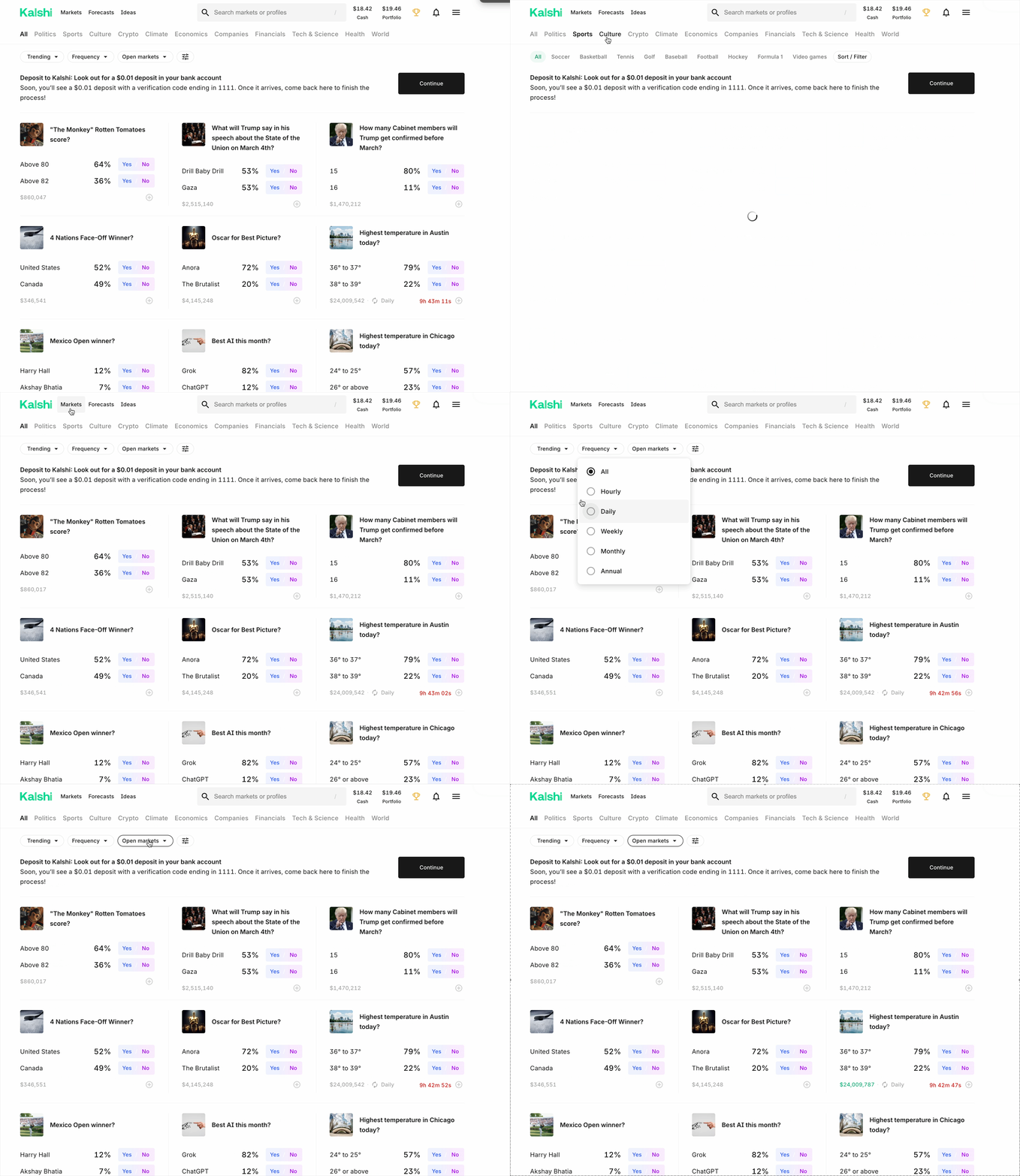
How it works
Texas has not challenged prediction markets
Texas has taken a different approach. While a growing number of states have issued cease-and-desist orders, pursued lawsuits or sought injunctions against prediction market operators, Texas authorities have not brought a comparable enforcement action. The state-level fight has continued elsewhere, including New Mexico, where the attorney general sued Kalshi over sports event contracts and the CFTC later sued New Mexico to block enforcement of state gambling laws against federally regulated exchanges.
Texas Attorney General Ken Paxton also declined to join a multistate amicus brief supporting Maryland’s effort to regulate Kalshi under state gambling law. Nexstar’s FOX 44 reported in January 2026 that while other states were challenging prediction markets, Paxton appeared to be “sitting this one out.”
The federal government has moved in the opposite direction. CFTC Chairman Michael Selig withdrew the agency’s 2024 proposed event-contract rule and has since outlined a new federal rulemaking process for prediction markets. The agency is working on standards for event-contract self-certification as the legal fight over state authority continues.
The CFTC has also become directly involved in those disputes. Its lawsuit against New Mexico is part of a broader federal effort to stop states from applying gambling laws to CFTC-regulated exchanges.
For now, prediction markets remain available in Texas, and Texas authorities have not brought the type of state gambling enforcement action seen elsewhere. The broader question of how far federal CFTC jurisdiction preempts state gambling law remains active in federal courts and could ultimately require resolution by the US Supreme Court.
Getting started: how to open an account from Texas
Setting up a prediction market account from Texas takes about 10 minutes. Here’s the process.
- Pick an app. Kalshi is the best starting point for those of us in Texas wanting to trade on sports or political races. It has the widest market selection, highest liquidity, and the most straightforward sign-up. If you already use Robinhood for investing, adding predictions to your existing account is the path of least resistance. If you want the deepest prop menu, OG has the edge.
- Verify your identity. Every CFTC-regulated site requires Know Your Customer (KYC) verification. Have your Texas driver’s license or passport, Social Security Number, current address, phone number, and email ready. Some apps approve instantly; others take a business day or two, particularly for common names or recently changed addresses.
- Fund your account. ACH bank transfer is free on most sites and the most cost-effective route. It can take 1-3 business days to fully clear, but many apps make funds available immediately through instant deposit. Debit cards provide instant funding but carry fees. Kalshi charges 2%, for example.
- Start with what you know. If you’re new to event trading, pick a market you follow closely. You already have an opinion on the outcome, and the binary Yes/No contract structure is simpler than a traditional sportsbook parlay card. Contracts can be as cheap as a few cents, so there’s no need to risk significant capital while you’re learning the mechanics.
Learn more: How fees work – How order books work – Kalshi vs. Polymarket
Sports prediction markets vs. Texas sports betting
There’s no licensed sportsbook in Texas. No FanDuel Sportsbook, no DraftKings Sportsbook, no BetMGM. Those operators can’t legally operate here. But while there are no Texas sports betting apps, their prediction market counterparts, FanDuel Predicts and DraftKings Predictions, are fully available, along with Kalshi, Robinhood, and the rest of the apps listed above.
The products overlap but they aren’t identical. Here’s what separates prediction market trading from traditional sports betting.
Who you’re trading against. If you’ve been betting at Bovada or BetOnline from Texas, you’ve been betting offshore and against the house. The operator sets the lines, bakes in a margin (usually 10% or more), and profits when you lose. On a prediction market exchange, you trade against other users. Prices are set by supply and demand, bids and asks, the same way stock prices move. There’s no house edge built into the odds.
How pricing works. Prediction market contracts are listed as Yes/No binaries priced between $0.01 and $0.99. The price represents the market’s implied probability. If Seahawks contracts are trading at $0.62 heading into the Super Bowl, the market is pricing Seattle at roughly a 62% chance of winning. Buy at $0.62, and a correct prediction pays $1.00, a $0.38 profit per contract. An incorrect prediction pays $0.00. Most apps now let you toggle the display to traditional American odds (use our prediction market calculators to convert between formats) if that’s what you’re used to.
You can exit anytime. This is one of the biggest practical differences. A traditional sports bet is locked in until the event ends. A prediction market position can be sold at any point before settlement. If you buy Seahawks contracts at $0.55 in the morning and the price moves to $0.75 after a strong first quarter, you can sell for a profit without waiting for the final score. Positions are liquid, just like stocks.
Market depth is more limited. A full sportsbook offers hundreds of props on a single NFL game: individual quarter lines, drive results, exact score margins, and deep player stat markets. Prediction market sites are expanding into player props, parlays, and same-game combos, but the menu is still thinner. Kalshi and Polymarket are the closest to matching sportsbook depth, followed by OG and DraftKings; apps running only on CME’s order book (FanDuel Predicts) are more limited. For some traders, the simpler selection is actually easier to navigate.
Tax treatment: prediction markets have a Texas-sized advantage
Federal tax treatment is one of the most underappreciated differences between prediction markets and sports betting, and it’s especially relevant for Texans.
Prediction market profits are taxed as capital gains because the contracts are classified as commodity derivatives. That means:
- Losses offset gains, and up to $3,000 in net losses can be deducted against ordinary income per year
- You don’t need to itemize deductions to claim losses
- Gains are taxed at capital gains rates, not as gambling income. For 2026, the IRS long-term rates are 0% (single filers with taxable income up to $49,450, or $98,900 for married filing jointly), 15% (up to $545,500 single / $600,050 joint), and 20% above those thresholds. Short-term gains on contracts held one year or less are taxed at ordinary income rates ranging from 10% to 37%.
Traditional gambling winnings receive much less favorable treatment. Losses can only be deducted against gambling winnings, and only if you itemize. The One Big Beautiful Bill introduced an additional cap on gambling loss deductions at 90% of reported winnings, making the math even worse for active bettors.
Here’s where you come out furthest ahead: Texas has no state income tax. Prediction market profits face federal capital gains treatment only. No state income tax, no state gambling tax. If and when Texas eventually legalizes sports betting, those winnings would be taxed federally as gambling income (a less favorable category), though still untouched at the state level. For now, trading prediction markets from Texas carries one of the lightest tax burdens anywhere in the country.
What’s available for Major League Baseball:
Kalshi and OG offer the deepest menus: game winner, spread, game total, and player performance markets. You can build parlays on Kalshi by combining multiple outcomes on a single game.
Robinhood and Coinbase mirror Kalshi’s full menu. DraftKings now runs its own exchange, DKeX, giving it a separate market menu from FanDuel’s CME-based offering. FanDuel offers the very basic set up through CME’s shared order book. Sleeper, which launched prediction markets just before the Super Bowl, has moneylines, spreads, totals, and novelty props.
Positions can be opened and adjusted throughout the game. If you take a first-half position and momentum shifts at halftime, you can sell before the second half at whatever the market price dictates. That flexibility, the ability to trade in and out of a live sporting event based on real-time probability, is something no traditional online sportsbook offers you in Texas, legally or otherwise.
Why Texas doesn’t have sports betting and when that might change
Prediction markets have given Texans access to sports trading, but they don’t address the larger economic question hanging over the state: Texas is leaving significant tax revenue uncollected by not legalizing regulated sports betting. The Texas sports betting debate has stalled repeatedly, and the numbers only get bigger each session.
The 2025 legislative failure
The Texas Legislature meets only in odd-numbered years, and the 2025 session produced nothing on sports betting. Rep. Sam Harless filed House Joint Resolution 134 in February 2025, proposing a constitutional amendment to authorize regulated sports betting with licenses for professional sports teams, PGA Tour event hosts, and Class I racetracks. HJR 134 never made it out of the House State Affairs Committee. Its final status: “Introduced, Dead.”
The story was familiar. In 2023, HJR 102 had passed the House with a convincing 100-43 vote, only for Lt. Gov. Dan Patrick to block it before the Senate could vote. Patrick controls the Senate agenda as its presiding officer, and he has repeatedly said he lacks Republican support to move gambling legislation forward, claiming only three or four GOP senators back it. A dozen House Republicans publicly opposed gambling expansion during the 2025 session, further narrowing the path.
Patrick announced in April 2025 that he’s running for another four-year term, which signals no change in his position. Gov. Greg Abbott took a different tack, signaling support for legal online sports betting in early 2025, a notable shift from prior opposition. The Dallas Cowboys, Texas Rangers, Houston Texans, Houston Astros, and Dallas Mavericks have all pushed for legalization through the Texas Sports Betting Alliance. A University of Houston survey found 73% of Texans support casino gambling and 60% support online sports betting.
The votes may exist. The political will at the top of the Senate does not.
The economic stakes
A 2024 study by Eilers & Krejcik Gaming projected that legalized mobile sports betting would generate $360 million or more in annual direct tax revenue, $2.6 billion in annual economic output, 8,000+ jobs, $32 billion in handle at market maturity, and $24.3 million in additional non-gaming tax revenue. The Tax Foundation estimated in January 2026 that Texas would collect $326 million annually at a 10% gross gaming revenue tax rate, making it the second-largest untapped market in the country behind California. The Sports Betting Alliance projects $1.12 billion in revenue over the first five years and has framed the funds as a vehicle for property tax relief.
These are revenue streams that prediction markets cannot generate. Event contracts traded on CFTC-regulated exchanges don’t produce tax revenue for the state of Texas. The exchanges operate under federal regulation and don’t pay into state coffers. Prediction markets give individual Texans a legal way to trade on sports outcomes, but they don’t address the hundreds of millions in annual revenue the state is forgoing.
Prediction markets don’t require a road trip
What prediction markets do solve is the access problem. Neighboring states have legal sports betting. Louisiana offers full mobile wagering, and Oklahoma’s WinStar World Casino sits roughly an hour north of Dallas-Fort Worth. Texans have been crossing state lines for years to bet legally, sending their money to Oklahoma and Louisiana in the process.
Prediction market apps are accessible from anywhere in Texas: El Paso, Beaumont, Amarillo, Brownsville, and everywhere in between. Texas prediction markets don’t require a road trip or a state border crossing. You can deposit funds, trade on a midweek Astros or Rangers game, and cash out winnings the same day, all from your phone. No state lines to cross. No unregulated offshore site.
Whether the state eventually captures the broader economic opportunity through legalized sports betting is a question for the 2027 Texas legislature. The earliest a constitutional amendment could reach voters, assuming it passes both chambers by a two-thirds supermajority, would be a November 2027 ballot. Legal bets at a licensed Texas sportsbook are years away under the most optimistic scenario.
In the meantime, prediction markets are here now.
The national legal battle and what it means for Texas
The prediction market industry is fighting a multi-front legal war across the country, and the outcome will shape what Texas traders can access going forward. Kalshi alone is involved in 19 federal lawsuits, a mix of offensive suits against state regulators, defensive cases brought by state gaming commissions and tribal interests, and consumer class-action complaints.
Every case circles the same question: does federal regulation under the Commodity Exchange Act preempt state gambling laws? Kalshi says yes. State regulators say no. Federal courts have split.
Nevada and New Jersey initially sided with Kalshi, finding that the CEA grants the CFTC exclusive jurisdiction over designated contract market transactions. Maryland went the other direction, ruling that Congress didn’t intend for CFTC oversight to override state gambling authority. Massachusetts became the first state court to order Kalshi geofenced. Nevada later reversed its own earlier ruling in favor of state regulators.
Texas sits outside this fight entirely. The state has issued no cease-and-desist orders, filed no lawsuits, and made no public statements challenging prediction market operators. The current attorney general declined to join the multi-state coalition opposing Kalshi. The CFTC under Chairman Selig has withdrawn its proposed ban on prediction markets and signaled willingness to challenge states that go after the industry.
For you, the immediate risk is low. The legal question will be resolved in federal appellate courts. The Third Circuit (New Jersey appeal), the Fourth Circuit (Maryland appeal), and the Ninth Circuit (Nevada appeal) are all active, and potentially at the Supreme Court. Whatever those courts decide will apply nationally, including in Texas, regardless of what Austin does or doesn’t do.
The 2026 attorney general race introduces some theoretical uncertainty, but any Texas challenge would face the same federal preemption arguments that have already prevailed in multiple jurisdictions, and would cut against the posture of the current CFTC.
Until the federal courts or Congress draw a definitive line, prediction markets remain fully operational and legal in Texas with no impediment from any state authority.
Other state markets
Availability data verified weekly. Operator footprints reflect platform terms — sports-specific markets on some operators may have additional state-level restrictions.
Know before you trade
This guide is for informational purposes only and does not constitute legal, financial, or tax advice. The regulatory landscape for prediction markets is evolving, and rules may change. Before trading:
- Read each app’s terms of service
- Understand that you can lose your entire investment on any trade
- Consult a tax professional about reporting requirements for your situation
- Consider speaking with an attorney if you have legal questions
- Trade only with money you can afford to lose
- All trading involves speculation and risk
If you or someone you know is struggling with a gambling problem, help is available through the National Council on Problem Gambling at 1-800-522-4700 or by texting 1-800-522-4700.
FAQ
Yes. CFTC-regulated prediction market exchanges remain operational in Texas under the federal Commodity Exchange Act, even though traditional online sports betting is not legal in the state.
Our ranked top five are Polymarket, Kalshi, Gemini Predictions, FanDuel Predicts and OG Predictions. Other available options covered on this page include Underdog, Robinhood, DraftKings Predictions, Fanatics Markets, Coinbase Predictions, PrizePicks Predict and Sleeper.
Yes. Federally regulated prediction exchanges offer event contracts tied to professional and college sports, including teams and events followed by Texas residents.
Prediction markets match buyers and sellers in event contracts on federally regulated exchanges. Traditional sportsbooks set wagering lines and remain unavailable online in Texas under state law.
Available categories include sports, politics and elections, economic indicators, cryptocurrency prices, entertainment and other real-world events.
Funding methods vary by platform and can include bank transfers, debit cards, USD, USDC or balances already held in a connected brokerage or cryptocurrency account.
Prediction-market profits can have federal tax consequences. Texas does not impose a state individual income tax, but traders should consult a qualified tax professional about their circumstances.