Spot vs. Perps: What’s the Difference?
Spot trading means buying an asset at its current price. Perpetual futures let you trade its price without owning it, with the ability to go long or short and use leverage.
In the world of trading, spot and perpetual futures can give you exposure to the same market in very different ways. If you spend $1,000 buying Bitcoin at spot, you own roughly $1,000 of BTC at the time of the trade. If Bitcoin rises 5%, your position gains about $50 before fees.
A Bitcoin perp works differently. You don't own BTC. You open a position tied to its price and put up cash as margin. If you put up $1,000 in margin and open a $5,000 Bitcoin perp position, you are trading $5,000 of BTC exposure. The same 5% move would produce roughly $250 in P&L before funding and fees.
To give you an easy comparison: spot means owning the asset, while a perp means opening a position on where its price goes next.
Spot vs. perps at a glance
Feature | Spot trading | Perpetual futures |
|---|---|---|
What you trade | The underlying asset | A derivative tied to its price |
Own the asset | Yes | No |
Go long | Yes | Yes |
Go short | Usually requires borrowing or another product | Yes |
Leverage | Not on a normal spot purchase | Available |
Liquidation | No on an unleveraged purchase | Possible if margin falls too low |
Funding | None | You can pay or receive funding |
Expiration | None | Usually none |
Margin required | No | Yes |
Position size | Based on the amount you buy | Can be larger than your posted margin |
Withdraw the underlying asset | Yes, where supported | No |
Examples | BTC or ETH at spot | Bitcoin perps, gold perps, index perps |
Main use | Ownership and longer-term exposure | Trading price moves, leverage, shorting and hedging |
Are spot or perps better?
Neither is automatically better. If you want to buy Bitcoin and actually own BTC, spot does that directly. If you want to short Bitcoin, trade gold perps, hedge an investment or take a position on Nvidia without borrowing shares, perps give you more ways to structure the trade.
Use spot when:
- You want to own the asset and be able to withdraw or transfer it
- You want a position with no margin requirement, funding or liquidation price
- You want your exposure to match what you spent, dollar for dollar
Use perps when:
- You want to go short without borrowing the asset first
- You want a bigger position than your cash alone would buy
- You want to hedge another investment without selling it
- You want to trade a market with no simple spot asset, such as an index
- You are prepared to manage funding, margin and your liquidation price
The better question is: what are you trying to trade, how big do you want the position to be and how much margin risk are you comfortable taking?
How spot trading works
Trading at spot means you are buying the underlying asset at its current price. If ETH trades at $2,500 and you buy $1,000 of ETH at spot, you receive approximately 0.4 ETH before fees. At $2,750, that ETH is worth about $1,100; at $2,250, it is worth about $900.
You still own the 0.4 ETH either way. There is no liquidation price on a normal unleveraged spot position, and depending on the platform, you may be able to withdraw the ETH, transfer it or use it elsewhere.
Spot margin is a separate product. If you borrow money or crypto to increase the size of a spot position, you introduce leverage and liquidation risk. For this comparison, spot means buying the asset without borrowed funds.
How perps work
With a perp, you open a long or short tied to the price of an asset, index or commodity. Instead of paying the full value of the position, you put up margin.
That means your position size can be larger than the amount of cash you put down. If you post $1,000 in margin and open a $5,000 gold perp position, a 2% move changes your P&L by roughly $100 before funding and fees. With only $1,000 of exposure, the same move would be about $20.
How much leverage you can use depends on the venue and the market. Kalshi sets leverage limits by contract, while Polymarket shows different limits across its perp markets.
What can you trade with perps now?
Perps are no longer mainly a Bitcoin or crypto product. Depending on the venue, you can now trade crypto perps, gold perps, index perps, commodity perps and even individual stock perps.
Not every perp has a direct spot equivalent. You can buy BTC or ETH at spot, but you can't buy an index such as USA500 itself and withdraw it. Investors normally get broad index exposure through an ETF or fund, while an index perp gives you a long or short position tied directly to the index.
Kalshi perps
Kalshi offers US traders perps across several categories:
- Index perps: US Large Cap and US Tech 100
- Energy perps: WTI oil
- Metal perps: gold, silver, platinum, palladium, copper and aluminum
- Crypto perps: BTC, ETH, SOL, XRP, DOGE, LINK, BNB, AAVE and other assets
The leverage limit is set by market, so a gold perp, Bitcoin perp and US Large Cap perp can all have different margin requirements and maximum position sizes.
Kalshi's perps also sit alongside its prediction markets, which makes it different from a standalone crypto derivatives exchange.
Polymarket perps
Polymarket offers a broader perp lineup that includes:
- Stock perps: Apple, Microsoft, Nvidia, Tesla, Amazon, Meta and others
- Index perps: USA500 and US100
- Commodity perps: gold, silver, WTI oil and Brent oil
- Crypto perps: BTC, ETH, SOL, XRP, DOGE, AAVE, UNI and dozens more
Polymarket International is separate from Polymarket US and is available only in supported jurisdictions outside the United States. Our Polymarket perps guide covers the access code, fees and how the product works.
Its stock perps are a useful example of how much the market has expanded. You can take a long or short position on Nvidia, Tesla or Apple without buying or borrowing the underlying shares. Kalshi's equity perps are index-based, through US Large Cap and US Tech 100, rather than individual stocks.
Other perp venues
Kalshi and Polymarket are not the only places to trade perps. Most crypto perp volume still runs through centralized exchanges and on-chain venues, and some of those have moved into wallets and apps people already use.
MetaMask is the clearest example. Its mobile app now has a Perps tab powered by Hyperliquid, the largest on-chain perp exchange, with more than 150 contracts and leverage of up to 40x. You fund the account with any EVM token, which is converted to USDC, and keep self-custody of your wallet throughout.
These venues are crypto-only and availability depends on where you live. The core mechanics are the same, though: margin, position size, funding and a liquidation price. The main differences are the asset list, the leverage cap and whether the exchange is regulated in your jurisdiction.
Your position size matters more than spot vs. perp
Suppose Bitcoin rises 5%.
- $1,000 of BTC at spot gains approximately $50
- A $1,000 Bitcoin perp position gains approximately $50 before costs
- A $5,000 Bitcoin perp position backed by $1,000 of margin gains approximately $250 before costs
If Bitcoin falls 5%, the losses are approximately $50, $50 and $250.
That is the better way to compare spot and perps. Look at the position size first, then look at how much margin is backing it.
Compare spot vs. perps with our calculator
Going short with perps
Perps make shorting much simpler.
If you want to profit directly from Bitcoin falling at spot, you generally need to borrow BTC through a margin product and sell it. With Bitcoin perps, you can simply open a short.
Suppose BTC trades at $100,000 and you short a $5,000 Bitcoin perp position. If BTC falls 5% to 250. If BTC rises 5%, your P&L is roughly -$250.
Suppose gold trades at $4,000 per ounce and you think it is going lower. Both Kalshi and Polymarket offer gold perps, so you could open a $5,000 short without buying or borrowing physical gold.
If gold falls 3%, your gross P&L is approximately +150 before funding and fees.
You aren't selling gold bars. You are short gold through a perp and closing the position when you want to take the P&L.
The same idea works with index perps and stock perps. A trader who thinks US large caps are going lower can short Kalshi's US Large Cap perp. You could also short USA500, Nvidia or Tesla perps on Polymarket where available.
Using perps to hedge your investment
Perps can also hedge an investment you already own. A short perp moves against the market you hold for as long as you keep it open.
Suppose you hold $20,000 in large US stocks and want less market exposure around a Federal Reserve decision without selling the portfolio. You could short an index perp such as Kalshi's US Large Cap. If the broader market falls, gains on the short can offset part of the losses in your stock holdings.
If you are already trading prediction markets, you can approach the same risk from the event side. For example, if a particular Fed decision would be negative for your portfolio, you could take a position in a prediction market tied to that decision. If the event occurs, the payout from the prediction market can offset some of the loss elsewhere.
The two hedges work differently. A perp moves with the price of the market you are shorting, while a prediction market pays based on whether a defined event happens. Neither is automatically a one-for-one hedge, so the size of the position and how closely it matches the risk you are trying to cover both matter. Our guide to perps vs. prediction markets goes deeper on when each one fits.
Funding is your interest
Perps don't have the normal expiry that pulls a traditional futures contract toward its underlying market price, so funding helps keep the perp aligned with its reference price.
The simplest way to think about funding is that it acts like interest on an open perp position, except you can either pay or receive it depending on the funding rate.
When the funding rate is positive, longs pay shorts. When it is negative, shorts pay longs. On both Kalshi and Polymarket, the exchange sets the schedule and passes the payment between traders rather than keeping it as a fee.
Kalshi settles funding every eight hours, at 12:00 AM, 8:00 AM and 4:00 PM ET. Polymarket also pays funding between longs and shorts and shows the live rate on each perp market. You can compare live perp funding rates by exchange, including Kalshi, Coinbase and Polymarket.
If you buy BTC at spot and hold it, you don't keep paying simply because you still own the Bitcoin. If you hold a Bitcoin perp, gold perp or index perp, funding can either cost you money or add to your P&L while the position stays open.
If you plan to keep a position open for days or weeks, read our guide on how long you can hold a perp and what funding costs over time.
How liquidation works
If you buy $1,000 of BTC at spot and Bitcoin falls 20%, the position is worth roughly $800. You still own the BTC.
Your liquidation price is the approximate price at which your remaining margin hits the venue's maintenance level and the position is closed for you.
Kalshi uses initial margin to determine what you need to open the position and maintenance margin to determine how much equity needs to remain while you hold it. Polymarket works the same way, with the maintenance requirement shown per market and liquidation triggered when your margin can no longer cover the position.
On the $5,000 Bitcoin perp backed by $1,000 of margin, a 20% move against you would wipe out the margin entirely. Liquidation comes before that point, because the venue closes the position once your equity drops to its maintenance level rather than to zero.
A leveraged perp is different because your margin is what keeps the position open. As the trade moves against you, losses eat into that margin. Once it falls to the venue's maintenance level, you either add margin or the venue closes the position.
Your leverage alone does not tell you your exact liquidation price. It sets the starting distance, but the contract's maintenance margin, any collateral you add, fees and the venue's rules all shift where the line sits.
Some venues use a mark price rather than the last traded price to decide when to liquidate, so the price on the chart and the price that closes your position may not match. Check how the venue calculates it before you size the trade.
Difference between isolated vs. cross margin
With isolated margin, you assign collateral to one position. If the trade moves against you, only that margin supports it, and only that margin is lost if the position is liquidated.
With cross margin, your whole perp balance backs every open position, so a winning trade can prop up a losing one. Polymarket offers cross margin on its perps. In the main Kalshi app, perps run on isolated margin only, while Kalshi Pro adds portfolio margin, which nets offsetting positions against each other when setting the requirement.
Cross margin pushes your liquidation price further away because there is more collateral behind the position, but one bad trade can drain the whole balance. Isolated margin keeps the liquidation price closer and the damage contained to what you put into that trade.
Isolated margin is the simpler choice for a single directional trade. Cross margin is best if you hold several positions that partly offset each other.
There is no margin mode to pick on a spot purchase made without borrowing. The most you can lose is what you paid.
How do spot vs. perp fees work?
With spot, your main costs are usually the spread and the fee to buy or sell the asset, plus a withdrawal fee where one applies.
With perps, you also need to watch funding and any maker or taker fees. If you hold the position for longer, funding can become a much bigger part of the trade than the fee you paid to open it.
This is why traders usually ask more than “what's the trading fee?” They also look at what the funding is, how big the position is and how long they are holding it.
Example: Bitcoin at spot vs. a Bitcoin perp on Kalshi
To give you an easy comparison, suppose Bitcoin trades at $100,000 and you have $1,000.
If you buy BTC at spot, your $1,000 gives you approximately 0.01 BTC before fees. If Bitcoin rises 10% to $110,000, the position is worth about $1,100, for a $100 gain.
If you instead deposit the $1,000 on Kalshi and open a long Bitcoin perp sized at $5,000, your margin is $1,000, your position size is $5,000 and your leverage is 5x. Kalshi sets a maintenance margin for each contract, and your liquidation price sits where losses on the $5,000 position would push your equity down to that level.
If Bitcoin rises 10% to $110,000, the position is up about $500 before funding and fees. If you hold through a funding payment and the rate is positive, you pay a small amount to the short side for that period. Close the position and you keep the $500 less funding and fees. You never held any BTC.
If Bitcoin falls 10% instead, the position is down about $500 and half your margin is gone. How close that leaves you to liquidation depends on the contract's maintenance margin, so you either add margin or accept the risk of being closed out.
The Bitcoin price moved exactly the same amount. The difference was your position size. Funding comes on top of that, so check current Bitcoin funding rates before you size the trade.
FAQ
- What is the main difference between spot and perps?
Spot means you own the underlying asset. A perp gives you a position tied to its price without owning it. If you spend $1,000 on BTC at spot, you own roughly $1,000 of Bitcoin. A $1,000 Bitcoin perp position gives you price exposure instead.
- Is spot or perps better for beginners?
Spot is generally easier. You pay for what you get, and there is no funding, margin or liquidation to manage. Perps add all three.
- Does a 1x perp make the same P&L as spot?
Yes, it can. If the spot position and perp have the same dollar position size and follow the same price move, their gross P&L can be similar. The final return can still differ because of funding, fees, spreads and differences between the perp price and spot price.
You also own the asset at spot. You do not own it through the perp.
- Can you get liquidated at spot?
No, not on a normal unleveraged spot purchase. If you buy $1,000 of BTC at spot and Bitcoin falls 20%, you still own the BTC; it is simply worth less.
Spot margin is different because you are borrowing funds or assets.
- Can you lose money faster with perps?
Yes. Leverage can make your position size much larger than the margin you put up. If $1,000 of margin supports a $5,000 perp position, each 1% move changes your P&L by roughly $50 before costs. The same $1,000 at spot changes by roughly $10 for a 1% move.
- What is a liquidation price?
A liquidation price is the level at which the venue closes your position because your margin has run too low. Your leverage sets how far away it starts, and the contract's maintenance margin and any extra collateral you add move it from there.
- Do you own Bitcoin when trading Bitcoin perps?
No. A Bitcoin perp gives you exposure to BTC's price but does not give you Bitcoin. If you want to own BTC and potentially withdraw it, you need to buy Bitcoin at spot.
- Why trade perps instead of buying at spot?
Perps let you short, use leverage, hedge and trade markets such as indices that have no spot asset. In return you take on funding, margin and liquidation risk.
- What does funding mean in perps?
Funding is a recurring payment between traders holding long and short positions. Depending on the funding rate and which side of the trade you're on, you can either pay funding or receive it.
- Are perps more expensive than spot?
They can be, especially if you hold for a while. A spot trade is usually a one-off fee and spread. A perp adds funding for as long as the position stays open, so the cost grows with time.
 Hyperliquid Policy Center Urges SEC to Adopt Crypto Rules with Five Changes
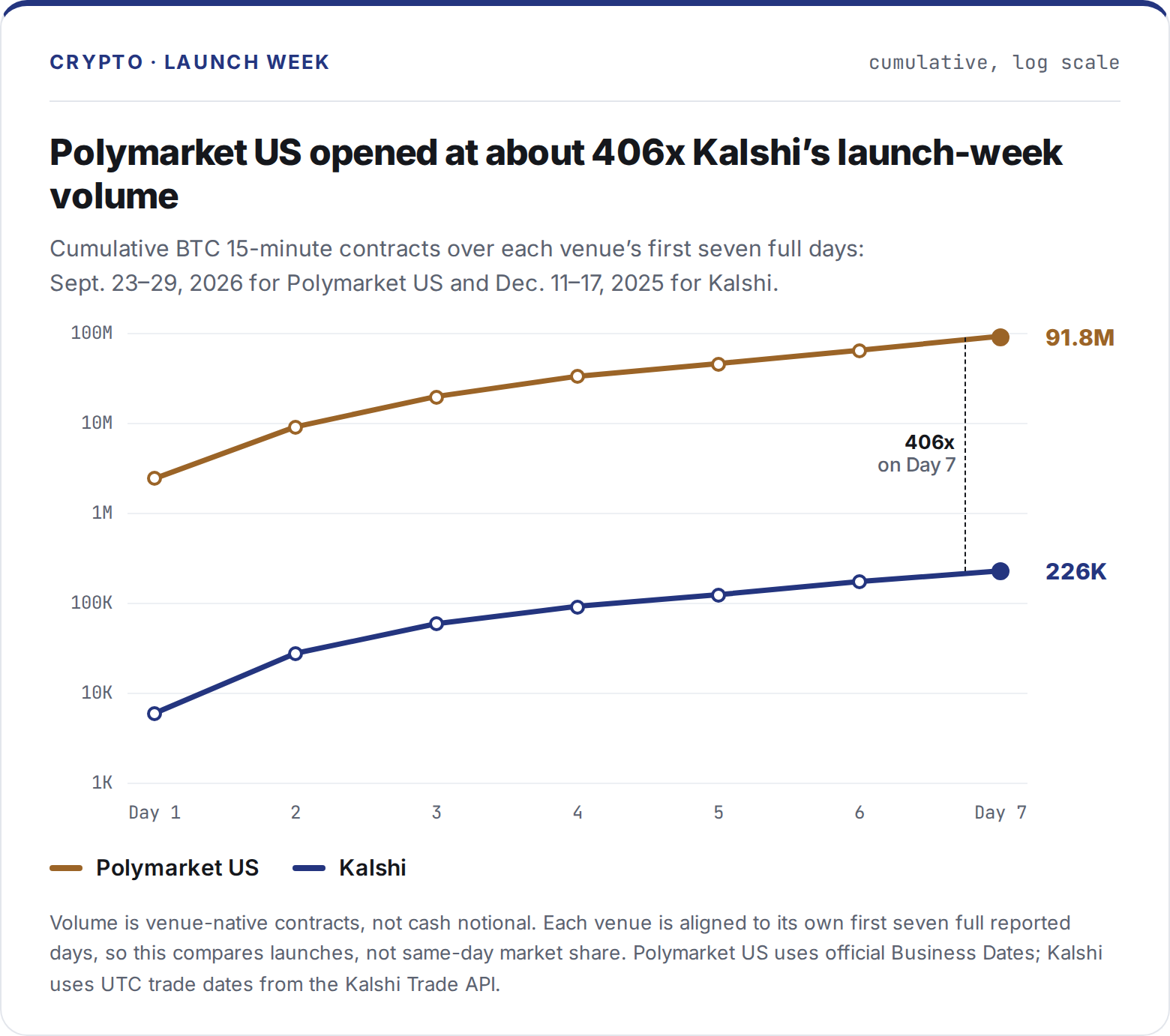 Polymarket US 15-Minute Bitcoin Volume Hits $92M in First Full Week
 BitMEX Winds Down as Crypto Perps Take Off, Faces Insider Trading Suit
 The CFTC ‘Fit a Square Peg in a Round Hole’ to Bring Crypto Perps Onshore