Senate Markets Favor Democrats as Republicans Spend Final Week Defending Red States
Texas has drawn $47 million in trading as Kalshi favors Democratic candidates across several Republican-held seats. Close polls still leave plenty of room for a different outcome.
Republicans are spending the final week before Election Day defending territory they ordinarily expect to win, and prediction market traders are increasingly treating those defensive fights as a route to a Democratic Senate.
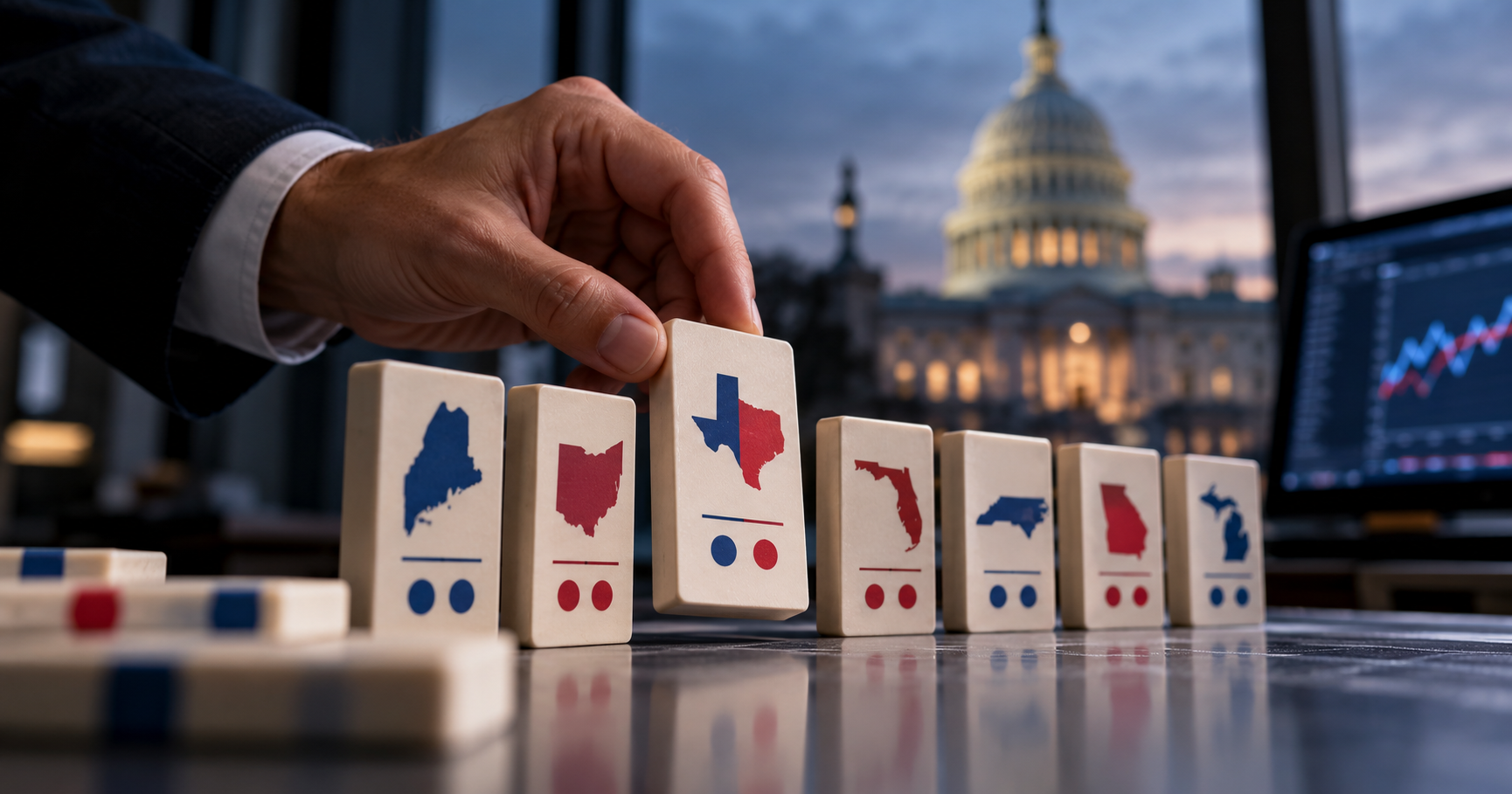
Kalshi’s Tuesday snapshot favors Democrats in Republican-held Alaska, Maine, North Carolina, Ohio and Texas, while keeping Republican candidates ahead, but vulnerable, in Iowa and Kansas. Michigan remains Democratic-leaning, and New Hampshire has moved into the platform’s Safe Democratic category.
The most closely watched contests are attracting substantial trading. Texas has reached $47 million in volume, followed by Maine at $15.6 million and Michigan at $13.8 million as of Tuesday.
That market picture comes as President Donald Trump campaigns through states he comfortably carried in 2024. Reuters reported this week that Republican strategists are worried about races stretching from Alaska to South Carolina, with voter frustration over inflation, tariffs and the Iran war complicating the party’s closing message.
The direction looks favorable for Democrats. It is not a set of race calls, and it should not be mistaken for a representative survey of voters. But it does help convey national sentiment.
The Senate math gives Democrats several routes
Republicans hold a 53-47 Senate majority. Democrats need a net gain of four seats to take control and a 50-50 split would leave Vice President JD Vance with the tie-breaking vote and Republicans in charge.
That means defending Democratic seats such as Michigan, New Hampshire and Georgia while finding four pickups elsewhere.
North Carolina provides a prominent opening. Former Democratic Gov. Roy Cooper faces Republican Michael Whatley for the seat being vacated by Sen. Thom Tillis. Recent polls have shown Cooper well ahead, including an Elon University survey with a 52%-39% result. That survey covered adults rather than likely voters, an important limitation when comparing it with other election polls. Kalshi traders, in turn, have Cooper trading as a 96% favorite on $4.5 million in volume.
Beyond North Carolina, Kalshi’s supplied snapshot favors Democrats in four more Republican-held seats:
State | Democratic candidate | Market-implied Democratic win probability | Reported trading volume |
|---|---|---|---|
Alaska | Mary Peltola | 74% | $3.5 million |
Ohio | Sherrod Brown | 68% | $8.6 million |
Texas | James Talarico | 66% | $47 million |
Maine | Troy Jackson | 62% | $15.6 million |
If Democrats held their existing seats, winning North Carolina plus any three of those four would be sufficient for a majority. The breadth of the opportunity matters as the party does not need every competitive Republican seat to fall its way.
But simply adding separate-race probabilities does not capture the chance of Senate control.
Turnout, polling errors and national political conditions can affect several states at once.
Texas leads the trading, and the Republican rescue effort
Texas stands out in trading volume.
Its $47 million total is up from $35 million in last week's race update, an increase of $12 million. Talarico’s current 66% probability matches that earlier snapshot, showing that substantial additional trading does not necessarily change the quoted favorite.
Trump is scheduled to campaign in Corpus Christi and Lubbock on Tuesday to support Republican Attorney General Ken Paxton. The Associated Press described the trip as Trump’s third Texas swing since the September midterm convention in Dallas, a significant commitment to a state that has not elected a Democrat statewide in 32 years.
Talarico is also campaigning across Texas, with Tuesday stops planned in Midland, Amarillo and Lubbock. The AP attributed the competitive race to both the difficult national environment for Republicans and Paxton’s history of ethical and legal problems.
The market advantage remains larger than the polling margins. An ActiVote survey listed by NBC News put Talarico ahead 51% to 49%. Traders can reasonably favor a candidate in a close race, but that is different from expecting a comfortable victory.
Democratic defenses look firmer
The market map is not just expanding because Republicans have more seats to defend. Some Democratic-held contests are looking less threatening.
Michigan gives Abdul El-Sayed a 69% chance, with $13.8 million traded. New Hampshire moved from Likely Democratic to Safe Democratic over the past month, reaching 90%.
Georgia’s polling also gives Democrats reason to be confident. An Atlanta Journal-Constitution survey found incumbent Sen. Jon Ossoff ahead of Republican Rep. Mike Collins, approximately 48% to 40%, with nearly 12% undecided. The poll surveyed 1,000 likely voters Oct. 7-15 and carried a 3.1-percentage-point margin of error.
The AJC also cited earlier reporting that National Republican Senatorial Committee Chair Tim Scott was concentrating resources on Alaska, Iowa, Maine, Michigan, New Hampshire, Ohio and Texas, not Georgia or North Carolina. That does not mean Republicans have abandoned those races, but it shows where the party sees its most consequential remaining fights.
Michigan remains competitive enough to demand Democratic attention. Still, protecting a seat where traders favor the Democrat is different from trying to recover one where the Republican has become the favorite.
Red-state pressure extends beyond the main pickup targets
Iowa and Kansas remain Republican-favored on the dashboard, at 59% and 60%, respectively. Both sit in the platform’s Toss-up category. Kansas moved there from Lean Republican over the past month.
Nebraska is also competitive enough to appear in the Lean Republican column, with a 71% Republican probability.
Even changes in more Republican-friendly states are notable. Louisiana and Mississippi each slipped from Safe Republican to Likely Republican, with Republican probabilities of 89%. That still makes the GOP a strong favorite, not an underdog facing an imminent collapse.
Yet Mississippi drew Trump on Monday.
“I can’t take a chance,” he said while campaigning for Sen. Cindy Hyde-Smith. Reuters reported that the Senate Majority PAC announced last week a $1.2 million advertising campaign supporting Democratic challenger Scott Colom. Trump carried Mississippi by nearly 23 points in 2024.
His expected closing itinerary includes Texas, Ohio, South Carolina, Florida and Iowa. The emphasis is heavily defensive, though not exclusively, as Vance is also campaigning in Michigan, where Republicans could pick up a seat.
Seat-count markets point toward a Democratic majority
Kalshi’s Senate seat-count contracts offer another view of the same sentiment.
The Democratic seat market prices “Above 52” at 38% and exactly 52 seats at 18%, with approximately $7.43 million traded across that market. A separate Republican seat-count market prices 48 seats at 17% and 47 seats at 14%, with approximately $4.52 million in volume.
Those are separate markets with their own prices and trading conditions, not one perfectly synchronized forecast. But they show traders actively pricing outcomes beyond a bare Democratic majority.
The distinction between 51 seats and a larger majority would matter for governing flexibility. The immediate electoral requirement, however, remains the same: Democrats need four net pickups.
Close polls remain the warning label
The market map favors Democrats more than several individual polls suggest.
NBC’s polling tracker lists a two-point Peltola lead in Alaska and a two-point Talarico lead in Texas. In Maine, a recent Trafalgar survey put Republican Sen. Susan Collins ahead of Jackson, 47% to 46.5%, even as Kalshi’s supplied snapshot favors the Democrat.
That is why probabilities deserve more care than the horse-race shorthand often gives them. A 66% chance of winning is not 66% voter support, and a 74% favorite can lose even if the market assigned that outcome zero chance.
Trading volume is not a voter count, either. The same contracts can change hands repeatedly, and the people placing trades do not represent the electorate. The prices are useful evidence of market expectations, not proof of a national consensus.
Still, those expectations align with an observable campaign pattern this week: Republicans are deploying their biggest figures to protect states they usually win, while Democrats have multiple paths to the four pickups they need.
National reporting supports the defensive Republican picture, but the polls leave the final outcome far less settled than the market favorites might suggest.
 Kalshi Takes Combos Into Election Week as Multi-Leg Trading Drives Growth
 S&P Dow Jones Indices Announce Kalshi Partnership Platforming Benchmarkets on Exchange
 Will the Fed Hike Oct. 28? Get $55 With Kalshi Promo Code RATE
 CFTC Sues Utah to Block Kalshi Crackdown After State’s Court Victory