Polymarket Reportedly Hits $21B Valuation in New $1B Funding Round
Polymarket is reportedly raising new funding at a valuation close to Kalshi's, even as courts question whether its sports contracts belong under federal derivatives law.
Polymarket is reportedly raising $1 billion at a $21 billion valuation, putting the prediction market platform near Kalshi’s $22 billion mark.
The new financing round is another sign that investors see event trading as one of the biggest new categories in financial technology. Still, it comes as the legal argument supporting the industry’s sports expansion is starting to fracture in federal court.
The new valuation makes Polymarket and Kalshi a roughly $43 billion private-market bet on the idea that prediction markets can become a permanent part of how consumers trade information, politics, sports and economic events. There were reports this summer that Kalshi is eyeing a $40 billion valuation.
While trading volume has exploded, the United States Court of Appeals for the Ninth Circuit’s recent court ruling for Nevada said Kalshi’s sports contracts are likely sports bets, not Commodity Futures Trading Commission-regulated swaps, creating a direct conflict with the Third Circuit and putting a major part of the sector’s business model under pressure.
The $43 billion prediction market bet
Polymarket’s reported deal would bring another $1 billion into a business that has been growing into a broad event-trading company.
According to multiple reports, including the New York Times and Wall Street Journal, the new round is led by 1789 Capital, the investment firm that includes Donald Trump Jr. as a partner and has become increasingly involved in the overlap among politics, technology, crypto, and financial markets.
A $21 billion valuation is difficult to ignore, especially for a company whose value proposition still sounds simple on the surface as users buy and sell contracts tied to the outcome of real-world events.
But that simplicity is part of why the sector has attracted so much attention. Prediction markets have become a place to trade elections, interest-rate decisions, corporate outcomes, entertainment events, sports and other news-driven questions. The bigger bet from investors is that these markets are not just a niche betting product but an alternative way to price information.
Investors appear to be betting that event contracts can become a permanent layer of consumer finance and media.
Kalshi, Polymarket now neck-and-neck
The new valuation also sharpens the competitive story.
Kalshi has spent much of 2026 positioning itself as the regulated U.S. event-contract platform, while Polymarket has benefited from its crypto roots and massive global brand recognition.
Kalshi’s reported $22 billion valuation earlier this year gave it a nominal lead, but Polymarket’s new $21 billion mark puts the two platforms effectively side by side.
Neither figure is a public-market price, as both are private financing marks tied to particular investors, deal terms, and expectations about future growth.
It suggests that investors see more than one winner in the sector. The market increasingly values both companies as dominant platforms, with different paths to the same outcome: becoming a place where users trade probabilities on the real world.
Sports remain the legal problem
The growth story, however, is now colliding with the legal one.
Last week, the Ninth Circuit dealt Kalshi a major loss in its fight with Nevada regulators. The court held that Kalshi had not shown that its sports-event contracts were federally protected swaps under the Commodity Exchange Act, thereby affirming the dissolution of an injunction barring Nevada from enforcing its gaming laws against the platform’s sports products.
The court did not just reject Kalshi’s preemption argument on technical grounds. It said the contracts functioned as sports bets, noting that products tied to a team winning, a point spread, player performance, specific scores or parlays look like gambling regardless of whether they trade on a CFTC-registered designated contract market.
That conclusion matters because sports contracts are central to the sector’s growth. The Ninth Circuit opinion noted that more than 90% of Kalshi’s trades and 95% of its 2025 revenue were sports-related.
The court also pointed to a CFTC rule that says registered entities “shall not” list contracts involving, relating to or referencing gaming. Kalshi and the CFTC argued that the agency retained discretion to evaluate such contracts. Still, the Ninth Circuit held that the existing rule remains controlling unless and until it is changed.
The industry now has a circuit split
The Third Circuit previously backed Kalshi’s preemption argument against New Jersey. That court concluded that the company’s sports-related event contracts are swaps under CFTC regulation.
That creates an appellate split over a national business model. Other cases remain active or unresolved in multiple other courts, and the already existing split makes an already expected Supreme Court decision all the more likely.
Investors are clearly betting that the answer eventually favors the platforms. The courts have not reached that conclusion yet.
Valuation versus reality
Polymarket’s new valuation is not simply that the company has raised a lot of money. It shows private investors are willing to value prediction markets as if the regulatory fight is a temporary obstacle rather than an existential one.
That could prove right. The CFTC could revise its gaming-contract rules, Congress could clarify the scope of federal authority, courts could ultimately side with the Third Circuit’s approach, or platforms could build sustainable businesses around non-sports contracts even if state restrictions endure.
But each path requires something that has not happened yet.
For now, investors are valuing prediction markets as a mature national financial category, even though they still operate within a fragmented legal landscape. The money is betting on scale, while the law is still deciding exactly what these companies are allowed to scale.
 Polymarket Promo Code Rate: $25 Bonus for Jaguars vs. Texans London Game
 Polymarket Promo Code Rate: $25 Bonus for Notre Dame vs. BYU CFB
 Kalshi Promo Code RATE: $25 Bonus for UFC Edmonton Malott vs. Buckley Predictions
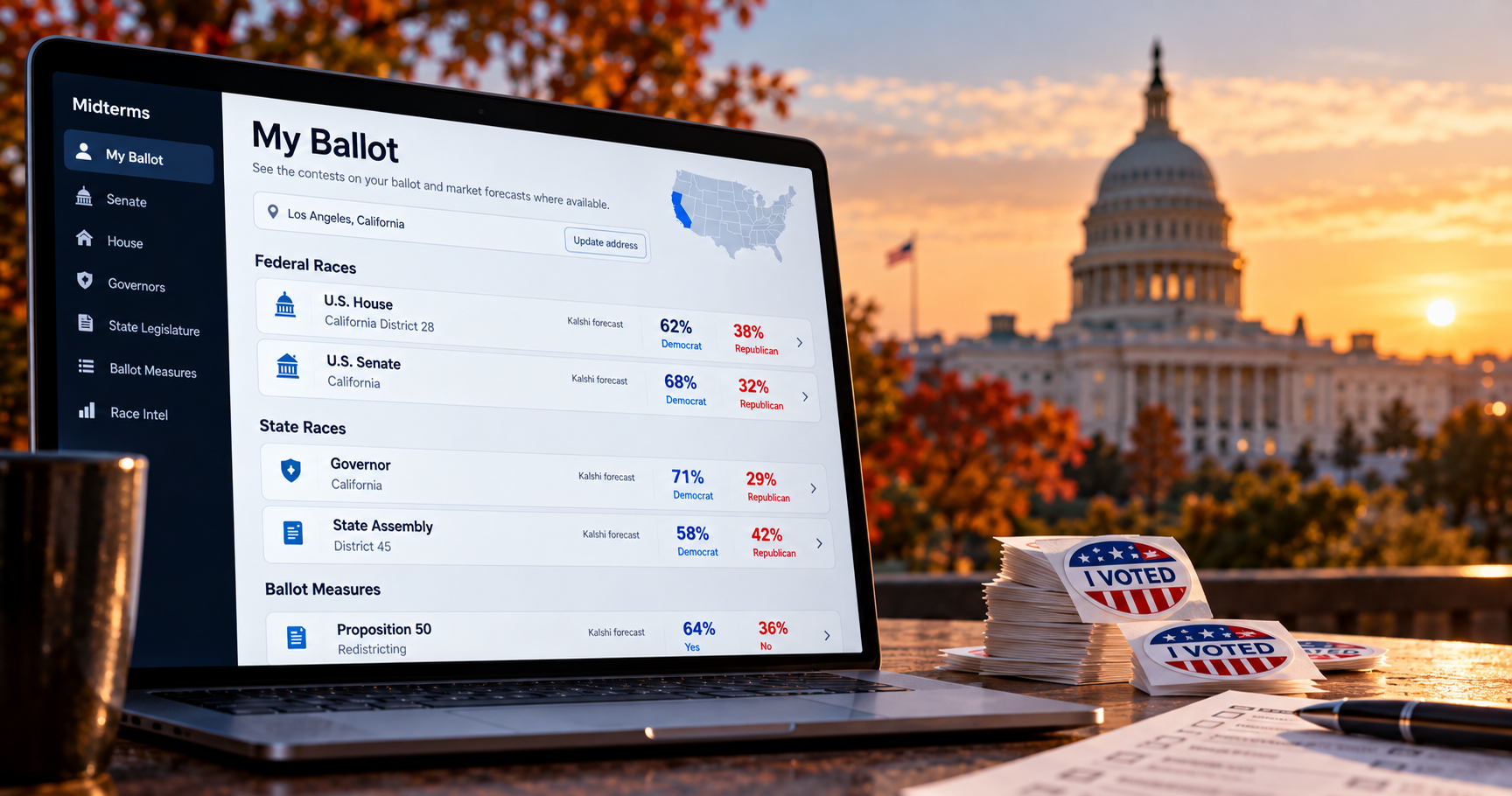 Kalshi Launches Personalized Ballot Guide With Ballotpedia Data