CFTC Nominees Avoid Sports Betting Verdict as Democrats Press for Guardrails
Nathan Anonick and Matthew Rowland declined to settle whether sports event contracts are sports bets. But Rowland outlined support for stronger customer protections, conflict-of-interest rules and enforcement staffing.
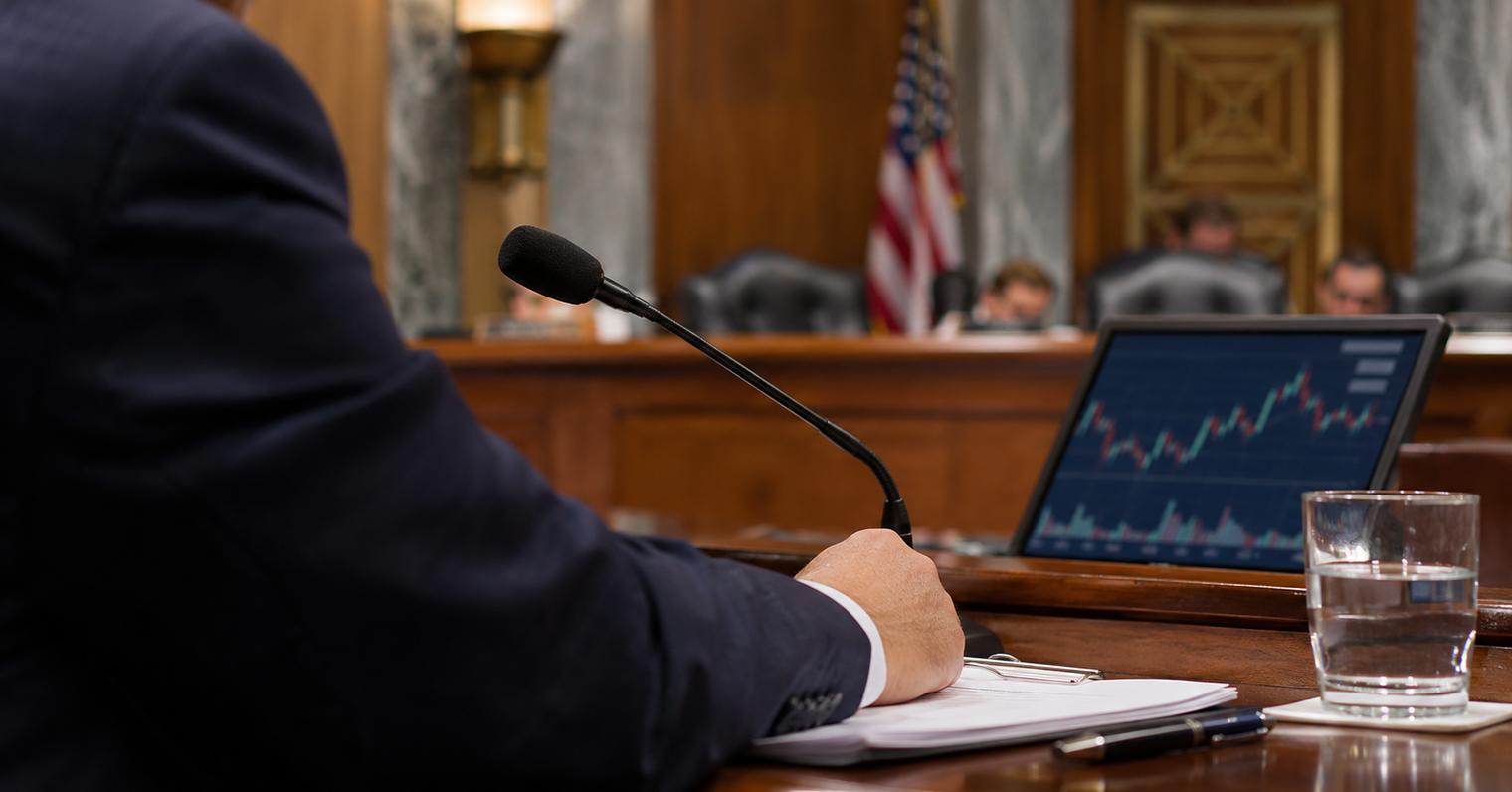
President Donald Trump’s two Commodity Futures Trading Commission (CFTC) nominees declined to take a definitive position Tuesday on whether sports event contracts constitute sports betting, citing divided courts and ongoing litigation.
Their answers left unresolved how each would vote on the agency’s most contentious prediction markets policies.
At the Senate Agriculture Committee’s Tuesday confirmation hearing, Republican Nathan Anonick and Democrat Matthew Rowland faced questions about state and tribal gambling authority, the CFTC’s public interest obligations and whether an understaffed regulator can supervise a growing retail market.
Rowland offered more specific support for changes to customer protections, conflicts rules and marketing standards. Anonick emphasized consultation and fact-finding before taking positions.
Neither committed to prohibiting sports contracts or reversing Chairman Michael Selig’s approach.
The hearing came less than a week after their nominations and one day after nine Democratic senators demanded that Selig withdraw or suspend the agency’s geographic-access interpretation. As DeFi Rate reported on that letter, lawmakers are challenging the CFTC’s national access push while preparing for Democratic control of Congress.
Schiff asks the football question again
Sen. Adam Schiff (D-CA) used his questioning to revisit the answer Selig gave during his own confirmation process: That he would approach the classification of sports contracts with an open mind and look to the courts.
Schiff accused the chairman of departing from those assurances by aggressively defending prediction markets and opposing geographic restrictions.
Schiff then asked Anonick whether using a prediction market to wager on the winner of Thursday’s Colts-Texans NFL game was a sports bet.
“I certainly appreciate the practical argument. I just say it’s legally complex,” Anonick replied during the exchange.
Anonick acknowledged the practical comparison but would not turn it into a legal conclusion about the CFTC’s jurisdiction.
Anonick said reaching a decision would require a thorough process involving agency lawyers, outside counsel, states, tribes and other stakeholders. He also said the CFTC would need to follow a U.S. Supreme Court decision if the justices resolved the issue.
That is a commitment to process and compliance with a future ruling, not a commitment to withdraw the agency’s current litigation positions. Schiff’s concern was precisely whether another nominee’s promise of an open mind would translate into a different approach after confirmation.
Rowland puts public interest alongside economic usefulness
Ranking Member Amy Klobuchar (D-MN) asked a different question: Regardless of the jurisdictional litigation, what independent obligation does the CFTC have to examine contracts involving gaming and other activities identified in the statute?
Rowland pointed to the event contract framework’s public interest analysis and the rulemaking underway under Selig.
“I think that it’s important that as part of that rulemaking, which is still ongoing and which I hope to be able to participate in if confirmed, that we really think long and hard about balancing the public interest against the kind of economic usefulness of these contracts.”
That answer did not endorse either a blanket prohibition or unrestricted access. It identified a balancing exercise Rowland expected the agency to undertake, rather than treating the jurisdictional question as the only issue.
Rowland also said he expected a Supreme Court decision within the next term or the following one and would be bound by it.
Smith presses on gaming restrictions and tribal rights
Sen. Tina Smith (D-MN) pressed both nominees on the difference between a sports wager and a sports event contract.
Smith first asked whether CFTC regulations prohibit event contracts related to gaming. Rowland acknowledged that Regulation 40.11 is written that way. Anonick emphasized his understanding that the Commodity Exchange Act gives the agency discretion to determine whether a contract involving an enumerated category, including gaming, is contrary to the public interest.
They addressed the existing regulation and the underlying statutory discretion. Neither resolved how those provisions should apply to the sports contracts currently being litigated.
When Smith asked about the practical distinction, Rowland acknowledged her argument but declined to comment definitively on active litigation. He expressed sympathy for concerns raised by states and tribes and said he would want to work with them if confirmed.
Anonick likewise cited conflicting court decisions and promised to hear from stakeholders. His description of the dispute as a sensitive, emotional issue drew a correction from Smith.
“I would just argue, with friendly pushback, that I don’t think that this is an emotional issue. I think this is a legal issue,” she said.
Smith grounded her objection in state authority and the Indian Gaming Regulatory Act. Her position was that sports event contracts are subject to those protections regardless of their label.
Staffing questions test the agency’s expansion
Democrats also questioned whether the CFTC has enough personnel to supervise new products without weakening oversight of agricultural, energy and other established derivatives markets.
Klobuchar cited substantial staffing reductions, including reports that the Chicago enforcement office had lost its enforcement attorneys. Sen. Michael Bennet (D-CO) questioned the combination of rising trading activity and significant staff attrition.
Rowland’s prepared testimony called for rebuilding the agency’s capacity:
“I also believe that bringing the enforcement program back to its historical size and level of activity will complement the CFTC’s rulemaking and other regulatory work.”
Rowland has worked at the CFTC for more than 11 years, including in enforcement, the general counsel’s office and as senior counsel to former CFTC Commissioner Kristin Johnson. He has also worked on detail to the Agriculture Committee.
Anonick said he would seek detailed briefings on staffing, technical expertise and hiring plans. He supported an appropriately resourced commission while noting that Congress controls agency funding.
More commissioners would broaden debate, not guarantee a reversal
As DeFi Rate reported when Trump announced the nominations, confirmation would bring the commission to three members: Selig and Anonick as Republicans, with Rowland as a Democrat. Two seats would remain vacant.
Klobuchar welcomed the additional perspectives, while Chairman John Boozman (R-AR) said he looked forward to advancing the nominations.
The commission they could join is already defending its authority through lawsuits against states. Its Louisiana action followed a state court restraining order, while lawmakers are separately demanding records behind its geographic-access policy. The CFTC has sued 12 states, looking to protect its jurisdiction.
Tuesday’s testimony offered no assurance that those policies would be reversed. Anonick resisted prejudging the legal disputes. Rowland signaled a stronger interest in customer protections, public interest review, and rebuilding enforcement, without committing to a sports contract ban.
The hearing’s clearest implication is the prospect of a larger commission debating that policy in public, and a Congress increasingly unwilling to accept jurisdictional claims as the complete answer to questions about oversight.
Retail protections produced a clearer policy answer
Rowland was more specific when Klobuchar asked how the CFTC should respond to increasing participation by ordinary customers in prediction markets and digital asset derivatives.
He said the agency’s core principles are broad and flexible, but the implementing rules need to adapt. He identified customer protections, conflicts of interest at increasingly vertically integrated businesses, and marketing and advertising standards as areas for stricter rules.
The CFTC can face questions about how customers are treated, how products are promoted, and how conflicts are controlled even while courts decide the boundaries of federal and state jurisdiction.
Rowland did not propose the text of a rule or commit to a particular enforcement action. But he identified a concrete regulatory agenda rather than limiting his answer to waiting for litigation.
 Novig Sues Ohio, Arguing New CFTC Rules Change the Sports Contract Fight
 Fourth Circuit Panel Affirms Maryland District Court's Kalshi Preliminary Injunction Denial
 Opinion: Courts and Congress Remembered That They Have Jurisdiction Over CFTC Chair Michael Selig. It's Long Overdue.
 CFTC Sues Louisiana to Block Prediction Market Shutdown as State Fight Escalates