Polymarket US 15-Minute Bitcoin Volume Hits $92M in First Full Week
Polymarket US’s 15-minute Bitcoin markets did $91.8M in their first full week, while total Bitcoin volume jumped from just $625K before launch to $101.2M. Volume and trade count both rose about 11.6x, while average trade size barely changed.
Polymarket US saw nearly $92 million go through its 15-minute Bitcoin markets during its first full seven reported days, a much faster start than Kalshi saw when it launched the same short-duration format late last year.
The prediction market did more than 400 times as much 15-minute Bitcoin volume as Kalshi during those first full seven-day periods.
That doesn't mean Polymarket US will follow the same path as Kalshi. But it does show that this new product category is more than just a niche market.
Polymarket top-line performance on 15-minute crypto markets
Polymarket US BTC before launch: $624,904 across all verified BTC markets during Sept. 15-21.
Polymarket US first full week after launch: $101.19 million across directly classified Bitcoin markets from Sept. 23-29, roughly 162x the prior seven business days.
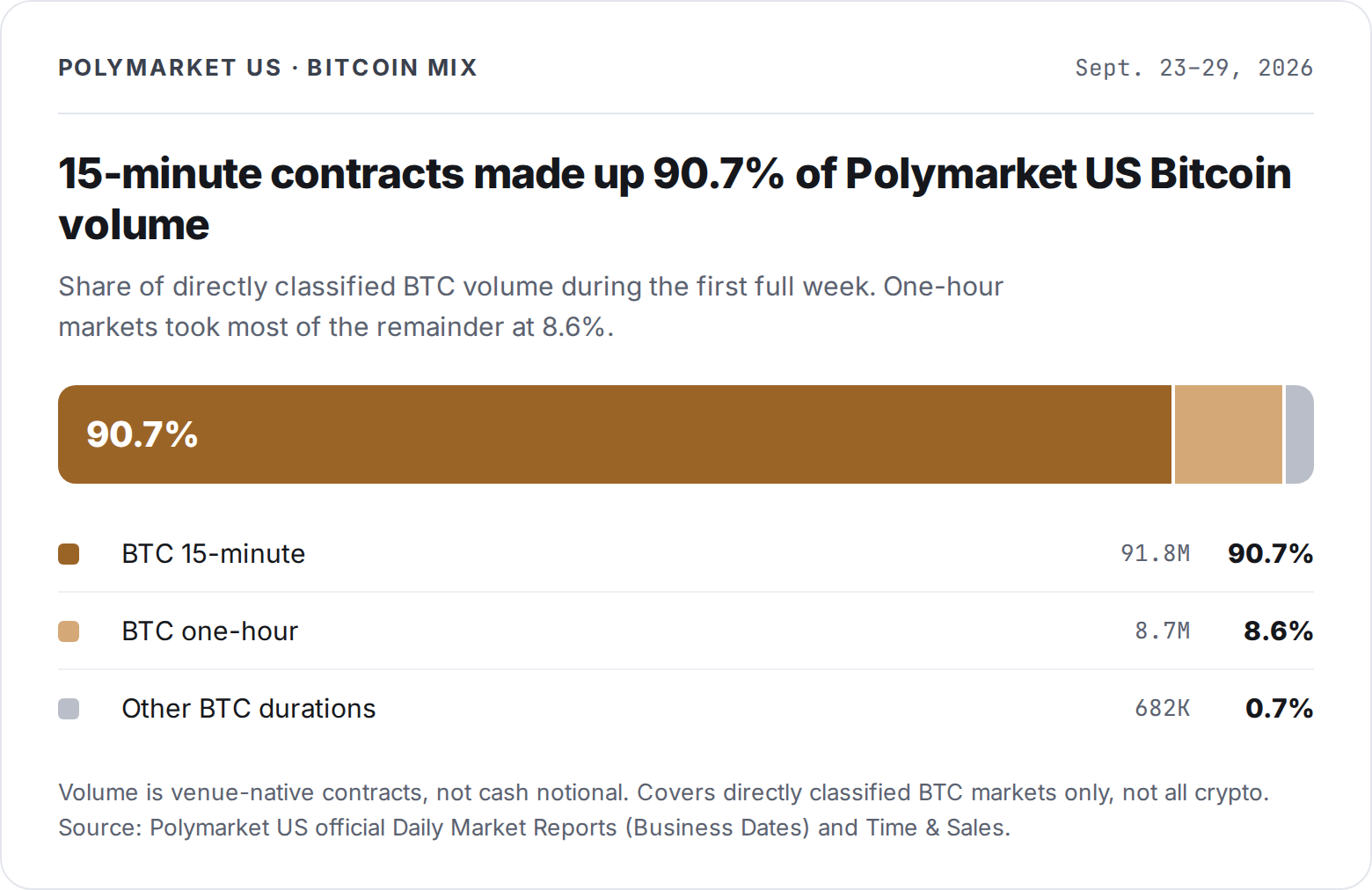
BTC 15-minute volume: $91.76 million, or about 90.7% of directly classified Bitcoin volume during that first full week.
BTC 1-hour volume: $8.74 million.
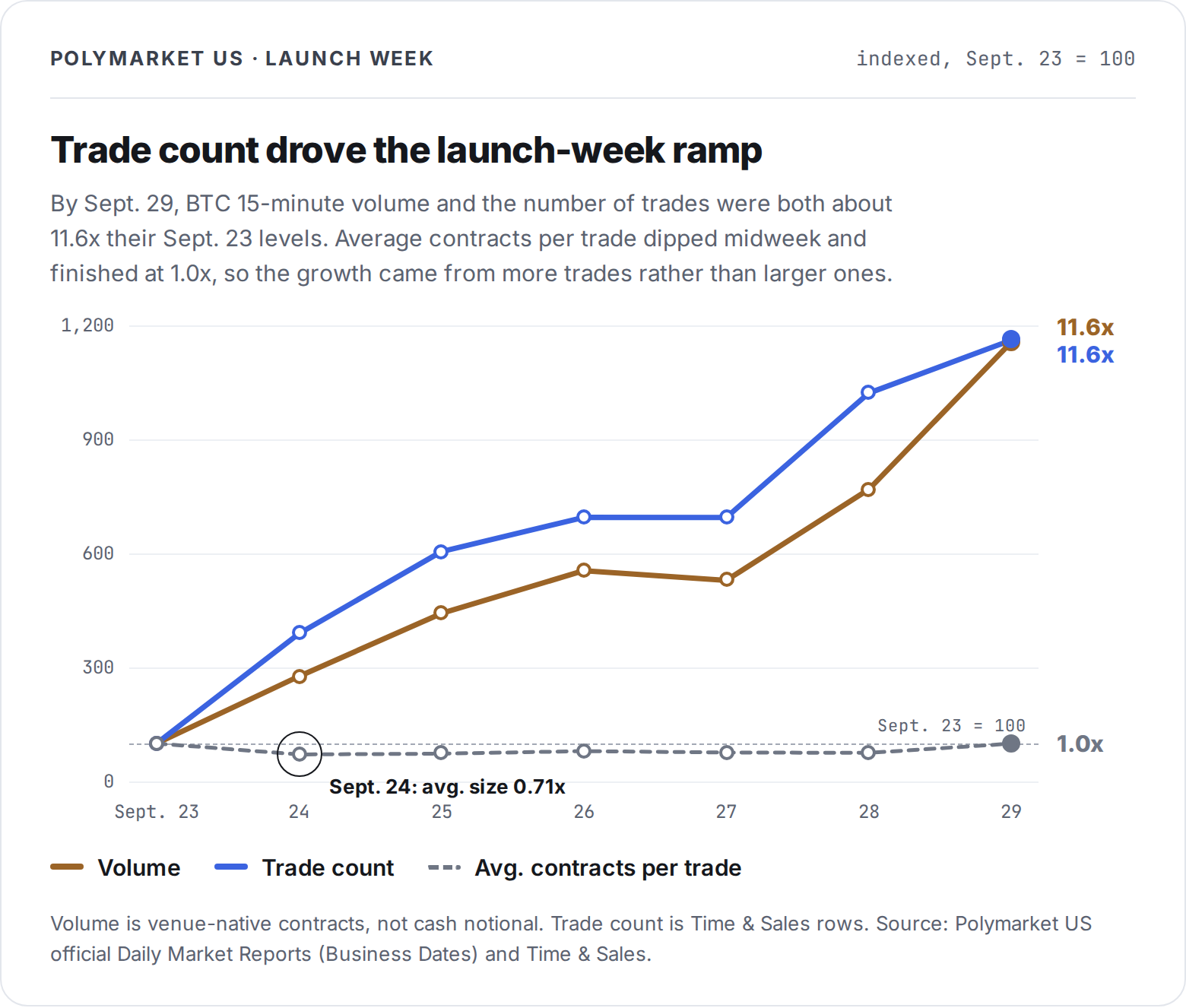
Daily 15-minute volume: increased from $2.40 million on Sept. 23 to $27.71 million on Sept. 29.
Reported transactions: increased from 63,650 to 739,034 over the same period.
Short-term markets are changing the size of the Bitcoin business
The venue recorded $1.47 million in total verified BTC volume 30 business days before the short-term launch. On Sept. 21, the day before launch, Bitcoin volume was only about $218,000.
From Sept. 23-29, Bitcoin volume skyrocketed to $101.2 million. That's almost 69 times the volume of the previous 30 business days combined.
On Sept. 29 alone, PUS BTC markets did about $30.6 million, with reported transactions jumping from roughly 64,000 to 739,000.
Average contracts per reported transaction barely changed, from about 37.7 to 37.5.
Fifteen-minute Bitcoin took most of the new volume
The one-hour product grew too, but the split was not overly close.
During the first full week, the company recorded $91.8 million in 15-minute BTC, $8.7 million in one-hour BTC, and another $682,000 across other Bitcoin durations.
The 15-minute market accounted for about 91% of directly classified Bitcoin volume.
Traders overwhelmingly ended up in the shortest interval, with as many as 96 separate 15-minute windows. The short-term product is appealing to a unique trading audience.
More trades, not bigger trades, drove the category
On Sept. 23, the 15-minute Bitcoin markets generated about $2.4 million across 63,650 reported transactions. By Sept. 29, daily volume had reached $27.7 million from 739,034 transactions.
Volume increased about 11.6 times. The transaction count also increased by about 11.6 times, though interestingly, the average contract per transaction finished almost exactly where they started.
Across the first full week, the 10 largest individual market rows accounted for only about 5% of total volume.
Median volume per individual market also climbed sharply as the product got going. Through Sept. 28, it had risen from roughly $23,700 to almost $182,000.
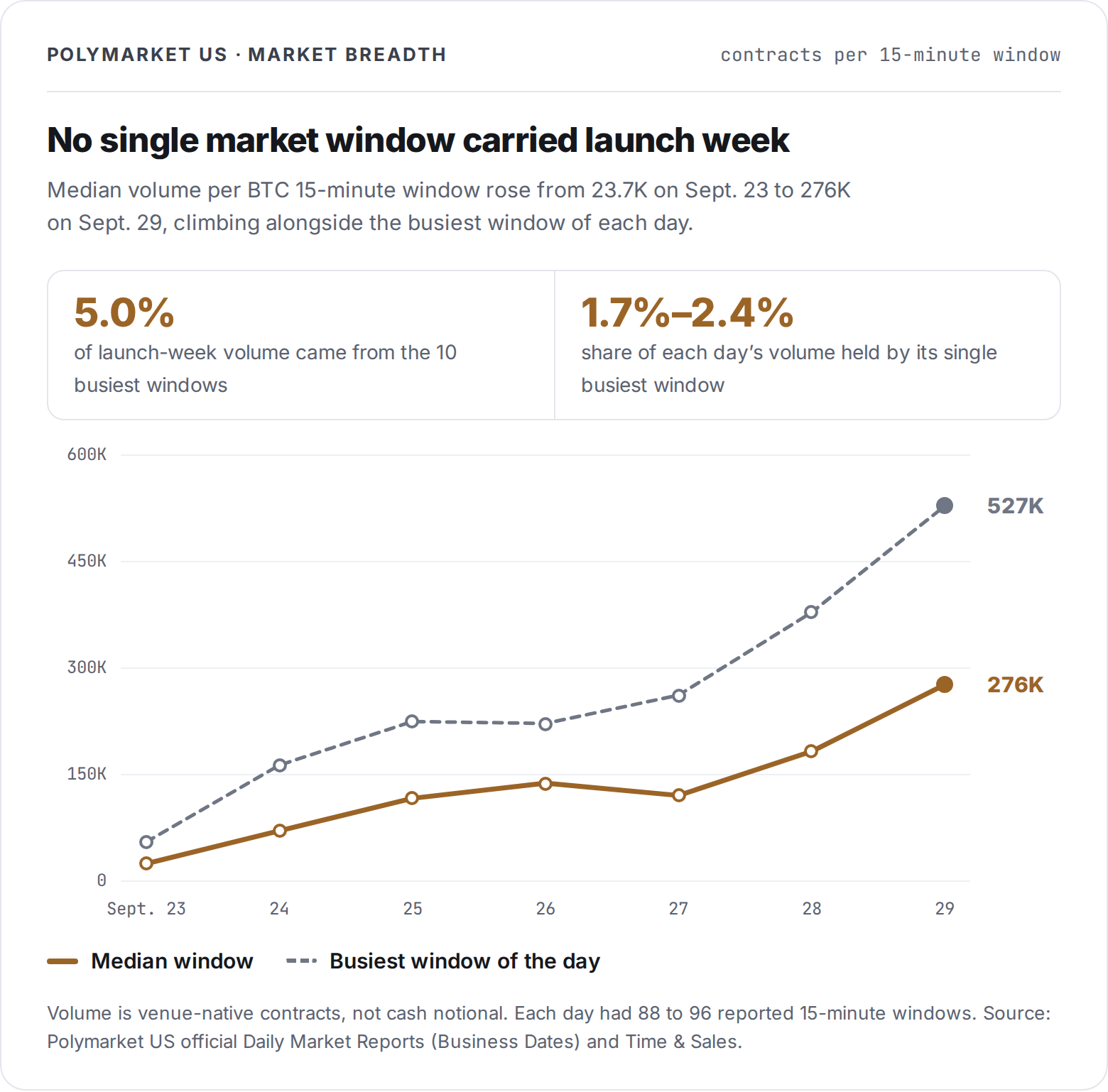
So activity was getting deeper across many individual markets rather than one hour dragging the total higher.
Nearly $92 million spread across hundreds of repeating markets looks more like people adopting the product than a few isolated events driving Polymarket's US numbers.
Kalshi had already shown short-term crypto could work
Kalshi started from a much smaller base. Its BTC 15-minute markets generated about $226,000 during their first full seven days, compared with a 406x difference on Polymarket US.
Kalshi's one-hour markets continued to grow, from about $3.2 million per day before launch to $15.8 million per day by days 61-90.
At the same time, crypto became a much bigger part of Kalshi. It went from about 2.6% of exchange volume before the 15-minute launch to 14.5% in September.
By then, 15-minute markets were doing most of the work. Kalshi recorded about $8.17 billion in crypto volume from Sept. 1-28, with roughly $7 billion, or 86%, coming from 15-minute markets.
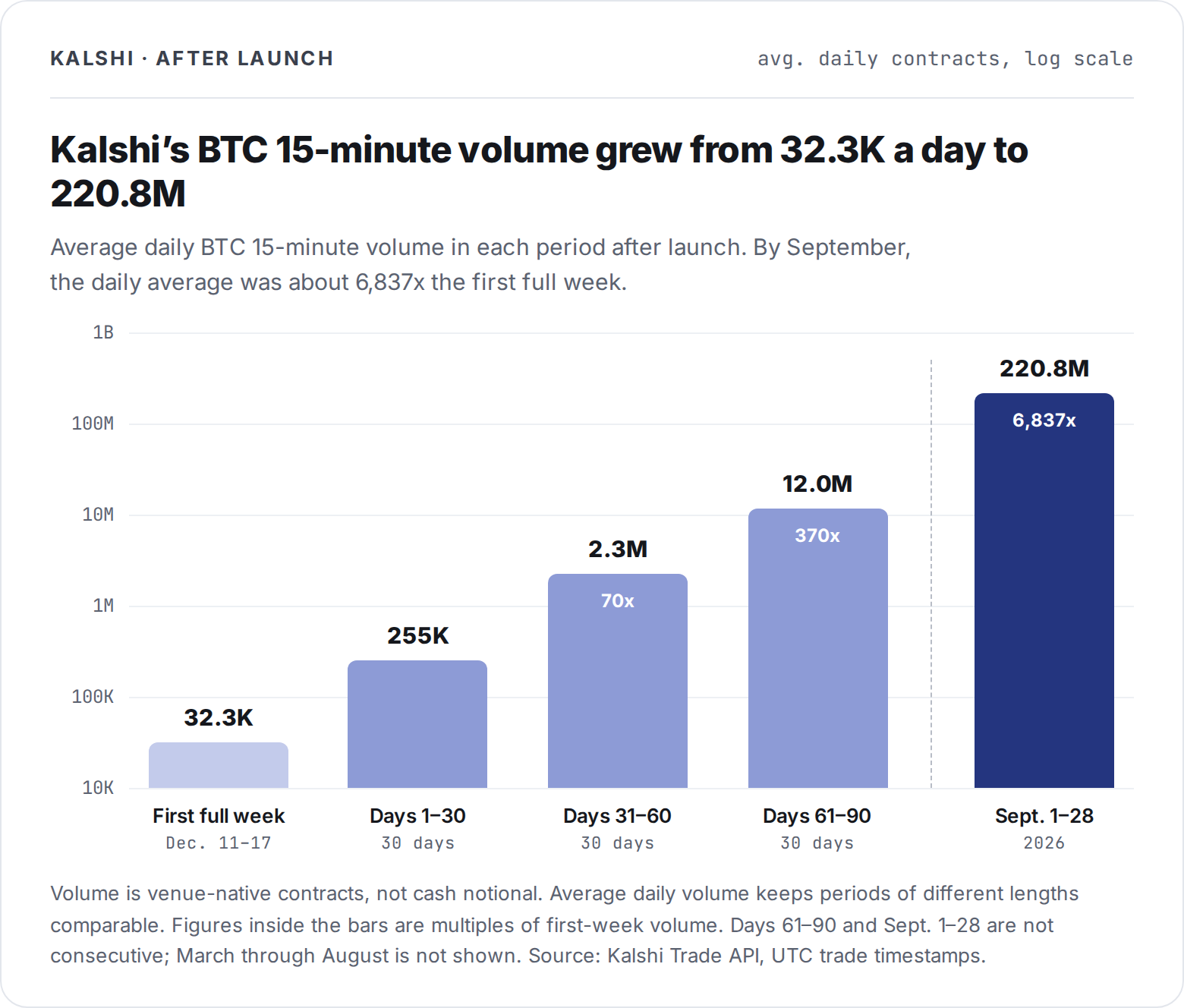
Kalshi gives a useful long-term comparison. The product started tiny and grew without killing the one-hour market.
Polymarket US is starting from a completely different place. Its first full week was already hugely successful.
There is no guarantee the next part of the curve looks like Kalshi. It could level off.
But the early product demand is pretty clear.
The Bitcoin category got dramatically bigger after short-term markets appeared and Kalshi's history offers a clear example of how quickly a small, repeating market can grow.
About the data: DeFi Rate pulled and analyzed 94,705,964 BTC 15-minute trade records for this study. That includes 91,734,870 Kalshi trade records across its launch period and September 2026, plus 2,971,094 Polymarket US Time & Sales records from Sept. 22-29. We also analyzed official venue volume reports and product-level market data for the before-and-after comparisons. These are trade records, not unique traders; neither public dataset provides trader IDs. Kalshi activity is grouped using UTC transaction dates, while Polymarket US uses official business days, so cross-venue comparisons use each venue's native reporting period rather than perfectly aligned timestamps. The pre-launch Polymarket US comparison uses Sept. 15-21 and the first full post-launch comparison uses Sept. 23-29, leaving the Sept. 22 launch day out of both periods.
 CFTC Proposes Adjustment to Exclude Casino-Style Games From 'Swaps' Definition
 NFL Week 4 Predictions: Latest Spread from Kalshi and Polymarket
 Iowa, Kansas and Nebraska Put New Senate Seats in Play as Prediction Markets Lag the Poll, Parties
 Peltola Holds 70% on Kalshi Despite Staff Allegations as Alaska Senate Race Tightens