Netflix’s “The Prediction Games”: 36 Minutes Is Not Enough for Prediction Markets
Netflix's The Prediction Games is more balanced than its trailer, covering founders, regulators, traders and the worst outcomes, but its short runtime can't do any of them justice.
Netflix premiered Instadocs: The Prediction Games on Sunday, offering a brisk introduction to an industry that has rapidly moved from a relatively obscure forecasting tool to a mainstream source of election probabilities, sports trading and political controversy.
Running just 36 minutes, the documentary has little time to explore any one subject deeply. Instead, it moves quickly through the history and purported value of prediction markets, the rise of Kalshi and Polymarket, the experiences of several high-volume traders and some of the most serious questions surrounding the industry, including manipulation, insider trading and markets tied to war and other sensitive events.
The finished product is broader and more balanced than the clip released ahead of its debut suggested on July 23. That preview clip, which opens the documentary, focused heavily on a gaggle of rowdy sports traders celebrating wins inside a Las Vegas mansion, prompting criticism that Netflix had reduced prediction markets to little more than a vehicle for thrill-seeking gamblers.
The trailer also triggered a cease-and-desist threat from Kalshi over footage involving a disputed trade receipt and the apparent timing of sports trading in Nevada. The disagreement generated considerable attention before the documentary arrived, though the sequence at the center of the uproar ultimately occupies only a small portion of the full film.
What Netflix’s prediction market documentary covers
The Prediction Games opens inside the Las Vegas mansion featured heavily in its trailer, but the sports traders occupying it are only the film’s entry point. Netflix quickly widens its lens, moving through the history of prediction markets, the theory behind them and the rise of Kalshi and Polymarket as mainstream sources of political, economic and sports probabilities.
James Surowiecki, author of the influential 2004 book The Wisdom of Crowds and a longtime writer on prediction markets, supplies much of the documentary’s historical and intellectual foundation. He traces modern prediction markets to the Iowa Electronic Markets and explains how prices can create a “collective forecasting machine” by aggregating information held by many participants.
Kalshi co-founder and CEO Tarek Mansour and Polymarket founder and CEO Shayne Coplan then make the case for their respective platforms.
Mansour argues that putting money behind an opinion encourages people to think more carefully, while describing sports as “an amazing propeller” that introduces users to prediction markets before some move into economics, politics and culture.
Coplan recounts founding Polymarket during the pandemic and presents the 2024 presidential election, particularly Joe Biden’s withdrawal from the race, as the moment the platform demonstrated its forecasting value to a much wider audience.
The documentary also spends considerable time with market participants. A section titled “The Sharp” follows professional traders Isaac Rose-Berman, Datian Zhang and Mark Pattinson as they move large sums during the World Cup and candidly explain the advantage sophisticated traders hold over casual users.
“The Novice” section of the film then introduces Daniel James, a 19-year-old line cook who borrows money from his roommate, loses it trading on New York Knicks markets and falls behind on rent.
From forecasting tool to cautionary tale
The documentary’s more critical sections are similarly organized around named archetypes. Dustin Gouker, a longtime analyst of sports betting and prediction markets, appears in a section titled “The Critic.” He explains the industry’s rapid growth, its heavy reliance on sports volume and the legal clash between federally regulated exchanges and state gambling authorities.
CFTC Chairman Michael Selig appears as “The Regulator,” defending the commission’s jurisdiction over prediction markets and addressing concerns about the industry’s political connections. Kalshi Head of Enforcement Robert DeNault is presented as “The Enforcer,” taking viewers inside an early-morning surveillance meeting and describing the exchange’s investigations, trade monitoring and referrals to law enforcement.
The film then uses two participants to illustrate how prediction-market incentives can spill into the real world. “The Whistleblower” features Minneapolis IT worker and former prominent Kalshi trader Caleb Davies, who detected suspicious Spotify streaming activity affecting the data used to settle music markets. Spotify later removed artificial streams after Kalshi had already paid out one of the contracts, and Davies says he ultimately liquidated his account.
“The Messenger” follows Emanuel Fabian, a military correspondent for The Times of Israel, who received threatening messages allegedly from Polymarket traders demanding that he change reporting about an Iranian missile strike. The traders appeared to have money riding on whether Iran had successfully struck Israel on a particular date. Fabian refused to alter the story and warns that he is unlikely to be the last journalist placed in that position.
Those episodes allow the documentary to explore insider trading, manipulation, consumer harm and markets tied to war without losing sight of the arguments supporters make for prediction markets.
The documentary ultimately returns to Surowiecki, Mansour and Coplan and the potential value of forecasting, leaving prediction markets framed as both a potentially important information tool and an industry whose incentives remain difficult to control.
The $5,000 trade controversy
The documentary opens with the same clip released as a teaser on July 23, showing guests at a Las Vegas mansion during a World Cup final watch party sponsored by Winible, an online platform that helps sports handicappers track their activity and sell picks, subscriptions and other content. In the opening, guests discuss World Cup positions they had taken on prediction platforms.
The pre-release clip’s most disputed moment showed one attendee holding up what appeared to be a Kalshi receipt for a $5,000 position on Spain to win the tournament. Because the footage was filmed in Nevada while Kalshi was subject to a court order restricting sports-event contracts there, CNN reporter Marshall Cohen and others questioned where and when the position had been opened. Netflix said the attendee was showing a screenshot of a trade made in May 2025, before the Nevada restrictions.
Hmm…… this was filmed Sunday in Vegas, and shows people saying they used Kalshi and Polymarket to trade on the World Cup final. But prediction markets have been banned for Nevada-based users since March, per court order. Where and when did they do these trades? https://t.co/nHadqEd5zK
— Marshall Cohen (@MarshallCohen) July 23, 2026
Kalshi responded with a July 24 cease-and-desist demanding that Netflix remove the trailer within one hour, publish a retraction and preserve documents and communications related to the production. The company said the displayed receipt “appears to have been entirely fabricated,” citing its May 16, 2025, date, the word “Crop” at the top of the image and terminology Kalshi said had never appeared in its interface.
Kalshi also said the market recorded only about $580 in total volume that month and argued that a $5,000 transaction could not have occurred. A separate search of Kalshi’s public trade data likewise found no transaction approaching $5,000 in the relevant market during that period.
One possible explanation is that the image was generated outside Kalshi. Winible has offered a tool that creates bet slips from picks posted on its platform, so the attendee may have displayed a shareable representation of a position rather than a direct Kalshi confirmation.
That could explain the image’s format, but it does not resolve the absence of a corresponding trade in Kalshi’s data.
The same phone image remains in the finished documentary, but the attendee’s remarks are given more context. In the trailer’s mansion sequence, his comment is presented as, “I put $5,000 on Spain to win the whole thing.” In the documentary, he says, “So before it started, I put $5,000 on Spain to win the whole thing.”
The longer version makes clear that he was claiming to describe a position opened before the tournament, not one placed during the Nevada party. It is not known whether Netflix added that context after Kalshi objected or whether the final cut had already been completed.
Netflix did not remove the trailer. The company defended the documentary, telling TheWrap, “Netflix upholds the highest standards of journalistic integrity in its documentary programming. No footage in ‘Instadocs: The Prediction Games’ was fabricated.”
The company separately told Front Office Sports that “any specific trades or bets referenced during that weekend are between the individual and the app in which they placed the trades.”
Kalshi remains critical of documentary
Kalshi officials began criticizing the documentary shortly after Netflix released the pre-release clip, initially focusing on the disputed trade receipt and what they viewed as an unrepresentative portrayal of the sports traders featured at the Las Vegas party. The criticism continued after the full film premiered.
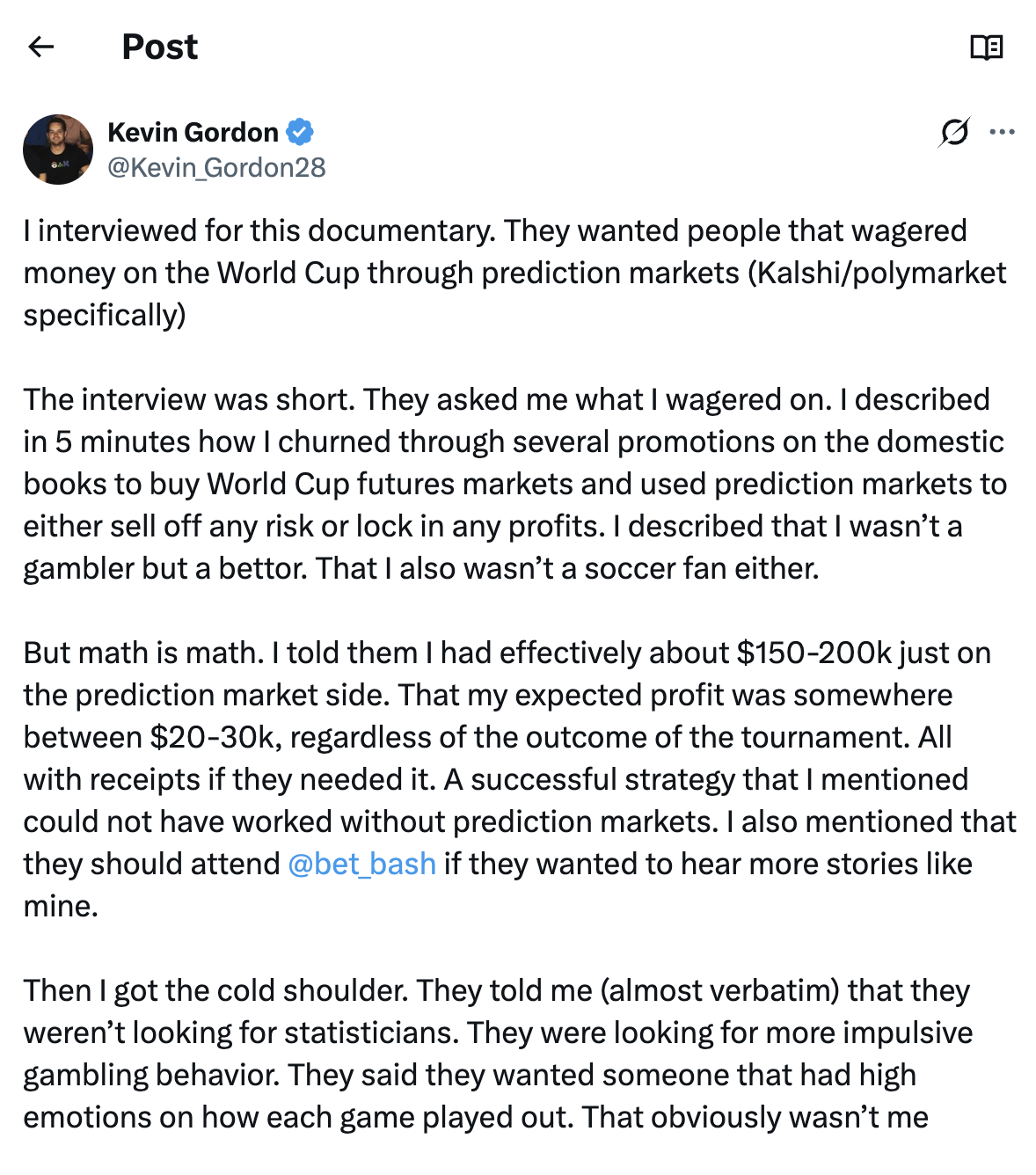
In a thread Sunday, Kalshi spokesperson Jacki McGavick called the documentary “sensationalized” and said the people interviewed were not representative of the exchange’s broader user base.
She also said Netflix omitted any coverage of Kalshi’s election data, objected that the film could leave viewers with the impression that Kalshi offers markets on war, terrorism and assassination, and again challenged the authenticity of the $5,000 receipt.
We will say it again. Netflix had a chance to make a genuinely interesting documentary about prediction markets. Instead, they made a sensationalized film that had a clear agenda.
The people they interviewed are not a representation of who trades. You don't have to take our word… pic.twitter.com/AcL72ndCnr— Jacki McGavick (@jackikotkiewicz) July 26, 2026
Her criticism echoed complaints from several traders and industry participants who argued that Netflix emphasized colorful personalities and controversial moments while overlooking participants they consider more representative.
A story worth more time
At 36 minutes, The Prediction Games does a good job introducing a complicated industry, but its runtime inevitably limits how fully it can capture prediction markets’ rapid rise and the advantages and risks that have emerged along the way. A documentary running at least 90 minutes could have told that broader story with considerably more depth and nuance.
A documentary series could be more compelling still, giving Netflix room to dig into some of the fascinating stories behind the industry’s growth, including the rise of Kalshi and Polymarket, their fight for market leadership, the explosion of sports trading and some of the controversies that have ensued. The escalating conflict between federally regulated exchanges and state and tribal gaming authorities could sustain an episode on its own.
The film works well as an introduction. But the larger prediction market story is rich enough to support something far more ambitious.
 Polymarket Promo Code Rate: $25 Bonus for Chiefs vs. Seahawks SNF
 Kalshi Promo Code RATE: $55 Bonus for Packers vs. Lions
 Polymarket Promo Code Rate: $25 Bonus for Bengals vs. Ravens
 Kalshi Promo Code Rate: $55 Bonus for Ole Miss vs. Texas CFB