ForumEX Seeks CFTC Approval for Perpetual-Style ‘Cultural Attention’ Futures
Y Combinator-backed ForumEX applied to the CFTC to become an exchange offering perpetual-style futures on online attention around people, games and other cultural subjects.
ForumEX, the exchange arm of Y Combinator-backed Forum Markets Group, has joined the Commodity Futures Trading Commission’s list of pending designated contract market (DCM) applicants with an unusual proposition: turning what Forum calls “cultural attention” into a federally regulated futures market.
Forum already operates a beta platform using simulated funds where users can take long or short positions in contracts tied to a proprietary Attention Index measuring online interest in subjects ranging from Kanye West, Donald Trump and Grand Theft Auto VI to SpaceX, Polymarket and Kalshi. The index combines signals from Google Trends, YouTube, Reddit and X to track changes in online attention over time.
The product looks more like a perpetual-style futures market than a conventional prediction market contract. There is no Yes/No question or event that ultimately resolves the trade. Instead, traders profit or lose as the contract price rises or falls, while funding payments help keep that price aligned with the underlying attention index. Forum’s beta contracts technically expire after five years, while its proposed regulated exchange would use fully collateralized contracts that settle daily and automatically roll into the next trading day.
Forum has been signaling its regulatory ambitions since launching earlier this year, saying six months ago that it was working with the CFTC to bring real-money trading to the U.S. The newly public ForumEX application, dated Aug. 21, provides a detailed look at how the startup plans to convert those simulated “cultural attention” futures into a federally regulated market.
Forum has been building toward a regulated launch
Forum launched earlier this year as part of Y Combinator’s Winter 2026 cohort, founded by Owen Botkin and Joseph Thomas. Botkin previously traded long/short equities at Balyasny Asset Management, while Thomas worked in software roles at GEICO and NASA, according to Y Combinator.
The beta initially gave users $1,000 in simulated funds. Forum later ran weekly trading competitions in which the top three traders shared a $500 cash prize pool, according to competition rules.
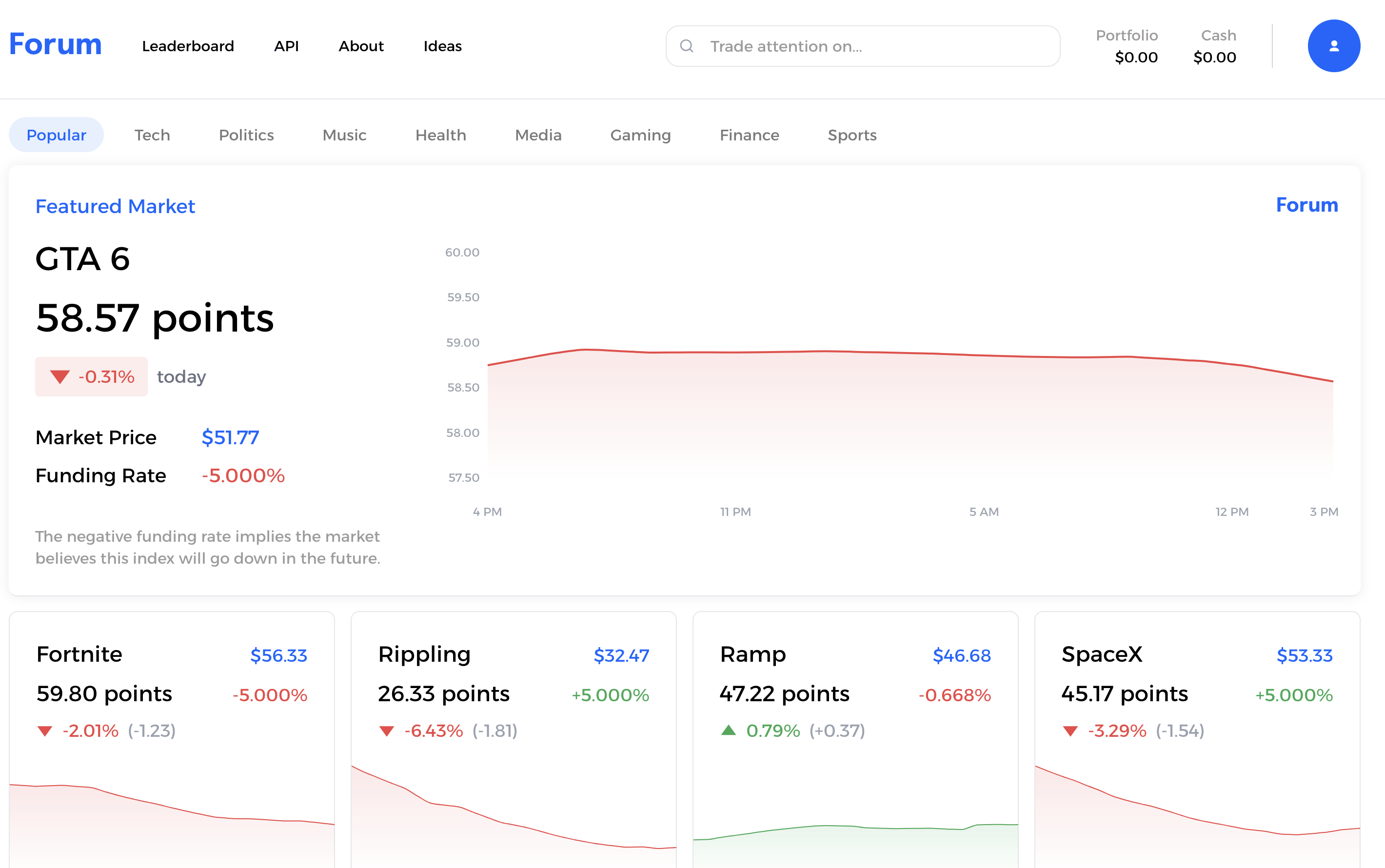
Forum’s current homepage
The regulatory buildout has become more visible in recent months. Forum Markets Group formed ForumEX as the exchange entity and recently hired former CFTC official Maggie Sklar as chief compliance officer. Sklar previously worked in the agency’s Division of Market Oversight and served as senior counsel to former CFTC Chairman J. Christopher Giancarlo.
ForumEX’s DCM application also says the exchange has engaged the National Futures Association to provide regulatory services including audit-trail review and trade-practice surveillance. Forum would retain responsibility for enforcing its own rules and disciplinary decisions.
ForumEX would create continuous exposure through daily-settled futures
ForumEX is proposing a non-intermediated, fully collateralized exchange, meaning approved participants could trade directly without going through a futures commission merchant or introducing broker. The application says both individuals and entities could become participants, with the exchange checking that sufficient funds are available before an order is matched.
The exchange would clear trades through an affiliated entity, Forum Clearing LLC, which the proposed rulebook identifies as the derivatives clearing organization (DCO) for ForumEX contracts. A separate DCO application for Forum Clearing has not yet appeared in the CFTC’s public portal.
Orders would trade through an anonymous central limit order book using price-time priority, similar to the structure used by many electronic futures and prediction market exchanges. ForumEX does not plan to offer block trades or other off-exchange execution methods, according to the filing.
The rulebook says contracts would generally begin trading at 5 p.m. ET each day, with trading paused between 3 a.m. and 8 a.m. Open positions would settle against the value of the underlying Attention Index each trading day, with gains and losses credited to or debited from users’ accounts.
Eligible positions could then automatically roll into the next day’s contract at the previous settlement price, allowing traders to maintain continuous exposure. That makes the regulated product perpetual-like in practice, even though ForumEX would technically use a series of daily-settled futures rather than a single contract with no expiration.
Forum pitches attention as a new asset class
Forum’s broader pitch is that online attention already has economic value and can be treated as a tradable asset in its own right. The company says brands, media companies and investors are exposed to what it calls “cultural risk,” the possibility that a campaign, product, artist or competitor suddenly gains or loses relevance.
An indexed copy of Forum product documentation that is no longer live gives examples of businesses using attention futures to hedge marketing campaigns that underperform or to offset the impact of a rival going viral. Traders, meanwhile, could use the same contracts simply to speculate on which artists, companies or trends are about to become more or less prominent.
Forum’s index methodology is designed to put a number on that attention. Its general Attention Index currently weights Google Trends at 30%, YouTube at 28%, Reddit at 21% and X at 21%, with data updated every 30 minutes and smoothed to reduce short-lived spikes. Those weightings are also displayed on individual markets in Forum’s current beta.
Forum has described the concept as creating a new asset class around attention. In its Y Combinator launch, the founders put it more simply: “We turn virality into tradable markets.”
Attention markets are already spreading
Forum is not alone in trying to turn online relevance into something traders can price. Polymarket partnered with Kaito AI earlier this year to launch “attention markets” tied to measures such as mindshare and sentiment, although those products remain conventional prediction contracts that ultimately resolve Yes or No.
Noise, a Paradigm–backed startup, is using a model much closer to Forum’s. Its platform lets users take long or short positions in contracts tied to the relevance of trends, brands and ideas, with prices informed by both social data and trading activity. Noise says its markets are continuous rather than binary, with no single resolution event.
Forum has not announced a timetable for launching real-money trading. For now, its existing platform continues to operate using simulated funds while the company pursues federal exchange approval.
 Polymarket Promo Code Rate: $25 Bonus for Buccaneers vs. Cowboys Thursday Night Football
 NFL Backs Up New Jersey Officials in Request for Supreme Court Review
 Report Says Gemini, Prophet X, WeBull Have Restricted Trading in Connecticut
 Kalshi Promo Code RATE: $25 Bonus for Rays vs. Yankees Game 3