




The Michigan Democratic Senate primary is turning into a national stress test for the progressive wave, and prediction markets are already calling the result.
Abdul El-Sayed is the overwhelming favorite to win the nomination, but the real question is whether that kind of candidate can hold a must-win battleground seat in November against a credible Republican in former U.S. Rep. Mike Rogers.
El-Sayed is hugely favored heading into Tuesday’s primary against U.S. Rep. Haley Stevens in both prediction markets and polling. The state is a pivotal battleground in the 2026 midterm elections as Democrats hope to retake control of the Senate, and retaining Michigan’s seat as Democratic Sen. Gary Peters retires will be crucial to that result.
That’s why this primary matters far beyond Michigan. The race has become a proxy fight between a surging progressive wing and a nervous moderate establishment worried about the general election. Traders are still pricing Democrats as favorites in November, but the margin is narrow enough to make Michigan one of the clearest readouts of whether the progressive bet pays off in 2026.

Senate control on the line
Michigan is one of the seats Democrats have to hold if they want any realistic path to Senate control after 2026. The winner on Tuesday will take on Rogers, who barely lost in 2024 against Sen. Elissa Slotkin and is now seen as a credible threat in a purple state that can flip either way, as shown by Slotkin winning the Senate while President Donald Trump won the state in 2024.
That makes Michigan’s 2026 midterm elections a high-stakes test of whether the party’s progressive wing can deliver a win without jeopardizing the general heading toward 2028.
The market is still leaning toward Democrats in November, but not without some caution. Kalshi has Democrats at 67% to win the Senate seat on just under $1 million in volume, and Polymarket has them at 68% on $155,000.
That’s enough to say the seat is still a Democratic lean, but not enough to say the progressive nominee is a clean lock against Rogers.
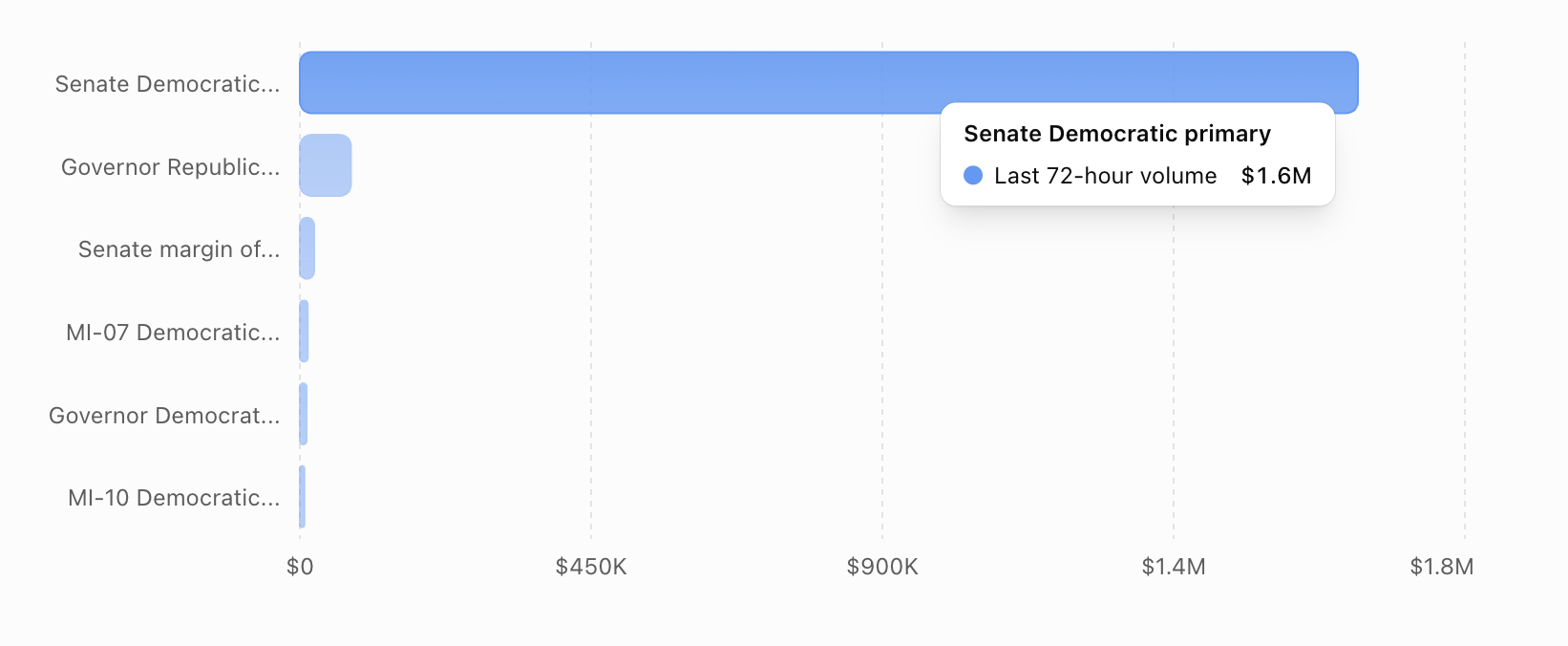
Where traders have focused in the Michigan markets
Combined Kalshi and Polymarket US contract volume over the last 72 hours by market group.
Prediction markets show progressive momentum
El-Sayed’s lead is now overwhelming in the primary prediction markets contracts.
Kalshi has him at 98% to win Tuesday on more than $8 million in volume, with more than $3.5 million trading on Stevens as no and more than $3.2 million on El-Sayed as yes.
Polymarket is at 99% on $1.8 million in volume. That’s a clear signal that traders think the primary is effectively decided.
That fits the pattern seen across other Democratic primaries this cycle. Progressives have been scoring wins in states like Colorado, and the endorsement battle has reinforced that divide. Figures like Rep. Alexandria Ocasio-Cortez and Sen. Bernie Sanders are backing El-Sayed, while Michigan’s establishment, including Peters and Gov. Gretchen Whitmer, has sided with Stevens.
The broader Senate fight is playing out in microcosm here. There’s a progressive surge on one side, and a fear among moderate Democrats that this could cost them in November on the other.
Party splits and Trump worries ahead of November
The split inside the Democratic Party mirrors a broader tension in the 2026 midterms.
On the left, the progressive wave is being framed as a necessary correction. Rep. Ro Khanna recently argued that economic concerns are driving far-left success and that voters are looking for a sharper break from the status quo.
On the right, Republicans are already worrying that Trump’s political baggage could hurt their results in November, especially in competitive states where they need to protect vulnerable incumbents.
That makes Michigan a useful barometer. If El-Sayed wins big in the primary and then holds up in the general, it could strengthen the progressive case moving toward 2028. If he struggles against Rogers, it could revive the moderate argument that Democrats need to be more careful about who they nominate in swing states.
Other Michigan races
The Senate race is the headline, but it is not the only contest worth watching.
In Michigan’s 7th Congressional District, Kalshi has progressive candidate William Lawrence at 92% to win on $455,000 in volume, suggesting the progressive wave goes beyond the Senate contest. On the Republican side of the governor’s race, Rep. John James is at 94% on almost $1 million in volume against Perry Johnson, while Democrats are at 84% to win the general, with Secretary of State Jocelyn Benson at 99% on the Democratic side.
That’s a lot of movement in one state, and it all points to the same thing. Michigan is a battleground where both parties are trying to prove they can win in a tough environment. The Senate race is the biggest piece, but the down-ballot contests are also telling you where the energy is flowing.
The bottom line is simple: Michigan matters for Senate control, and the primary is now mostly about what kind of Democrat emerges to face Rogers. El-Sayed looks like the nominee, and prediction markets are still giving Democrats the edge in November, but the race is close enough to be a real test.
If progressives can hold Michigan, it strengthens their case elsewhere. If they can’t, it gives moderates a powerful counterargument heading into the 2028 presidential election.
