Louisiana Wins Temporary Order Against Kalshi, Polymarket, 8 More Platforms
A state judge ordered operators to block Louisiana residents from accessing covered event contracts, including sports, elections and awards. Kalshi is seeking a competing federal order to stop enforcement.
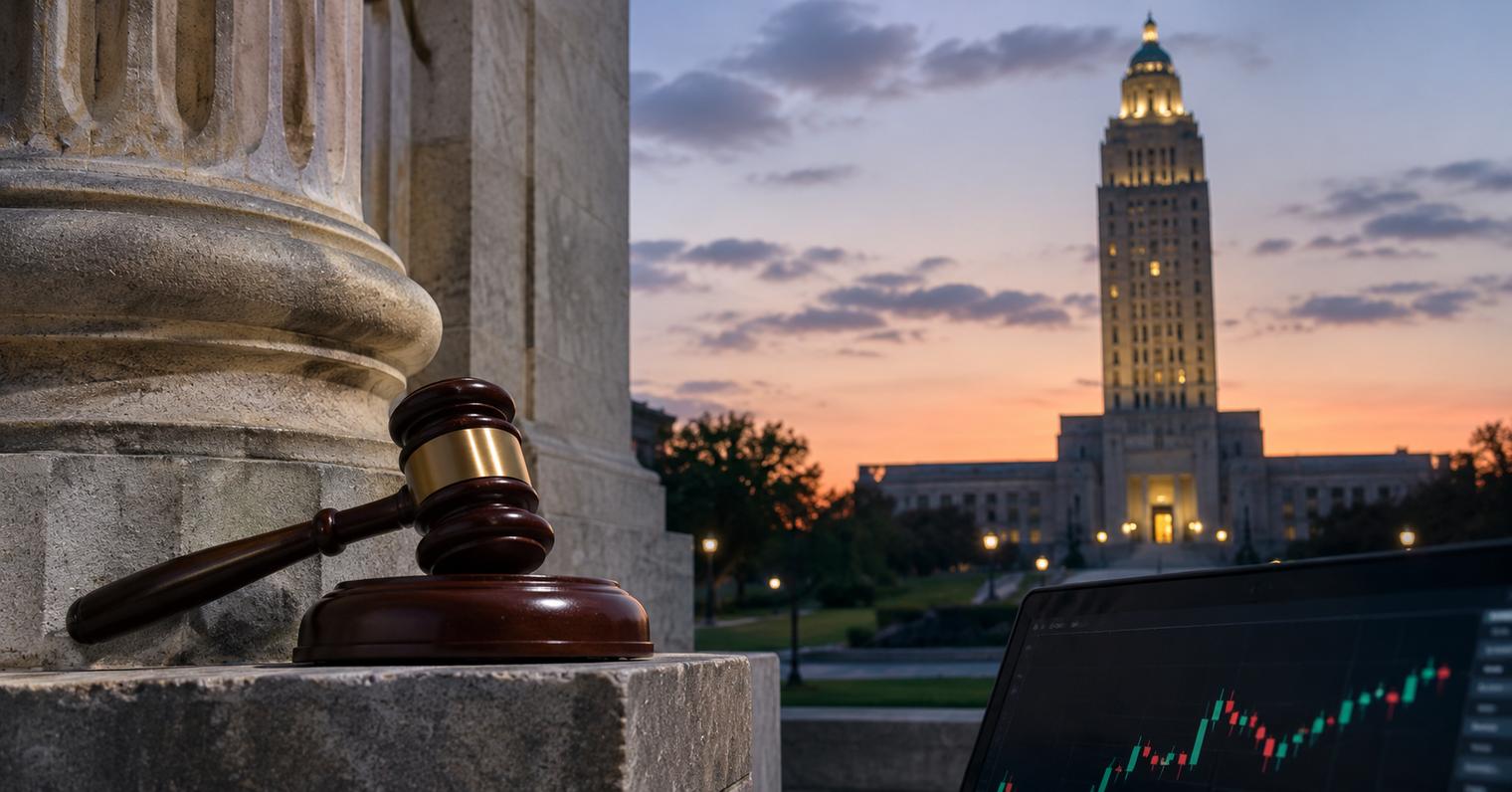
Louisiana sued a broad group of prediction market operators Thursday and secured a temporary restraining order hours later, escalating the jurisdictional fight from a threatened crackdown to a court-ordered restriction.
Judge Jeffrey Johnson of the 21st Judicial District Court in Tangipahoa Parish temporarily barred the named companies from offering or facilitating covered event contracts for people in Louisiana without state gaming authorization. The order also requires geofencing and restricts representations that the products are lawful or licensed in the state. Johnson’s order came just hours after Attorney General Liz Murrill filed a lawsuit against 10 prediction markets operators in state court.
The defendants include:
Coinbase
Crypto.com
ForecastEx
Gemini
Kalshi
Novig
Polymarket US
ProphetX
Robinhood
Underdog
The restriction reaches beyond sports to contracts involving elections and awards. The order is effective for 10 days unless extended or the defendants consent to a longer period. A preliminary injunction hearing is scheduled for Nov. 30.
Louisiana targets the full transaction, not just new trades
Murrill’s lawsuit argues that the platforms are offering unlicensed gambling, regardless of whether they describe the products as financial contracts.
“It’s not complicated: if you aren’t a licensed gaming operator, you aren’t legal,” Murrill said. “Illegal gambling is a crime and is subject to jail time and significant penalties.”
The restraining order takes a broad approach. It prohibits named defendants from operating, offering, listing, accepting, clearing, settling, brokering, making markets in or otherwise facilitating covered event contracts for anyone located in Louisiana without the required state license and permit.
It also:
- Bars accepting wagers from, or allowing covered market access to, people in Louisiana.
- Requires geofencing to prevent access within the state.
- Prohibits representations to Louisiana customers that the covered offerings are lawful, licensed or authorized there.
The inclusion of clearing, settlement and brokerage activity means this is not simply an instruction to stop customers opening new sports positions. It reaches multiple parts of the trading process and businesses distributing access to exchanges.
The Advocate reported that Louisiana users could still purchase Kalshi contracts at 7 p.m. Thursday.
Kalshi asks a federal court to block the state
Kalshi responded Thursday by seeking its own temporary restraining order and preliminary injunction in federal court.
The exchange had already sued Murrill, Gov. Jeff Landry and Louisiana gaming officials Oct. 23, arguing that the state was preparing to interfere with a federally regulated market. As DeFi Rate previously reported, that case opened a potential route to the Fifth Circuit Court of Appeals.
The new emergency request asks the federal court to stop Louisiana’s enforcement.
“The operation of federally-regulated exchanges is the exclusive province of the federal government. Full stop,” Kalshi Head of Litigation Jovy Dedaj wrote on X.
That is the company’s position, not a settled national rule. Kalshi argues that the Commodity Exchange Act and Commodity Futures Trading Commission (CFTC) jurisdiction displace Louisiana gambling restrictions. Murrill argues that the contracts are wagers subject to state authorization.
The two proceedings now present opposite requests: Louisiana has obtained temporary state-court restrictions, while Kalshi is asking a federal judge to prevent the state from enforcing them.
The geofencing requirement collides with the CFTC’s national access position
The Louisiana order arrives shortly after the CFTC directed regulated exchanges to address domestic geographic restrictions.
The agency’s impartial access interpretation gives designated contract markets 30 days to remove restrictions that violate federal requirements or explain why compliance is not feasible. It also directs exchanges to address restrictions imposed through intermediaries.
“Derivatives markets must operate on a uniform basis at a national scale in order to achieve the purposes set out in the Commodity Exchange Act,” CFTC Chairman Michael Selig said in the release.
Louisiana’s order pushes in the other direction by expressly requiring a geographic block.
But the CFTC interpretation does not vacate state-court injunctions. Its explanation process is particularly relevant for exchanges that say judicial restrictions prevent them from providing nationwide access. Operators cannot assume that an agency announcement has dissolved an order entered against them.
The Louisiana case therefore turns the national access dispute into an immediate compliance problem, not merely an abstract disagreement over regulatory policy.
Another potential appellate front in a divided national fight
Kalshi’s federal Louisiana case sits within the Fifth Circuit.
An appeal from a relevant federal ruling could eventually bring the jurisdictional question before Fifth Circuit judges. For now, the immediate dispute remains in the trial courts.
Other appellate courts have reached differing conclusions. The Third Circuit sided with Kalshi in New Jersey, while the Ninth Circuit ruled against the exchange in Nevada and denied rehearing Nov. 4. The Sixth Circuit rejected preliminary protection in the linked Ohio and Tennessee cases.
The Second Circuit also denied injunctions pending appeal Nov. 3 in Kalshi’s New York and Connecticut cases and Coinbase’s Connecticut case, without deciding those appeals on the merits.
As DeFi Rate’s litigation tracker documents, U.S. Supreme Court petitions remain pending, but the justices have not agreed to resolve the dispute.
Louisiana’s approach also resembles Utah’s broader enforcement campaign in one important respect: the state is not limiting its challenge to conventional sports outcomes. Utah’s civil action likewise targets multiple categories of event contracts, alongside a separate criminal prosecution.
November 30 is the next scheduled hearing, not a guaranteed extension
The next confirmed state-court date is the Nov. 30 preliminary injunction hearing.
Before then, the key questions are whether the 10-day TRO is extended, whether defendants challenge or seek to modify it, and whether the federal court grants Kalshi emergency relief.
For customers, the order should not be read as proof that every app has already stopped trading or that existing positions will receive identical treatment.
For the industry, the development is more concrete: Louisiana has moved from anticipated enforcement to a broad temporary court order reaching exchanges, brokers and related businesses. Whether those restrictions survive the next stage, and how they interact with federal access requirements, is now the immediate fight.
 Kalshi Promo Code RATE: $55 Bonus for Warriors vs. Spurs Props
 Kalshi Promo Code RATE Guarantees $55 Bonus for Commanders vs. Giants Tonight
 Novig Injunction Denial Adds to Prediction Market Defeats in New York District Court
 Texas Bill Imposes Age Minimum, Introduces Restrictions for Event Contract Trading