


Texas opened the 2026 midterm primary season on March 3, when James Talarico won the Democratic Senate nomination. Ken Paxton later defeated John Cornyn in the May 26 Republican runoff. With most major spring and summer primaries complete, attention is shifting to the remaining late-summer races.
General election markets are active while the remaining state primaries run through September 15. DeFi Rate tracks them with live prediction odds aggregated from first-party exchange data and refreshed every 30 minutes.
This is our central hub, giving you a view of the featured markets, key states we are tracking, props and where to bet on the primaries and midterms.
Odds on Senate Balance of Power
Current probabilities across platforms with liquidity indicators
DSDD Senate, D House
Vol $151.2K
Spread 2.0%
Agg
48.9%↑ +0.4%
P
49.5%
K
47.5%
RSDR Senate, D House
Vol $85.0K
Spread 1.0%
Agg
36.3%↑ +0.8%
K
36.5%
P
35.5%
RSRR Senate, R House
Vol $380.5K
Spread 4.0%
Agg
11.8%↓ -4.7%
K
15.5%
P
11.5%
DSRD Senate, R House
Vol $64.5K
Spread 0.6%
Agg
1.4%↑ +0.7%
K
1.6%
P
1.0%
OTOther
Vol $21.0K
Spread —
Agg
0.4%— +0.0%
P
0.4%
| Outcome | Aggregated | Spread | Volume | Kalshi | Polymarket |
|---|---|---|---|---|---|
DSD D Senate, D House | 48.9% ↑ +0.4% | 2.0% | $151.2K |
Kalshi
47.5%
|
Polymarket
49.5%
|
RSD R Senate, D House | 36.3% ↑ +0.8% | 1.0% | $85.0K |
Kalshi
36.5%
|
Polymarket
35.5%
|
RSR R Senate, R House | 11.8% ↓ -4.7% | 4.0% | $380.5K |
Kalshi
15.5%
|
Polymarket
11.5%
|
DSR D Senate, R House | 1.4% ↑ +0.7% | 0.6% | $64.5K |
Kalshi
1.6%
|
Polymarket
1.0%
|
OT Other | 0.4% — +0.0% | — | $21.0K |
Kalshi
—
|
Polymarket
0.4%
|
Probability Over Time
Hover for details · Cursor-synced tooltips
Tap "Chart settings" to adjust the chart.
Chart settings
The live balance-of-power market above currently makes a Democratic Senate and Democratic House the leading outcome at roughly 49% as of August 14. The embedded odds update every 30 minutes as prices change.
Latest news and updates

Texas Senate Race Continues To Trade Like a Toss-Up as Paxton Holds a Thin Kalshi Edge
More than $10.6 million has traded on Kalshi’s Texas Senate market since the race turned competitive in August, while Polymarket traders now narrowly favor Democrat James Talarico. The split-screen comes as Republicans, including Sen. Ted Cruz, Senate Majority Leader John Thune and President Donald Trump, publicly acknowledge that Texas is no longer a race they can take for granted.

Over $106M Has Been Traded on LA’s Mayor Race as Bass Holds a Narrowing Edge
More than $100 million has traded on Kalshi’s Los Angeles mayor market, where Karen Bass remains near 65%.
Challenger Nithya Raman is gaining ground, has just secured the endorsement of the local Democratic Socialists of America chapter, and is running in a city where the general election is less a fight over party than a fight over what kind of Democrat gets to run Los Angeles.
AOC and Ossoff Overtake Newsom in 2028 Democratic Presidential Nominee Prediction Markets as Money Floods In
The 2028 Democratic primary market is becoming a three-way race, but Gavin Newsom is no longer leading it. With $194 million now traded on Kalshi and nearly $1.3 billion on Polymarket, Alexandria Ocasio-Cortez and Jon Ossoff have surged past the California governor, an early sign that traders are pricing a Democratic future less defined by the old establishment and more by the party’s progressive and battleground-state wings.
Prediction Markets Call Trump Candidate Wins In South Carolina and Oklahoma Runoffs, Margins Show His Grip Still Has Limits
Trump-backed Darline Graham Nordone and Mike Mazzei both won Tuesday’s Republican runoffs, validating the markets that continued to price each as the favorite after shaky first-round performances. But Graham’s earlier failure to clear 50% in deep-red South Carolina, and Mazzei’s 0.6-point Oklahoma win after finishing second in the first round, show that Trump’s endorsement remains powerful without making his candidates invincible.

Trump Doubles Down on Mazzei in Oklahoma Governor Runoff After Prediction Markets Missed First Round
Mike Mazzei entered Oklahoma’s GOP governor primary as a near-90% prediction market favorite, only to finish just behind Attorney General Gentner Drummond, forcing a runoff. Trump is now escalating his support for Mazzei ahead of Tuesday’s vote, while Kalshi and Polymarket again put him at 78%, setting up another test of whether markets and a presidential endorsement can overcome a close, unpredictable Republican electorate.
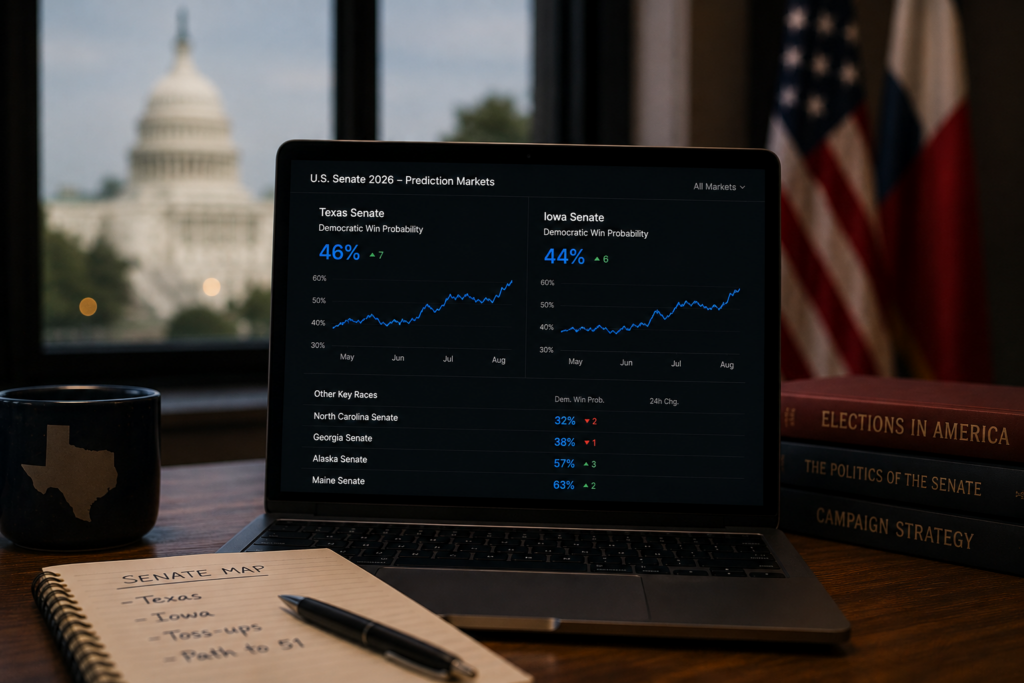
Cook Moves Texas and Iowa Toward Democrats, but Prediction Markets Still See Different November Risks
Cook Political Report just moved the Texas and Iowa Senate races to toss-ups and upgraded the Iowa governor’s race to Lean Democratic, giving Democrats four more favorable ratings in two states that once looked reliably Republican. Prediction markets are reflecting the tighter Senate picture, especially in Texas, where Ken Paxton and James Talarico are neck-and-neck.
2026 races we’re tracking across prediction markets
Not every competitive race has meaningful market liquidity yet. The states below were selected based on Kalshi volume, general election competitiveness, and governor or downballot market depth.
| State | Race | Favorite | Markets available |
|---|---|---|---|
| Georgia | Senate & Governor | D / R | General election winner (both); Senate and governor primaries ✓ resolved |
| Texas | Senate & Governor | R | General election winner (both); Senate primaries ✓ resolved |
| Maine | Senate & Governor | D | General election winner (both); Senate and governor primaries ✓ resolved |
| North Carolina | Senate & Governor | D | General election winner (both); primary markets ✓ resolved |
| Florida | Governor & Senate (special) | R | Republican governor primary (Aug. 18), general election winner, Senate markets |
| Ohio | Senate (special) | R | General election winner; Democratic primary ✓ resolved |
| Nevada | Senate, Governor & Downballot | R | General election winner (both); governor and downballot primaries ✓ resolved |
| Minnesota | Senate & Governor | D | General election winner (both); primary markets ✓ resolved |
| New York | Governor & House | D | General election winner (Governor); House primaries ✓ resolved |
| Illinois | Senate & House | D | General election winner (Senate); House primaries ✓ resolved |
| California | Governor | D | General election winner; top-two primary ✓ resolved |
How to bet on 2026 midterm markets
Most people start with the headline markets — Senate control, House control — and stop there. That’s fine, but it leaves a lot on the table.
Prediction markets for the 2026 cycle cover far more ground than picking a winner. Kalshi and Polymarket list Senate, House, governor, control, seat-count, and proposition contracts, while PredictIt offers a narrower political market selection. Availability and eligibility vary by platform. Each category also carries different liquidity and serves a different purpose depending on the view you want to express.
Every election contract is structured the same way: a Yes/No binary priced between $0.01 and $0.99. That price represents the market’s implied probability on a win. A contract at $0.67 means the market collectively gives a 67% chance that outcome will be the winner. If the outcome occurs, the contract settles at $1.00. If it doesn’t, it settles at $0.
Sell your shares before election day
A benefit to prediction markets is that you can exit a position before resolution by selling at the current market price. If you bought 100 contracts at 60¢ ($60.00) and the market moved to 81¢, you could sell for $81.00 and lock in a $21.00 gain before fees without waiting for the race to be called.
The inverse is just as useful: if 100 contracts bought at 20¢ fell to 10¢, selling would recover $10.00 rather than risking the full $20.00 through resolution.
Senate primary markets
The Texas Democratic primary drew roughly $4.8M in volume before resolving on March 3, showing what a Senate primary market can look like at full liquidity. These markets ask who will win a party’s Senate nomination in a state, with candidate outcomes priced individually. Most high-profile Senate primaries have now resolved; the remaining congressional primary calendar runs from Florida on August 18 through Delaware on September 15.
Available on: Kalshi and Polymarket.
Governor primary markets
The Florida Republican governor primary is the key remaining governor-primary market before Florida votes on August 18. Byron Donalds held roughly 97% in DeFi Rate’s aggregated odds on August 14. Governor primary markets follow the same structure as Senate primaries, but endorsements, candidate exits, and late polling can move them quickly.
Available on: Kalshi and Polymarket.
House primary markets
Individual House primary contracts often have less volume than Senate or governor markets, so spreads can be wider and prices less stable. These markets cover district-level nominee races, and liquidity can change quickly around competitive open seats, incumbent challenges, or races drawing national attention. Check the order book before trading.
Available on: Kalshi and Polymarket.
Election props
Election props go beyond the binary winner question. They include margin-of-victory brackets, turnout thresholds, county-level outcomes, and matchup combinations. Texas has supported one of the cycle’s deepest prop-market groups, but liquidity varies widely by contract. These markets are best suited to traders with a specific view on how an outcome will unfold, not only who wins.
Available primarily on: Kalshi.
Meta and combo markets
Combo markets package several nomination outcomes into one contract, such as whether a party’s favored candidates win across a group of states.
Because many underlying primaries have now resolved, check each combo market’s status, remaining legs, and resolution rules rather than relying on prices from earlier in the cycle.
One thing to flag before trading either: the combo structure means a single unexpected result can flip your entire position. Read the resolution rules carefully — particularly how the platforms handle late-resolving primaries.
Available on: Kalshi, Polymarket.
Downballot markets
Downballot markets cover Attorney General, Lieutenant Governor, Secretary of State, and Comptroller races. They exist on both platforms but often carry thinner liquidity than top Senate or governor markets. They are most relevant to traders who follow state politics closely; check spreads and depth before placing an order.
Available on: Kalshi, Polymarket
General election markets
These are November winner markets — who wins a Senate seat or governor’s race — and they are distinct from primary markets. General election markets can open before a primary resolves and remain open through November 3. Holding a position in a primary market does not give you exposure to the general election; the two are separate contracts. Many major Senate and governor markets are listed in the race-by-race section above.
Available on: Kalshi, Polymarket, and PredictIt.
Where to bet on 2026 primaries and midterms
The three platforms below cover different parts of the market. Which one makes sense depends on what you’re trying to trade.
Kalshi primary markets
Kalshi is a CFTC-regulated exchange carrying the deepest liquidity on US election markets. For the 2026 cycle, Kalshi has individual Senate, House, and governor race markets across all competitive states, plus primary advance and seat count bracket markets not available elsewhere. You will also find prop markets and we expect that mention markets may unfold down the road. All contracts are cash-settled in USD, and Kalshi is available in all 50 states.
New users get a $25 Bonus using the Kalshi promo code RATE.
Polymarket primary markets
Polymarket offers separate international and US products. The international venue generally carries a broader election-market selection, while US eligibility, contract availability, and funding options can differ. Check which product and markets are available in your jurisdiction.
You can join through our Polymarket promo code page and use the invite code RATE.
PredictIt primary markets
PredictIt covers Senate and governor general election winner markets using a share-based model with a $3,500 cap per contract. It does not offer primary advance, party composition, or seat count markets. PredictIt continues to operate under a CFTC no-action letter allowing limited political event markets for academic research purposes. Its parent company Aristotle received CFTC approval on January 26, 2026 for AristotleExchange.com as a DCM and DCO, though that has yet to change how PredictIt itself operates. PredictIt is best suited for those who want exposure to general election outcomes with a lower position limit.
Review of PredictIt coming soon!
Key dates to watch
Volume often increases before a primary as polling, endorsements, and early-voting data attract attention. Once nominees are confirmed, trading shifts toward the November matchup. The dates below follow the FEC’s 2026 primary calendar and are subject to change.
| Date | Event | Market impact |
|---|---|---|
| August 18 | Florida, Alaska and Wyoming primaries | Florida governor and special Senate primary markets resolve; Alaska and Wyoming congressional markets update |
| August 25 | Oklahoma runoff, if required | Remaining Oklahoma nominations resolve |
| September 1 | Massachusetts primary | Senate and House markets update |
| September 8 | New Hampshire primary | Senate nominee markets resolve |
| September 9 | Rhode Island primary | Senate and House markets update |
| September 15 | Delaware primary | Senate and House markets update |
| November 3 | General election day | Remaining 2026 federal and state election markets resolve under their rules |
Is betting on Senate primaries legal in the US?
Election contracts are available in the US on federally regulated exchanges such as Kalshi. Kalshi is a CFTC-designated contract market, and a 2024 federal district court ruling held that its election contracts did not constitute “gaming” under the Commodity Exchange Act. The CFTC dropped its appeal in May 2025. Platform and market availability can still vary; see our list of prediction apps for current options.
Texas showed how quickly primary markets can move
The March 3 Texas Senate primary was the first major market test of the 2026 cycle. Kalshi traders had James Talarico at 86% to win the Democratic nomination while polling showed a tighter contest, and Talarico won. Traders also made a Paxton-Cornyn runoff the leading Republican outcome before votes were counted; Paxton went on to win that runoff on May 26.
How to bet on US primaries and midterms
If you’re new to primary markets specifically, the mechanics are worth understanding before you put money in. Depending on the platform and the race, you can bet on who wins a nomination, whether a candidate advances past a primary, the margin of victory, turnout by party, or even which counties a candidate will carry. The most liquid markets are nominee markets and general election winner markets, but the full range of options is worth knowing before you place a position.
Every primary market on Kalshi and Polymarket is structured as a Yes/No contract on a specific outcome. You are not picking a winner from a list — you are deciding whether a particular outcome will happen and buying a position accordingly.
How to buy and sell election contracts
Each outcome has its own contract priced between $0.01 and $0.99. That price reflects the implied probability that the outcome will occur — a contract trading at $0.72 means the market collectively gives that outcome a 72% chance of happening.
If the outcome occurs, the contract settles at $1.00 and you collect the difference. If it does not, it settles at $0 and you lose your stake.
You can also sell your position at any point before the market closes, locking in a gain or cutting a loss without waiting for the result.
How to read election odds
The Florida Republican governor market offers a current example. Byron Donalds was priced near 97¢ in DeFi Rate’s aggregated odds on August 14, implying roughly a 97% chance of winning. Buying 100 contracts at 97¢ would cost $97 before fees and return $100 if the outcome resolves Yes. Prices can move before resolution, so traders can also sell earlier through the order book.
Primary vs. general election markets
Primary markets resolve according to each contract’s stated rules after the nominee is determined. General election markets remain open through their specified closing or resolution date. The two markets are distinct — winning a primary does not settle the general election market. Traders who want exposure to the full cycle need to hold or trade both.