


Sports fans are putting real money behind their predictions legally in all 50 states. This guide breaks down how sports prediction markets work, which platforms have the best odds and liquidity, and what’s actually available in your state when it comes to the NFL, NBA and other sporting events.
We cover the difference between trading contracts and placing bets, how to convert prices to American odds, and side-by-side comparisons of the best sports prediction apps—a new alternative to sports betting sites that works in all 50 states.
Best sports prediction apps in 2026
If you’ve been betting on sports elsewhere, you now have options that are far more reputable. A year ago, Kalshi was the only platform offering sports contracts. Today, we have seven to choose from. DraftKings, FanDuel, and Fanatics all launched in December 2025, the same month Polymarket returned to the US after regulators forced it out in 2022.
Here’s what you’re working with if you’re interested in trading sports event contracts on prediction markets.
| Platform | Best for | Exchange | US states |
|---|---|---|---|
| Kalshi | Volume, sports depth | Own DCM | 50 states |
| Polymarket | Global liquidity, sports depth and crypto traders | Own DCM (QCEX) | Rolling out (waitlist) |
| DraftKings Predictions | Brand recognition, non-betting states | CME Group (Railbird pending) | 38 states |
| Fanatics Markets | Casual sports fans | Crypto.com | 24 states |
| FanDuel Predicts | Brand recognition, non-betting states | CME Group | 50 states |
| Robinhood | Brokerage integration | Routes through Kalshi | Select states |
| Crypto.com | Crypto-native users | Own DCM | Select states |
Why the exchange matters: You’ll notice we included the exchange. Apps routing through the same exchange share identical order books. DraftKings and FanDuel both use CME Group right now (though this will change), meaning the same markets and pricing appear on both apps. Think of it like a skin. The difference comes down to interface, fees, and user experience. Markets with their own exchanges (Kalshi, Polymarket, Crypto.com) have more flexibility to create unique markets and control pricing and fees.
Compare apps and sports markets
Kalshi Sports
Kalshi has been the market leader since launching sports contracts early last year. The company operates its own CFTC-registered Designated Contract Market and has grown trading volume over 100x since entering sports, with approximately 87% of activity now coming from sports markets. The sports contracts are available in all 50 states plus Washington D.C. New users qualify for a $10 sign up bonus on your first $100 in trades.
- Sports markets: NFL, NBA, NHL, MLB, college football, March Madness, golf, soccer, UFC, tennis
- Contract types: Game winners, championship futures, playoff brackets, props
- Fees: Variable formula based on contract price (highest near 50¢, lowest at extremes)
- Funding: ACH, wire, debit card, USDC, Solana
- Minimum age: 18+
- Key advantage: Earns 4% APY on uninvested balance, offers combos (parlays), wider selection of futures and event markets.
Polymarket Sports
Polymarket is the global volume leader compared to Kalshi and recently re-entered the US market after acquiring CFTC-licensed exchange QCEX. The US rollout started with waitlisted users and sports markets first, with broader categories expected later this year. If you’re after liquidity, you can’t go wrong with Polymarket. High traffic markets include NFL and soccer. This will likely be the #1 site when the 2026 World Cup takes place.
- Sports markets: NFL, NBA, NHL, soccer (Champions League, domestic leagues)
- Contract types: Game winners, spreads, championship futures
- Fees: Zero trading fees (for now), ~0.01% through QCEX
- Funding: USDC only (requires crypto wallet)
- Key advantage: Highest global liquidity, crypto
DraftKings Predictions
DraftKings is the #1 sportsbook on the market and recently launched DraftKings Predicts for states without regulated sports betting. DraftKings Predicts routes trades through the CME Group, the same as FanDuel but has plans to eventually operate its own exchange through Railbird. Sports contracts are available in 18 of 38 states, though there is currently a very limited selection and odds are not as good as what Kalshi and Polymarket offer. Non-sports markets (finance, culture) are available in states where DraftKings offers online sports betting.
- Sports markets: NFL, NBA, MLB, NHL (in non-sportsbook states)
- Contract types: Championship futures, game outcomes
- Fees: Not yet disclosed
- Funding: Integrated with DraftKings account
- Sports Predictions In: California, Florida, Georgia, Texas (sports available)
- Sportsbook Available In: All other states
- Key advantage: CME group partnership with FanDuel to offer more liquidity
Fanatics Markets
Fanatics was the first traditional sportsbook operator to enter prediction markets. Fanatics acquired introducing broker Paragon Global Markets in July 2025 and partners with Crypto.com’s CFTC-registered exchange for pricing and markets. The Fanatics Markets app is available in 24 states where Fanatics doesn’t operate its sportsbook.
- Sports markets: NFL, NBA, NHL, MLB (game scores, team outcomes)
- Contract types: Live game contracts, championship futures
- Fees: Not yet disclosed
- Funding: Shared wallet with Fanatics ecosystem
- Phase 2 (early 2026): Crypto, stocks/IPOs, pop culture, movies, music
- Key advantage: Integration with Fanatics merch, collectibles, tickets
FanDuel Predicts
FanDuel partnered with the CME Group, the same as DraftKings to launch FanDuel Predicts app. FanDuel initially started with just five states (Alabama, Alaska, North Dakota, South Carolina, South Dakota) but has expanded into all 50 states. Note that sports contracts are only available in 15 states, including ones without legal online sports betting or with a single sportsbook operator (Florida and Delaware).
- Sports markets: Baseball, basketball, football, hockey
- Contract types: Game outcomes, financial benchmarks, economic indicators
- Fees: Not yet disclosed
- Funding: FanDuel account integration
- Key limitation: Will stop offering sports contracts if a state legalizes sports betting
- Key advantage: An alternative sports betting option for fans in California, Texas or Georgia.
Robinhood Sports
Robinhood prediction markets is through a partnership with Kalshi, routing trades through Kalshi’s exchange. This is the same idea as FanDuel and DraftKings running through CME. Robinhood users have access to the same order book and pricing as Kalshi users. The integration brings event contracts to Robinhood’s existing brokerage customers without requiring a separate app. We’ve included Robinhood but its only real advantage is if you already have a Robinhood account. If you don’t, you are better off going direct through Kalshi, Polymarket or one of the sportsbook operators.
- Sports markets: Same as Kalshi (NFL, NBA, NHL, MLB, college, golf, soccer)
- Contract types: Same as Kalshi
- Fees: Robinhood markup on top of Kalshi base fees
- Funding: Robinhood brokerage account
- Key advantage: No separate app or account needed
- Key limitation: Higher fees than trading Kalshi directly
Crypto.com Sports
Crypto.com pioneered prediction market betting and operates its own CFTC-registered exchange (Crypto.com Derivatives North America). Crypto.com powers Fanatics Markets as the backend exchange. Crypto.com also directly offers prediction markets to its crypto exchange users.
- Sports markets: NFL, NBA, NHL, MLB
- Contract types: Game outcomes, championship futures
- Fees: Varies by market
- Funding: Crypto.com account (crypto deposits)
- Key advantage: Institutional-grade infrastructure
- Key limitation: Nevada blocked—first state to successfully enforce cease-and-desist
Are sports event contracts legal?
Yes, but through a different legal framework than sportsbooks. Sports contracts are regulated by the Commodity Futures Trading Commission (CFTC) as derivatives, not by state gaming commissions as gambling. This distinction is why Kalshi can offer sports contracts in California and Texas while sportsbooks like BetMGM cannot. It’s also why FanDuel and DraftKings quickly entered the market with an MVP product to capture the demand in states that don’t offer online sports betting.
How it works legally
Event contracts fall under the Commodity Exchange Act, which gives the CFTC authority to regulate derivatives markets. Platforms like Kalshi operate as Designated Contract Markets (DCMs)—the same regulatory status held by the Chicago Mercantile Exchange. Under federal law, CFTC jurisdiction preempts state gambling regulation for registered exchanges.
Kalshi tested this in court. When the CFTC tried to block election contracts in 2024, a federal judge ruled that event contracts are not “gaming” under federal law. That ruling opened the door for sports contracts in January 2025. A California federal court later upheld this framework against tribal challenges in November 2025.
State challenges
Not everyone agrees with the ruling. More than 30 states have filed amicus briefs supporting state authority over sports event contracts. The question around whether CFTC registration preempts state gambling law remains unresolved and will likely require appellate or Supreme Court review. In response, Kalshi, Crypto.com, Robinhood, Coinbase, and Underdog formed the Coalition for Prediction Markets in December 2025 to defend federal regulation.
How sports contracts differ from sportsbooks
If you’ve used DraftKings Sportsbook or FanDuel Sportsbook, prediction market betting works the same but differently. Here is a quick table to help explain why odds, payouts, and available markets don’t match what you see on a sportsbook.
| Feature | Sportsbook | Prediction Market |
|---|---|---|
| Who sets the odds? | Sportsbooks (DraftKings, FanDuel) | The market (other traders) |
| Who takes the other side? | Sportsbooks (DraftKings, FanDuel) | Another trader |
| How odds are displayed | American odds (-110, +150) | Contract price ($0.40, $0.65) |
| Can you sell before the event? | No (cash out at house price) | Yes (sell to another trader) |
| Vig/juice structure | Built into odds (typically -110/-110) | Spread between Yes/No prices |
| Parlays | Yes | Combos (variation of parlay) |
| Same-game parlays | Yes | No |
| Prop variety | Extensive (player props, alt lines) | Extensive (mostly Kalshi) |
| Betting limits | Imposed by sportsbook, can be limited | Position limits, but no profiling |
| Regulated by | State gaming commissions | CFTC (federal) |
How the exchange model works
Sportsbooks are basically dealers, or market makers. They set lines, take bets, and profit when bettors lose. If you win consistently, they may limit your account, which is often the complaint with regulated betting.
Prediction markets are exchanges. They match buyers and sellers and take a small cut on each transaction. The platform doesn’t care who wins (or loses), sites charge a fee either way. There’s no incentive to limit winning traders because the platform isn’t on the other side of your position.
What you give up with prediction markets
Sportsbooks offer features that prediction markets currently lack. No platform offers parlays on event contracts yet, though Kalshi has hinted at “new structures” coming. Player props are limited compared to sportsbooks. And the variety of alt lines, teasers, and exotic bets available on DraftKings Sportsbook doesn’t exist in the prediction market format. You won’t receive the promos you’re used to, either. The markets offer sign up bonuses, but these are usually capped at $10-$75.
What you gain with prediction markets
You can trade in and out of positions before the event settles. If you buy Chiefs to win the Super Bowl at $0.25 and the price moves to $0.40, you can sell for a profit without waiting for the game. This makes event contracts function more like stocks than bets. You also won’t get limited for winning.
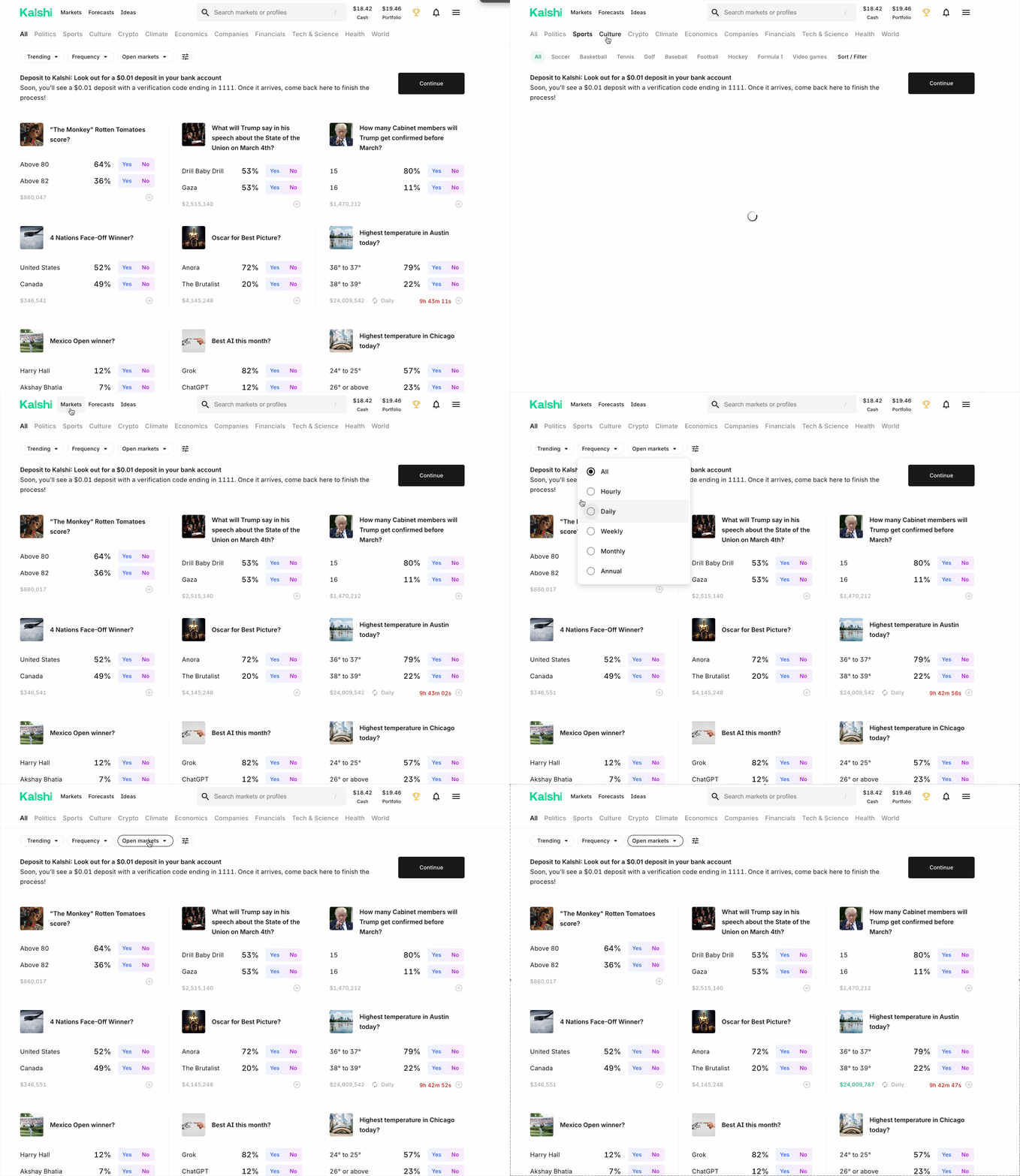
Here’s a quick tutorial using Kalshi as the example.
How to read sports contract prices
Event contracts trade between $0.01 and $0.99. The price represents the market’s implied probability that the outcome occurs. A $0.65 contract means the market estimates a 65% chance of that outcome.
How payouts work
Every contract settles at either $1.00 (outcome happens) or $0.00 (outcome doesn’t happen). Your profit or loss is the difference between your purchase price and the settlement price.
Example: Seahawks are Yes contract trading at $0.58. You buy 100 contracts for $58. If the Seahawks win, you receive $100 (profit of $42). If they lose, you receive $0 (loss of $58).

Converting implied probability to American odds
If you’re used to sportsbook odds, this table shows the equivalent in implied probability which is what you will see at Kalshi:
| Contract price | Implied probability | American odds | Potential profit per $1 |
|---|---|---|---|
| $0.10 | 10% | +900 | $9.00 |
| $0.20 | 20% | +400 | $4.00 |
| $0.33 | 33% | +200 | $2.00 |
| $0.50 | 50% | +100 / -100 | $1.00 |
| $0.67 | 67% | -200 | $0.50 |
| $0.80 | 80% | -400 | $0.25 |
| $0.90 | 90% | -900 | $0.11 |
The spread (how Kalshi and Polymarket make money)
On a sportsbook, vig is built into the odds (-110 on both sides instead of +100). On prediction markets, the equivalent is the spread between Yes and No prices.
Example: Chiefs to win. Yes trading at $0.52. No trading at $0.50. The $0.02 gap is the spread. If you buy Yes at $0.52 and immediately sell at $0.50, you lose $0.02 per contract. Tighter spreads mean more efficient markets.
Platform fees are separate from the spread. Kalshi charges a variable fee based on contract price (highest near $0.50, lowest near $0.01 or $0.99). Polymarket currently charges zero trading fees on its US platform for sports contracts.
Types of sports event contracts
Available markets vary by platform. Kalshi and Polymarket offer the widest selection and highest liquidity. DraftKings, Fanatics, and FanDuel launched with more limited offerings.
Liquidity guide: High = tight spreads, easy to enter/exit large positions. Medium = tradeable but wider spreads. Low = thin order books, harder to execute.
NFL, also called Pro Football
The NFL generates the most volume across all prediction market apps. Super Bowl markets alone have exceeded $10M in trading volume across the top two apps.
| Market | Kalshi | Polymarket | DraftKings | Liquidity |
|---|---|---|---|---|
| Super Bowl winner | Yes | Yes | Yes | High |
| Conference champions | Yes | Yes | Yes | High |
| Game winners | Yes | Yes | Yes | High |
| Division winners | Yes | Yes | Limited | Medium |
| Playoff bracket | Yes | Limited | Limited | Medium |
| MVP | Yes | Yes | No | Medium |
| Player props | Limited | No | No | Low |
NBA, Pro Basketball
The NBA has strong game-by-game volume, particularly on Polymarket where individual games routinely see $1M+ in trading.
| Market | Kalshi | Polymarket | DraftKings | Liquidity |
|---|---|---|---|---|
| NBA Champion | Yes | Yes | Yes | High |
| Conference finals | Yes | Yes | Yes | High |
| Game winners | Yes | Yes | Yes | High |
| MVP | Yes | Yes | No | Medium |
| Playoff series | Yes | Limited | Limited | Medium |
NHL / Ice Hockey
This has significantly lower volume than the NFL or NBA markets, but Polymarket offers more game-by-game coverage than all other apps. The NHL became the first major US league to sign licensing deals with prediction markets (Kalshi and Polymarket) in October 2025.
| Market | Kalshi | Polymarket | DraftKings | Liquidity |
|---|---|---|---|---|
| Stanley Cup winner | Yes | Yes | Yes | Medium |
| Conference finals | Yes | Yes | Limited | Medium |
| Game winners | Limited | Yes | Limited | Medium |
College sports
College football playoff and March Madness drive significant seasonal volume. Bowl games and tournament matchups are available on Kalshi. Limited access so far on DraftKings or FanDuel, which is expected at this stage.
| Market | Kalshi | Polymarket | DraftKings | Liquidity |
|---|---|---|---|---|
| CFP National Champion | Yes | Yes | Limited | High |
| March Madness winner | Yes | Yes | Limited | High |
| Bowl games | Yes | Limited | No | Medium |
| Tournament games | Yes | Yes | No | Medium |
Soccer/Football
Polymarket leads soccer coverage due to its global user base, while Kalshi focuses on major tournaments. Domestic league matches are primarily available on Polymarket though you can find a handful on Kalshi. We expect all North American apps to offer World Cup contracts.
| Market | Kalshi | Polymarket | DraftKings | Liquidity |
|---|---|---|---|---|
| World Cup winner | Yes | Yes | No | High |
| Champions League | Limited | Yes | No | Medium |
| Premier League | No | Yes | No | Medium |
| Match winners | No | Yes | No | Low-Medium |
Other sports
Kalshi offers the widest variety beyond major leagues, including golf majors, UFC/MMA, tennis Grand Slams, MLB, eSports and even darts. Coverage on other platforms is limited.
| Market | Kalshi | Polymarket | DraftKings | Liquidity |
|---|---|---|---|---|
| Golf majors | Yes | Limited | No | Medium |
| UFC/MMA | Yes | Limited | No | Medium |
| Tennis Grand Slams | Yes | Limited | No | Low-Medium |
| MLB | Yes | Limited | Yes | Medium |
Other market categories: Politics – Crypto – Mentions – Elections
FAQ
Prediction markets pay $1.00 per winning contract, not your stake plus winnings like sportsbooks. If you buy 100 contracts at $0.65 ($65 total), you get $100 back when you win. Your profit is $35, not $65. This is the most common complaint from new users who expect sportsbook-style payouts.
Yes, but they’re harder to find. Kalshi emphasizes “Will Team X win?” contracts on the main interface. Spreads and totals exist but take extra clicks to find. Polymarket displays them more prominently. If you want the full sportsbook prop menu, prediction markets are still catching up.
Other people, but not always traders like you. Kalshi uses institutional market makers like Susquehanna to fill orders when there’s no one on the other side. Kalshi also has its own trading arm. So while it’s technically peer-to-peer, you could be trading against firms that profit from the spread.
No, not on Kalshi or Polymarket. It’s not known with DraftKings or FanDuel plan to do. Unlike sportsbooks, prediction markets don’t limit winning accounts. Since the platform makes money from fees regardless of who wins, they have no incentive to ban sharp bettors. This is a major draw for professional bettors who’ve been limited elsewhere.
Settlement depends on each contract’s specific rules. These are posted below the odds. It is important that you read them before trading. Postponed games typically settle when played.
Big events (Super Bowl, NFL playoffs, NBA Finals) have tight spreads and fill quickly. Smaller markets, like mid-season NHL games, college basketball, soccer often have wide spreads and low volume, making it hard to enter or exit at fair prices. Always check liquidity before placing large positions.