Markets Aren’t Buying AOC‑Backed Rabb Surge in PA-03 Democratic House Primary
Prediction markets favor state Sen. Sharif Street in Philadelphia's open-seat Democratic primary over AOC-backed Chris Rabb and poll leader Ala Stanford.
Pennsylvania’s 3rd Congressional District Democratic primary isn’t just a local House race anymore. It’s turned into the hottest early test of the party’s 2028 fault lines.
Alexandria Octasio-Cortez is openly championing progressive Rep. Chris Rabb while Gov. Josh Shapiro maneuvers behind the scenes to boost state Sen. Sharif Street and block what Axios calls an “AOC‑backed progressive takeover.”
Prediction markets aren’t buying the progressive surge, or polls where state Rep. Ala Stanford leads. The markets, by contrast, are handing Street a clear edge with odds around 60% in the May 19 primary and turning this deep‑blue Philadelphia House contest into a masterclass in how the establishment machine still crushes the far-left when it matters.
Behind the Pennsylvania House race
What started as a routine open seat left by retiring Rep. Dwight Evans has become a national story. Shapiro, a rising moderate star with 2028 presidential race ambitions, is quietly advising labor unions to stay away from Rabb. Ocasio-Cortez, meanwhile, has thrown her weight behind Rabb as a progressive, framing it as a fight against the party’s establishment.
Shapiro isn’t just neutral. He’s actively working to derail Rabb through backchannel pressure on labor allies and signaling support for Street, the son of former Philly Mayor John Street and current state Democratic chair. Rabb, a term‑limited assemblyman with a vocal record on criminal justice and climate, has Ocasio-Cortez’s explicit backing and progressive cash flowing in.
Stanford rounds out the top tier, but prediction markets are treating the race between Street vs. Rabb as the establishment vs. insurgency test.
Philadelphia primaries live and die on turnout and machine muscle, and Street has both. Rabb has the viral energy and out‑of‑town progressive dollars, spending more than $1 million in ads already, but lacks the precinct captains who actually deliver votes on Election Day. Stanford’s been on TV for months and leads in polling, despite little backing by traders.
Polls show undecided chaos in PA-03 primary
The Public Policy Polling captures the mess:
- Stanford sits at 28%
- Rabb has odds of 23%
- Street comes in at 16%
- Another 33% don’t know
Philly’s Democratic electorate isn’t a monolith. Progressives pack North Philly and parts of Center City, but Street’s base in the Black church and unions spans the city.
That undecided bloc is where the Shapiro factor looms largest. If labor stays neutral or quietly nudges toward Street, Rabb’s path narrows fast. Ocasio-Cortez’s star power mobilizes the left, but it doesn’t always tune out the moderates who quietly decide these races.
Prediction markets aren’t buying Pennsylvania House polls
Prediction markets cut through the noise with ruthless efficiency. Polymarket’s PA‑03 Democratic Primary Winner contract gives Street 57% odds on $44K volume, with Rabb trailing at 37% and Stanford in the distance at 4%.
Kalshi’s PA-03 Democratic nominee market pushes Street even higher at 60%, with Rabb at 40% and Stanford at 4.6% on $120K in volume.
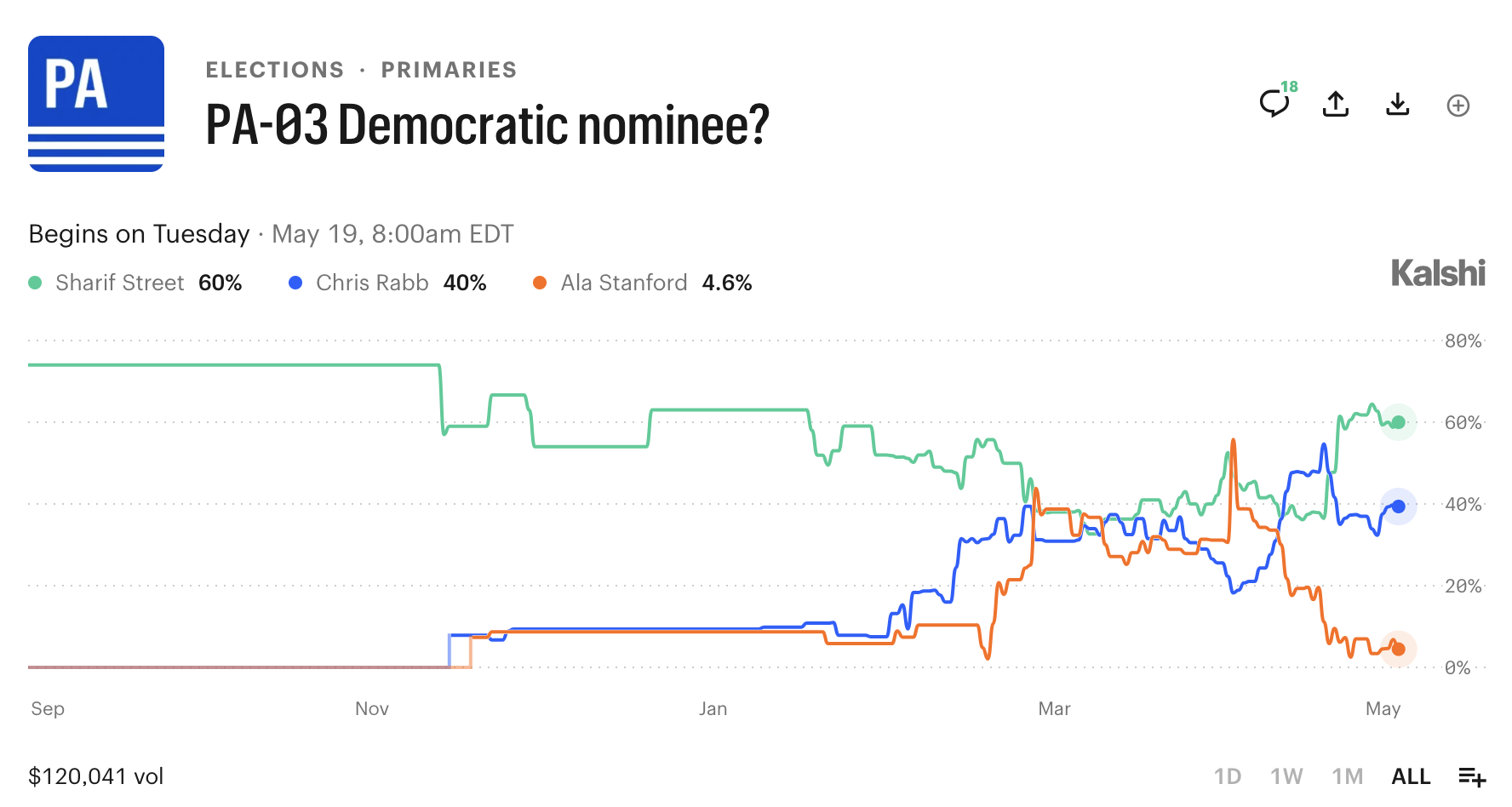
PA-03 Democratic primary odds at Kalshi as of May 13
Traders aren’t swayed by Ocasio-Cortez’s backing or progressive ad buys. They’re betting on the Philadelphia machine, the same one that’s delivered for Street’s family and allies for decades. Volume is building, and the line hasn’t budged much despite the national headlines and polling numbers.
Pennsylvania House prediction markets story
Pennsylvania’s 3rd is not about national tides or Trump backlash. Rather, it’s a hyper‑local fight where party infrastructure meets ideological purity tests. The markets are calling it for the establishment machine every time.
Street isn’t the flashy national story, but he’s got local politicians, the unions, and Shapiro’s invisible hand. Rabb has Ocasio-Cortez and viral moments, but not enough to overcome the math.
The real tell for prediction markets will be those undecided voters. If they break progressive, Rabb has a shot to force a messy runoff scenario. But at up to 60%, the money’s betting the establishment closes the deal for Street.
The Shapiro vs. Ocasio-Cortez influence battle, and several other Democratic midterm election primaries, could showcase how progressive the left is in 2028.
 Sixth Circuit Rules Against Kalshi, Lets Ohio and Tennessee Enforce Sports Betting Laws
 New York Sues Polymarket US Over Sports, Election and Culture Contracts
 Kalshi Traders Trim Jackson’s Edge After Poll Puts Collins Back in Front in Maine
 Kalshi Promo Code Rate: $25 Bonus for Falcons vs. Packers Thursday Night Football