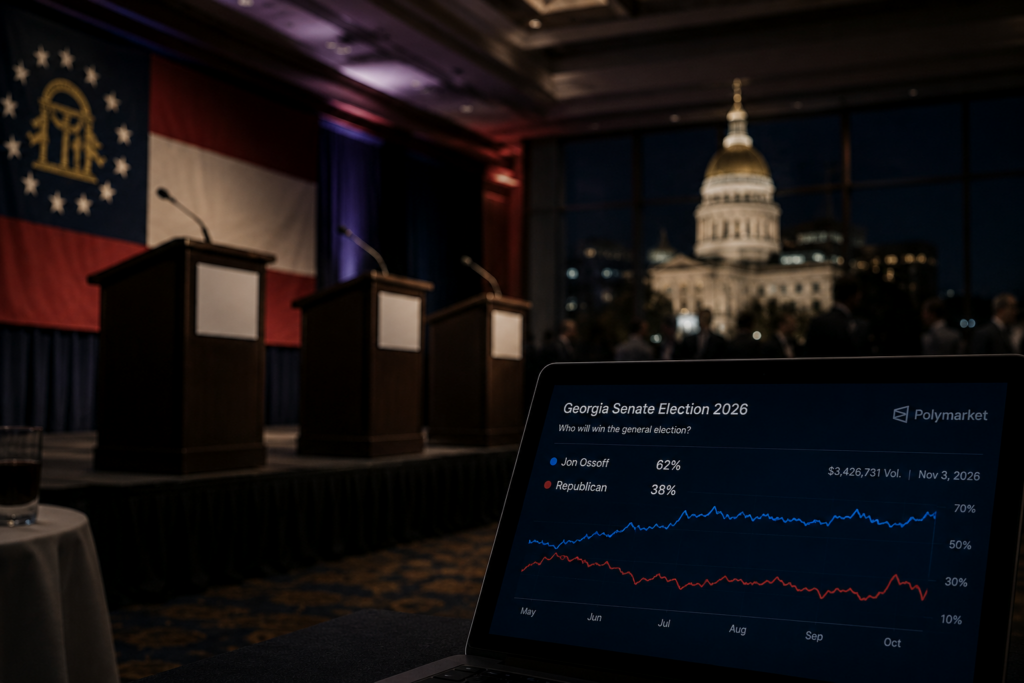







Georgia is back at the center of the 2026 Senate map, and prediction markets are fairly quiet on the races so far.
Democrat Jon Ossoff’s 2021 runoff win gave Democrats control of the Senate, and now his seat is one of the GOP’s clearest pickup chances. But the Republican primary and the general election markets are drawing less trading volume than other key races like Maine and Texas on prediction market exchanges Kalshi and Polymarket.
Mike Collins, Buddy Carter and Derek Dooley are pushing toward the March 19 Republican primary to run against Ossoff in November. If no candidate reaches at least 50% of the vote, a runoff will be held June 16.
Why Georgia Senate GOP primary matters
Georgia has spent the last decade behaving like a true swing state, moving from deep‑red reliability to one of the country’s most competitive battlegrounds. Ossoff’s runoff win over Republican David Perdue in January 2021, alongside Raphael Warnock’s 2020 special election victory against Kelly Loeffler, handed Democrats Senate control for the first time in years and proved Georgia could decide the balance of power in Washington.
Those Senate race wins coincided with Joe Biden becoming the first Democratic presidential candidate to pick up Georgia since 1992, helping him defeat President Donald Trump in 2020. Trump, however, flipped the state again in 2024.
That turbulent history over the previous six years is why the 2026 race matters. Democrats are defending a seat that is politically exposed but still very winnable, while Republicans see Georgia as one of their best opportunities to help flip a Democratic seat.
Trump has not endorsed a candidate in the race.
The Kalshi Georgia Senate GOP primary market
On the Republican side, the field is still unsettled but already showing a hierarchy in primary election odds.
Emerson College Polling shows Collins leading the GOP primary field, with Carter and former Tennessee football coach Dooley chasing him. Despite the broad field, Collins is up to 83% chance to take the nomination in the market with trading volume over $123K. Dooley and Carter trail but are neck-and-neck, trading at 9% (11¢) and 10% (9¢), respectively.
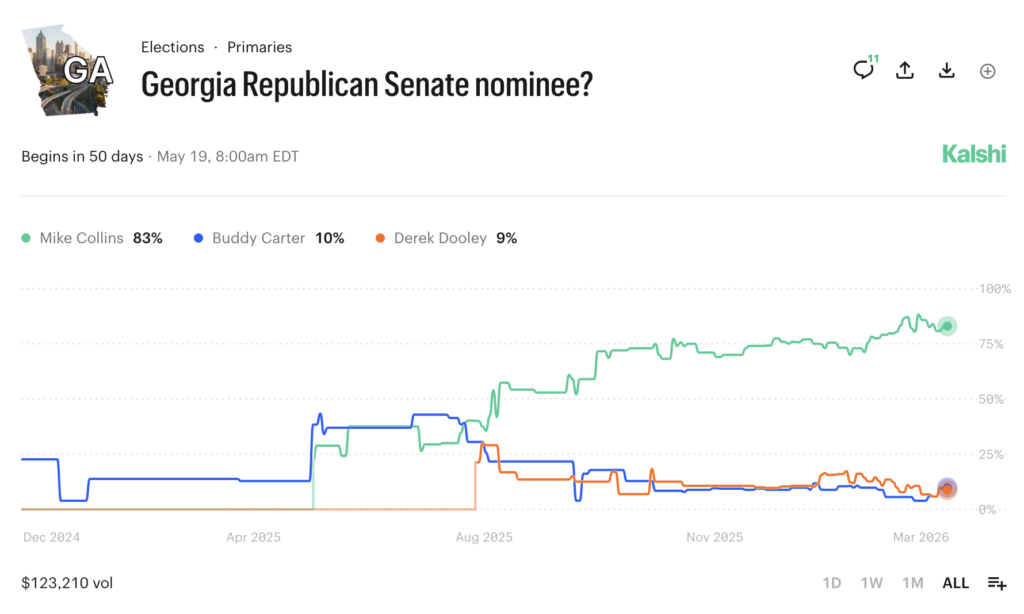
And ultimately, the lack of GOP primary action could correlate to the lack of Republican optimism for the general election. In the overall Georgia Senate market, with volume just over $170K, Democrats are trending at 83% to retain the seat.
Polymarket drawing more Georgia interest
Polymarket is drawing a touch more volume than Kalshi, with the GOP Senate primary market trading at just under $500,000. Traders are still staking heavily in Collins, who’s pacing the field at 79%.
Polymarket’s Georgia Senate Election winner market is just as lopsided as Kalshi’s. It currently prices Democrats at 82% and Republicans at 19%, but with just over $18K in total trading volume.
Early polling backs that up. Emerson’s March poll had Ossoff ahead of Buddy Carter 47% to 44% and Mike Collins 48% to 43%. The race is competitive, but it is not yet reading like a true toss‑up.
Overall Georgia market outlook
For now, the crystal ball on Georgia Senate is not that the race is flipping, but that it will stay in the Democratic column while the GOP primary decides just how competitive the November election will look.
With Georgia’s turbulent decade as a swing state and the tight national map, this race will stay one of the central pressure points where the broader “Who controls the Senate?” trade rubs against a very specific, state‑level prediction‑market story.