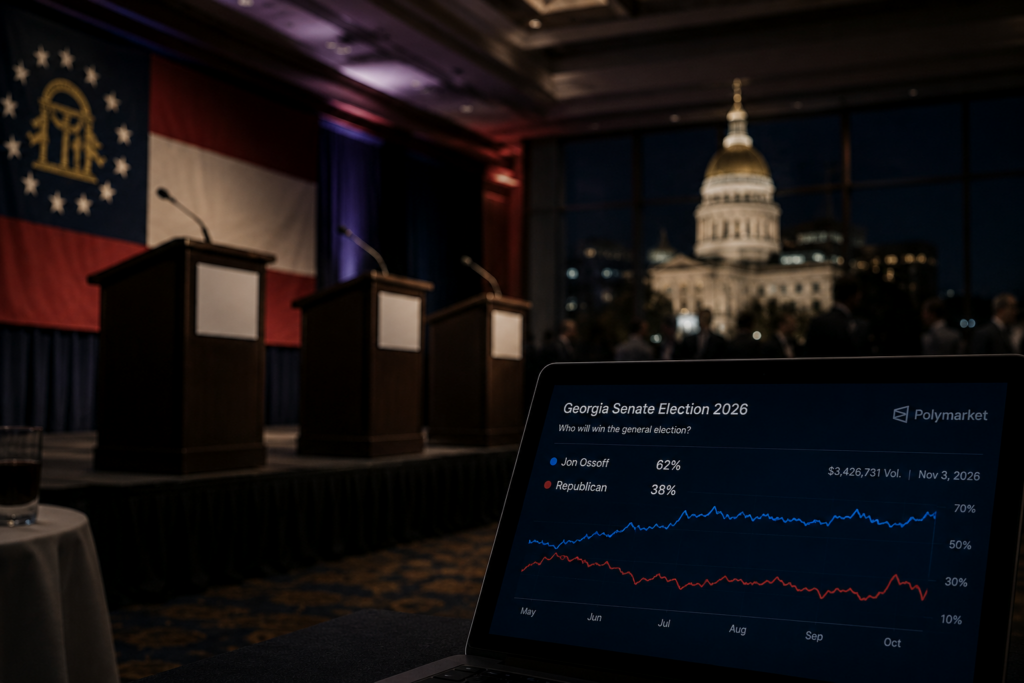






The Georgia governor primaries are looking less like coin flips and more like a split-screen race on prediction markets. Traders on Kalshi and Polymarket are strongly favoring former Atlanta Mayor Keisha Lance Bottoms on the Democratic side and businessman Rick Jackson on the Republican side in the Georgia election odds. The race is to replace outgoing Republican Gov. Brian Kemp.
Bottoms holds strong leads in polls as well, but they show a much tighter race on the Republican side. Georgians head to the polls for the Georgia Governor primaries on May 16. There is also a crucial Republican Senate primary for a race that could help decide which party secures the Senate in November.
What the markets are saying in Georgia Governer primaries
Polymarket’s Georgia primary board currently has Bottoms at 86% in the Democratic primary and Jackson at 59% in the Republican primary, which is a pretty clean market read that both parties’ frontrunners are in control. There is a combined $600K in volume on the two Polymarket contracts.
Kalshi is broadly aligned, with its Georgia governor nominee markets also heavily pointing toward Bottoms on the Democratic side and Jackson on the Republican side. The contracts have over $500K in notional trading volume.
That’s a meaningful signal because these are not just abstract labels. Traders are betting that Bottoms’ advantages in name recognition, endorsements and field consolidation outweigh the undecided voters still showing up in polls. On the GOP side, Jackson’s position in both Kalshi and Polymarket suggests the market has already accepted him as the most likely nominee even though the field remains fluid.
The polling picture is still more loose
The New York Times polling tracker shows a more conventional battleground picture, with Democrats holding an edge in the general election frame but still facing a meaningful amount of uncertainty as the primaries approach. Polls are in concurrence with the markets on the Democratic side, where Bottoms has held a greater than 30-point edge for more than a month.
The broader public polling environment has also shown that Georgia voters are not fully locked in yet on the Republican side. There are three competitive candidates, meaning name recognition and consolidation still matter a lot as the race comes to a close.
That’s why the markets feel firmer than the polls. The polling average can show a competitive race, but it still leaves space for late movement and undecided voters. The markets are already assigning a high probability to the candidates they think are most likely to survive the primary and shape the general.
Why Bottoms is the market favorite
Bottoms’ odds reflect a combination of campaign dynamics and plain old political gravity. She has emerged as the Democratic frontrunner in both market and polling data, with traders clearly treating her as the party’s strongest nomination bet.
Polymarket’s general election board also underscores that point. Democrats are trading around 67% to win the governor’s race overall, which suggests traders think Georgia’s swing state environment gives Democrats a real shot if Bottoms gets through the primary cleanly. Kalshi’s gubernatorial winner market similarly implies a Democratic lean, reinforcing the same broad market thesis.
However, fragmentation is exactly where prediction markets tend to differentiate more quickly than polls. If a candidate like Jackson can keep consolidating on the Republican side, the market will usually move before the polls fully reflect it.