
Mention & Speech Markets: Odds, Sites and How They Resolve
Compare live mention market odds across Kalshi and Polymarket for NFL broadcasts, earnings calls, political speeches, and FOMC press conferences
Mention markets let you trade event contracts on whether a specific word or phrase gets said during a live event. You buy Yes or No on a term like “inflation” during an FOMC press conference, “safety” during an NFL broadcast, or “headwinds” during an earnings call. If the word hits, Yes contracts pay $1. If it doesn’t, No pays $1. Prices between $0.01 and $0.99 reflect the market’s implied probability that the word will be said during the event.
Below we list which prediction market platforms currently offer mention markets, the event types you can trade on, and how their resolution rules differ. We also break down how mention markets actually resolve—which matters more in this category than any other—and where traders are finding edge.
Top sites with mention markets
Featured mentions markets
Traffic through the Strait of Hormuz? (4/6 – 4/12)
Quinn vs Merida
Alcaraz vs Sinner
Boston vs St. Louis
Top Mention Markets
| Platform | Mention categories | Resolution source | Parlays | Best for |
|---|---|---|---|---|
| Kalshi | NFL, earnings, political, FOMC, weekly | Official transcript / named media | Yes | Largest catalog, clear rulebooks |
| OG | NFL, sports, political, entertainment | CDNA exchange rules | Yes | Wide selection, margin trading coming |
| Polymarket | NFL, political, social media, viral | UMA oracle / broadcast audio | No | Broader resolution scope, viral markets |
| Robinhood | Kalshi markets via partnership | Same as Kalshi | Yes | Existing Robinhood users |
| Coinbase | Limited mention markets | Varies by contract | No | Crypto-native traders |
What are mention markets?
Mention markets—sometimes called “what someone says” markets—are a subcategory of prediction markets where the contract resolves based on whether a specific word or phrase is spoken during a defined event window. The concept is straightforward: someone picks a term, someone picks a speaker, and the market prices the likelihood that word comes out of their mouth.
What separates mention markets from other event contracts is the resolution source. In an election market, the outcome is certified by official results. In a mention market, the outcome depends on an official transcript, a broadcast recording, or a list of approved media outlets—and the fine print determines everything.
A word you clearly heard on a live broadcast might not count if the transcript omits it or the approved source didn’t cover the event. For a primer on how event contracts settle in general, see our learning hub.
Mention markets are available on Kalshi and Polymarket across five main event types: NFL and sports broadcasts, corporate earnings calls, political speeches and rallies, FOMC press conferences, and social media activity from public figures. Kalshi runs the largest catalog, particularly for sports and earnings. Polymarket leans toward social media and viral-driven markets with broader resolution criteria.
The category has grown fast. Kalshi debuted mention market parlays in November 2025, and by the Super Bowl in February 2026, individual games were drawing multi-million-dollar volume on what announcers might say.
| Market | Event type | Status |
|---|---|---|
| What will Trump say this week? | Political / weekly | Weekly on Kalshi / Polymarket |
| Super Bowl mention markets | NFL / annual | Settled — Super Bowl LX resolved Feb. 2026 |
| More markets coming | Earnings, FOMC, NFL 2026 season | Check back as new events are listed |
Mention markets have also generated the most heated disputes of any prediction market category—and the resolution controversies keep coming.
Types of mention markets
NFL and sports broadcast mentions
This is where the volume lives. Kalshi offered announcer mention markets for 64 NFL games during the 2025-26 season, listing around 130 different strike terms across those markets. The terms ranged from near-certainties like “safety” (which announcers said in every featured game but one) to deep cuts like “Ditka” and “doink.”
Per-game volume grew dramatically as the season progressed. Early-season games attracted less than $500K in total mention market trading. By the conference championships, that figure had climbed to $3.55M per game. Super Bowl LX between the Seahawks and Patriots featured 34 terms on Kalshi and 27 on Polymarket.
Platform resolution rules split the pricing here. Kalshi’s NFL mention markets resolve based solely on what the designated play-by-play and color commentators say during game coverage. For Super Bowl LX, only Mike Tirico and Cris Collinsworth counted.
Polymarket resolves if anyone on the broadcast says the term—players, coaches, sideline reporters, or audio picked up by field mics. That wider net is why identical terms often price higher on Polymarket. To see how this played out over the NFL season, see the analysis we shared with ESPN.
Earnings call mentions
Earnings call mention markets let you trade on whether a CEO or CFO uses a specific term during a quarterly call. Kalshi’s catalog covers major companies including Tesla, Apple, Nvidia, Reddit, Chipotle, and Rocket Lab. Resolution is typically tied to the official investor relations transcript published within 24 hours of the call.
These markets appeal to traders who already follow corporate earnings closely. If you know a CEO has a verbal tic—a favorite buzzword or a phrase they lean on every quarter—that pattern is tradable information. The rules often pre-define whether root words count: does “inflationary” qualify for a market on “inflation”? Does “headwinds” cover “headwind”? The answer is in the rules, and it varies by contract.
Earnings mention markets gained notoriety in November 2025 when Coinbase CEO Brian Armstrong deliberately read off a list of mention market terms during the company’s Q3 call. He rattled off words like “Bitcoin,” “Ethereum,” “Blockchain,” “Staking,” and “Web3” that were being actively traded on Kalshi and Polymarket. Roughly $84,000 was riding on those contracts.
Armstrong later joked about it on X, but the incident exposed how one person can move mention markets when they know the terms in play.
Political speech and rally mentions
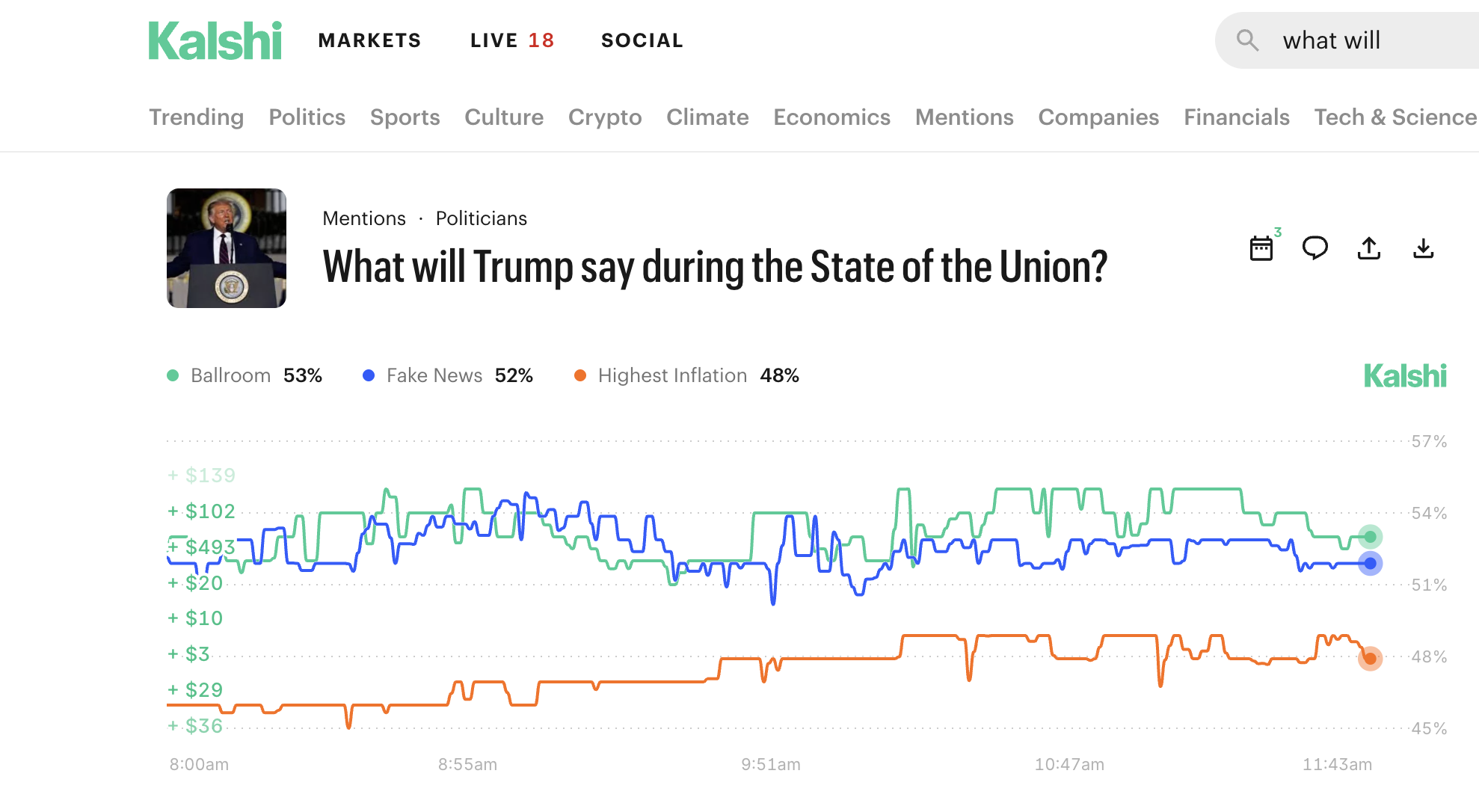
Political betting covers presidential addresses, rally speeches, press briefings, and congressional testimonies. Terms tend to track the news cycle—a Trump mention market might include “Greenland,” “tariffs,” or “TDS” depending on the week’s headlines. Kalshi refreshes its weekly Trump mention markets regularly, and both platforms list one-off markets tied to specific events like State of the Union addresses or Bernie Sanders rally stops.
These are the most controversial subcategory. In December 2025, someone affiliated with Kalshi’s ecosystem attended a Trump rally and shouted mention market words during the speech. Dustin Gouker covered the incident in The Event Horizon, noting the problematic optics even though less than $1 million was traded on the event.
More recently, Kalshi’s resolution of a Bernie Sanders rally in Greensboro, North Carolina, on February 12, 2026, ignited a firestorm. The market asked whether Sanders would say terms like “Trump,” “Billionaire,” “Working Class,” and “Elon / Musk” during the rally. Odds on Yes hovered around 90% for most terms, and the market attracted $3.6 million in volume.
Sanders did say those words—multiple videos from attendees confirm it. But the rally was a closed event at the Carolina Theatre, and Sanders reportedly barred mainstream press. Kalshi’s rules specified resolution based on coverage from approved outlets: The New York Times, AP, Reuters, Bloomberg, CNN, and several others. None of those outlets covered the rally. Kalshi resolved every contract as No.
Reddit’s r/Kalshi subreddit and Trustpilot reviews erupted. Users described the resolution as fraudulent. One Trustpilot reviewer wrote that they bet on five words—”billionaire, working class, middle class, trump and immigrant”—that Sanders said on video, and Kalshi graded them all No. Another called the handling “at best careless and at worst fraudulent” and argued the market should have been voided.
Kalshi has since adjusted its contract language for future mention markets, but the damage to trader trust is measurable—and it underscores why resolution rules are the single most important detail in this category.
FOMC press conference mentions
Fed Chair press conferences after FOMC meetings generate their own mention market category. Kalshi lists contracts on whether terms like “inflation,” “recession,” “soft landing,” or “labor market” appear in the official FOMC transcript. These markets attract finance-oriented traders who already dissect every word of Fed communication for signals.
The appeal is that Fed language follows patterns. The committee tends to use consistent phrasing across meetings, adjusting specific words when the policy outlook shifts. A trader who reads the last three FOMC transcripts can make a reasonably informed assessment of whether “disinflation” is likely to appear again. The official transcript is the sole resolution source, and Kalshi pre-defines whether variants count. For live odds on the next Fed decision, see our dedicated tracker.
Social media and creator mentions
Polymarket runs mention markets tied to the social media output of public figures—whether Elon Musk will tweet “Doge” in a given week, or what a streamer will say during a live broadcast. These are the fastest-paced and most speculative mention markets, with thinner liquidity and rapid price swings.
This subcategory is still emerging. The broader prediction market ecosystem sees creator-driven markets as a growth area, with startups building platforms specifically for betting on what content creators will say or do. But for now, social media mention markets remain niche and carry higher manipulation risk than any other type—the subject of the bet often controls the outcome entirely.
Where to trade mention markets
Two platforms currently offer mention markets in meaningful volume. How each one handles resolution affects pricing and which events are available.
Kalshi
Kalshi is a CFTC-regulated designated contract market and runs the largest mention market catalog by event count. The platform covers NFL broadcasts, corporate earnings calls, political speeches, FOMC press conferences, and recurring weekly markets like “What will Trump say this week?”
Kalshi’s main advantage for mention markets is rulebook specificity. Each contract defines the exact phrase, who must say it, which resolution source applies, and whether word variants count. The platform ties resolution to official transcripts or coverage from named media outlets rather than live broadcast audio. That distinction matters: what you hear on TV is irrelevant if the transcript records it differently or if the approved source didn’t cover the event.
Kalshi introduced mention market parlays (combos) in November 2025, allowing traders to bundle multiple terms into a single position. A three-leg NFL parlay might combine “late hit,” “pylon,” and “turf” from the same game. Combos offer higher potential payouts but require all legs to hit.
The platform is available in most U.S. states. Mention markets carry no maker or taker fees on political contracts, with fees on other categories varying by market.
Polymarket
Polymarket received CFTC approval in November 2025 and is rolling out U.S. access through FCMs and brokerages. The platform’s mention markets tend to be more viral and faster-moving, with a focus on social media, celebrity-driven events, and broader broadcast resolution criteria.
What matters for mention markets: Polymarket typically resolves based on whether anyone says the term during a broadcast, not just the designated announcers. That wider scope creates pricing gaps between the two platforms on identical terms. During Super Bowl LX, “Mahomes” traded at 68.5% on Kalshi (announcers only) and 79.5% on Polymarket (anyone on broadcast)—an 11-point spread driven entirely by resolution rules, not disagreement about probability.
Polymarket uses UMA’s decentralized oracle for resolution, where tokenholders vote on disputed outcomes. This process has produced disputes on other market types and introduces a layer of subjectivity that Kalshi’s internal resolution avoids. Deposits require USDC, and the platform charges no trading fees directly—spreads go to liquidity providers.
OG
OG is Crypto.com’s standalone prediction markets platform, launched in February 2026 and powered by the CFTC-regulated CDNA exchange. The app carries a wide selection of mention markets across sports and entertainment, with parlays available.
OG operates in 49 states plus Washington, D.C. (New York excluded). Fees are $0.02 per contract to open and $0.02 to close early—winning trades held to settlement have the close fee waived. Margin trading has been announced but is pending CFTC certification.
Robinhood
Robinhood offers mention markets through its partnership with Kalshi, routing trades directly through Kalshi’s exchange. Pricing, resolution rules, and the order book are identical to trading on Kalshi directly.
The main advantage is convenience if you already have a Robinhood account—no separate signup required. The tradeoff is that Robinhood adds its own fee on top of Kalshi’s, and the app doesn’t show order book depth or volume data on individual markets.
Coinbase
Coinbase launched prediction markets in January 2026 across all 50 states. The platform lists a smaller selection of mention markets compared to Kalshi and Polymarket, though the catalog is expanding.
Coinbase routes through its own infrastructure after acquiring The Clearing Company in December 2025. For crypto-native traders who already hold USDC on Coinbase, the onboarding friction is minimal. For a full breakdown of fees, features, and platform differences across all operators, see our best prediction market apps comparison.
When comparing odds across platforms, the resolution rules are as important as the numbers. A 10-point pricing gap on the same term doesn’t necessarily mean one platform is mispriced—it may mean the platforms are answering different questions. Use our arbitrage calculator to find cross-platform pricing gaps.
How mention markets resolve
Resolution is where mention markets get complicated, and it’s where traders lose money they didn’t expect to lose. Every mention market contract specifies four things. Answer these before you trade.
1. What exact phrase qualifies?
Some contracts require a letter-for-letter match. Others count root words and variants. If the target word is “border,” does “borders” count? If the target is “ICE,” does “ice water” trigger it? Kalshi often pre-defines this in the rules. Polymarket tends to leave more room for interpretation. Never assume—read the contract.
2. Who must say it?
“Commentators” is different from “anyone on broadcast.” An NFL mention market scoped to announcers won’t resolve Yes if a sideline reporter says the term. A political mention market might be scoped to the speaker at the podium, excluding audience members or journalists asking questions. The Sanders rally controversy was partly a “who” problem—attendees captured audio, but the contract required verification from specific media outlets that weren’t present.
3. Where must it appear?
Spoken audio, closed captions, official transcript, or on-screen graphics—the contract specifies which channel counts. Most Kalshi mention markets resolve based on the final published transcript, not the live broadcast. Transcripts are cleaned up. Stutters, false starts, and garbled audio get removed. If the speaker said the word but the transcriber didn’t catch it or cleaned it out, the contract may resolve No.
4. What is the source of truth?
This is the question that cost traders millions on the Sanders rally. Kalshi’s rules for that market specified resolution based on coverage from a named list of major outlets. When none of those outlets covered the event, Kalshi couldn’t verify the mentions through approved channels—even though video evidence existed from attendees. Every contract resolved No.
The Coinbase incident raised a different problem. Armstrong didn’t break any rules by saying the words on his own earnings call. He wasn’t an insider trader in the traditional sense—he didn’t place bets. But he directly controlled the outcome of active contracts. The CFTC framework says event contracts “readily susceptible to manipulation” shouldn’t be listed. Whether mention markets meet that threshold is an open question regulators haven’t fully addressed.
Recent resolution controversies
| Event | Date | What happened | Impact |
|---|---|---|---|
| Coinbase earnings call | Nov 2025 | CEO Armstrong deliberately read mention market terms during the call | ~$84K in trades affected; raised manipulation concerns industrywide |
| Trump rally attendee | Dec 2025 | Person with Kalshi affiliation shouted mention market terms at rally | Under $1M traded; drew scrutiny from The Event Horizon |
| Sanders Greensboro rally | Feb 2026 | All contracts resolved No despite video evidence of Sanders using the words | $3.6M volume; Reddit/Trustpilot backlash; Kalshi revised contract language |
Mention market strategy
If you want to trade mention markets with intent rather than impulse, there are concrete research steps that separate informed positioning from guessing.
Read past transcripts
This is the highest-value research you can do. For any recurring event—FOMC press conferences, a specific company’s quarterly earnings, weekly Trump remarks—past transcripts are publicly available and reveal patterns. Does the Fed Chair say “inflation” at every press conference? If so, a Yes price of 90¢ is probably justified. Did a CEO use “headwinds” for three straight quarters and then drop it? That shift in language is a tradable signal about how the company views its own trajectory.
Cole Sprouse, a 25-year-old business intelligence analyst and statistics major profiled by ESPN, took this approach to NFL mention markets systematically. He found publicly available announcer transcripts going back decades, wrote code to calculate how frequently specific words appeared, and used those frequencies to estimate probabilities for upcoming games.
Sprouse came to prediction markets from daily fantasy sports consulting, and his background in coding and data analysis gave him a framework most casual traders don’t have. That kind of data work consistently outperforms intuition.
Analyze the narrative
Ask why a speaker would or wouldn’t use a word. A politician pivoting away from an issue will actively avoid certain terms. A CEO who dropped a buzzword last quarter probably did it intentionally. Sports broadcasters build narratives around players with compelling story arcs—Sam Darnold’s path from his lowest moment to the Super Bowl was an arc NBC was always going to reference, which is why markets connected to his name priced high.
The flow of the game matters too. A blowout means more filler commentary and deeper background stories. A close game keeps announcer focus tight on the action. Weather delays, injuries, and momentum shifts all influence which words get airtime and which fade into the background.
Price vs. probability
High-probability mention markets (90%+) offer thin returns. You’re paying 90¢ to win $1—a 10¢ profit on a position that still carries risk if the transcript is cleaned up or the announcer just doesn’t get around to it. The most interesting trading opportunities sit in the 30-60% range, where the market hasn’t fully priced in the likelihood and the potential payout justifies the exposure.
The trap is assuming that an obvious storyline means an automatic Yes. When something becomes common knowledge—everyone expects the announcer to say “Lombardi” during the Super Bowl—the market bakes that in immediately. The edge isn’t finding the hottest narrative. It’s identifying cases where the current price doesn’t match the actual probability, and that usually requires research the casual trader hasn’t done.
Live trading dynamics
Most mention market volume lands during the live event, not in the days leading up to it. We’ve seen NFL mention markets sit at $18K a week before a game and spike to $1.3M on game day. Liquidity peaks once the event is underway, and prices move fast as terms are spoken or time runs out. Understanding how order books work helps here—watching where resting orders stack up can signal which side the sharp money favors before a term is spoken.
This speed creates both opportunity and risk. Traders watching the broadcast live who can react quickly to a mention—or a near-miss—before the market adjusts have a measurable edge. But the pace also triggers impulsive decisions. Mention markets are among the most addictive prediction market categories, and the cycle of rapid wins and losses during a live event keeps traders engaged beyond what their original strategy intended.
Manipulation and integrity
Mention markets have a structural vulnerability that other prediction market categories don’t share: the person being bet on can control the outcome. This isn’t theoretical. It has happened multiple times in the past year.
Brian Armstrong deliberately said every mention market term during Coinbase’s November 2025 earnings call. Someone attended a December 2025 Trump rally wearing Kalshi ecosystem branding and shouted mention market terms. In both cases, traders on the wrong side lost money because a participant decided to influence the result.
The CFTC’s regulatory framework states that event contracts should not be “readily susceptible to manipulation.” Whether mention markets clear that threshold is actively debated. Kalshi and Polymarket both restrict insiders from trading on their own events, but neither platform can prevent a CEO from saying a word they know is being actively traded—or a rally attendee from trying to trigger contracts.
The NFL raised this issue directly in congressional testimony in December 2025, pointing to mention market terms like “concussion protocol,” “late hit,” and “roughing the passer” as examples of contracts that could create integrity concerns around sports broadcasts. The league argued that prediction markets lack the state-level regulatory framework that governs licensed sportsbooks. The Coalition for Prediction Markets, which represents Kalshi and other operators, disputed that characterization.
For traders, the practical implication is clear: manipulation risk is concentrated in events where the speaker is aware of active mention markets. Earnings calls carry the highest risk because executives can see the terms in real time. NFL broadcasts are lower risk because announcers generally aren’t monitoring prediction markets during a game. Political events fall somewhere in between, depending on how prominent the markets are in the news cycle that week.
Where mention markets fit
Despite the attention they generate, mention markets remain a small fraction of overall prediction market volume—less than 1% of Kalshi’s trailing 30-day activity, according to Gouker’s analysis. Sports outcomes, elections, and economic indicators drive the majority of trading.
But the category punches above its weight in engagement. Mention markets are the prediction market type most likely to go viral, draw media coverage, and bring first-time users to a platform. Kalshi’s Super Bowl mention markets attracted coverage from ESPN, NPR, and Front Office Sports. The Sanders rally controversy played out across Reddit, Trustpilot, and industry newsletters within hours.
For traders already active in other prediction market categories, mention markets expose how platforms diverge on resolution criteria, manipulation guardrails, and pricing efficiency more clearly than anything else on offer. The same term priced differently on two platforms tells you something about how each exchange works, and that’s information worth having whether you trade mention markets or not.
FAQ
What are mention markets in prediction markets?
Mention markets are event contracts that resolve based on whether a specific word or phrase is spoken during a defined event—an NFL broadcast, earnings call, political speech, or press conference. You buy Yes or No contracts priced between $0.01 and $0.99, and the correct side pays $1 at settlement.
Where can I trade mention markets?
Kalshi, OG, Polymarket, Robinhood, and Coinbase all offer mention markets. Kalshi has the largest catalog across NFL, earnings, political, and FOMC events. OG carries a wide selection across sports and entertainment. Polymarket focuses more on social media, viral events, and broadcasts with broader resolution scope. Robinhood routes through Kalshi’s exchange with identical pricing. Coinbase offers a smaller but growing selection.
How do mention markets resolve?
Each contract specifies the exact phrase that qualifies, who must say it, the window in which it must be said, and the source of truth used to verify the outcome. Most Kalshi mention markets resolve based on an official transcript or coverage from named media outlets. Polymarket uses its UMA decentralized oracle. Always read the full resolution criteria before trading.
What happens if the speaker says the word but the transcript doesn’t include it?
If the resolution source is the official transcript and the transcript doesn’t include the term, the contract resolves No—regardless of what you heard on the live broadcast. Transcripts are cleaned versions that remove stutters, false starts, and unclear audio. The resolution source is the only thing that determines the outcome.
Can mention markets be manipulated?
Yes. The subject of the bet can influence or directly control the outcome. Coinbase CEO Brian Armstrong demonstrated this in November 2025 by deliberately reading mention market terms during an earnings call. Rally attendees have shouted terms to trigger contracts. There are no clear rules preventing a speaker from saying a word they know is being actively traded.
Does the plural or variant of a word count?
It depends on the contract rules. Some markets specify that root words and common variants count (e.g., “inflationary” counts for “inflation”). Others require exact phrasing. Kalshi typically pre-defines this in the contract. Never assume a variant qualifies—check the rules for the specific market you’re trading.
Are mention markets legal?
Yes. Mention markets on Kalshi are offered through a CFTC-regulated designated contract market and are available in most U.S. states. Polymarket received CFTC approval in November 2025. Both platforms operate as financial exchanges under federal jurisdiction, not state gaming law. Some states have active regulatory disputes with prediction market platforms over specific market types.
Why do Kalshi and Polymarket show different prices for the same mention term?
Usually because the resolution criteria differ. Kalshi’s NFL mention markets resolve based only on what the designated announcers say. Polymarket often resolves based on anyone on the broadcast. More voices mean more chances for a mention, which pushes Yes prices higher on Polymarket. The price gap reflects different questions being answered, not different assessments of the same question.
How much volume do mention markets generate?
NFL announcer mention markets generated over $47 million in total volume during the 2025-26 season across 64 games. Individual event volume varies widely—a regular-season NFL game might draw $500K while the Super Bowl attracts several million. Overall, mention markets account for less than 1% of total prediction market volume but generate outsized media attention and user engagement.
What’s the best strategy for mention markets?
Research past transcripts for recurring events. Calculate word frequency from historical data if you can code or use spreadsheets. Analyze the narrative context around a speaker using or avoiding a word right now? Focus on mid-range probability markets (30-60%) where the risk/reward is balanced. And read the resolution rules before you trade. Always.