Kalshi Hits $1B on Winner Market as Prediction Apps Continue to Gain Daily Active Users During World Cup
Apptopia data shows prediction market apps continued adding users later in the World Cup, while Kalshi’s tournament winner market topped $1 billion in trading volume.
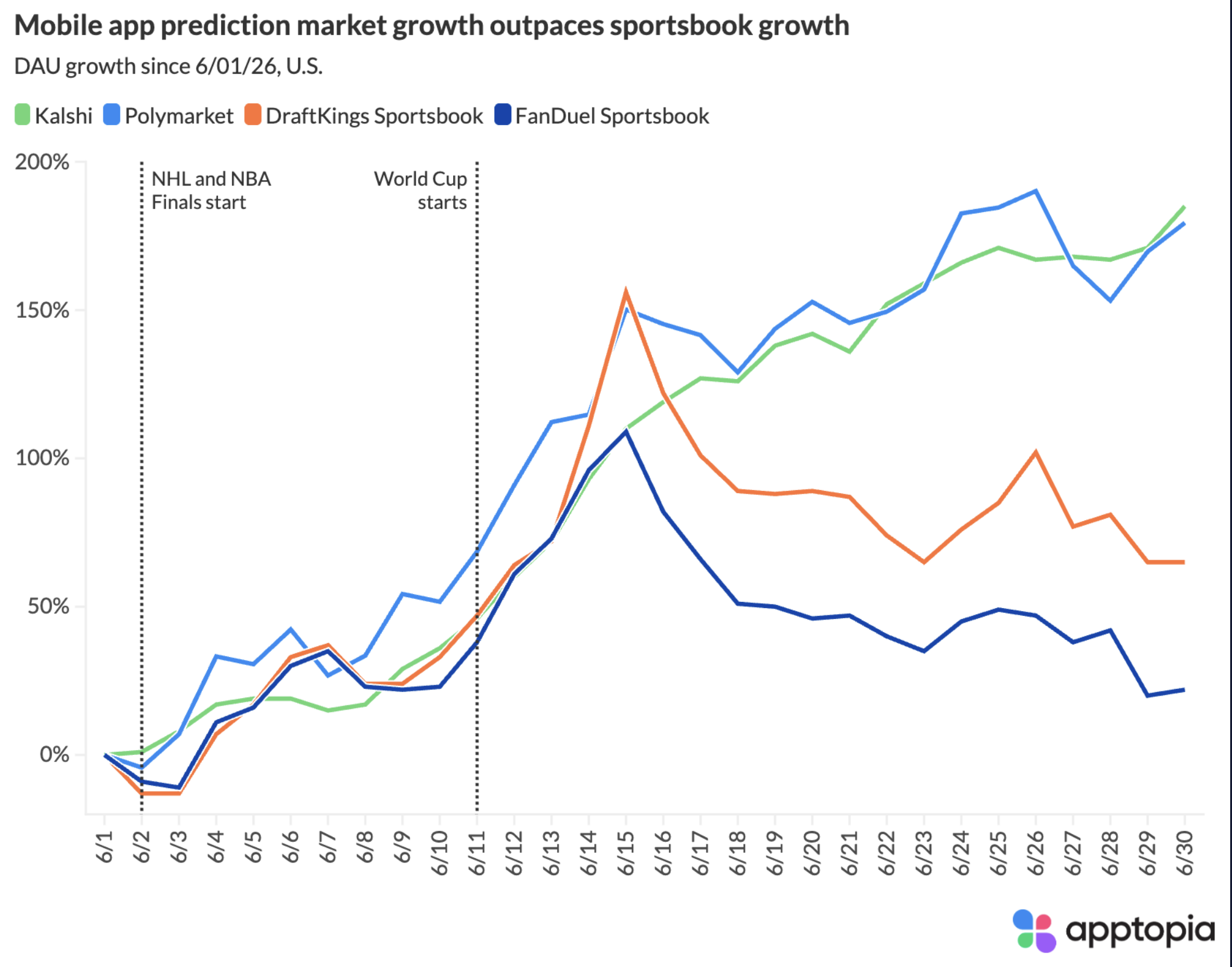
Kalshi and Polymarket continued gaining daily active users later in the World Cup after traditional sportsbook apps peaked early in the tournament, according to new mobile app data from Apptopia.
The report comes as Kalshi’s FIFA World Cup winner market topped $1 billion in trading volume, giving the prediction market platform a major milestone during one of the biggest sports events on the calendar.
Apptopia, a mobile app analytics firm that tracks downloads and app engagement, found that DraftKings, FanDuel, BetMGM and Caesars all hit their June daily active user highs on June 15, four days into the World Cup. Each sportsbook app then declined by month-end, while Kalshi and Polymarket continued adding daily users.
“The sportsbooks got a sharp, early spike,” Apptopia’s Adam Blacker wrote. “The prediction markets got a build.”
Kalshi, Polymarket gained active users after sportsbooks peaked
Apptopia’s July 6 report looked at app activity across DraftKings, FanDuel, BetMGM, Caesars, Kalshi and Polymarket, comparing downloads, daily active users, usage intensity, demographics and cross-app overlap during June.
Source: Apptopia
By June 30, Kalshi’s daily active users were 36% above their June 15 level, while Polymarket’s were 12% higher. DraftKings fell 36% from its June 15 peak by June 30, FanDuel fell 41%, and BetMGM and Caesars each declined 32%.
Among the six apps Apptopia studied, total daily users were nearly four times higher than last June, mostly thanks to surging World Cup interest. Kalshi accounted for 38% of that combined June 2026 audience, while Polymarket accounted for 13%. Last June, the two prediction market apps together accounted for only about 6% of the combined audience.
The install data pointed in the same direction. Apptopia’s earlier World Cup tracking found Kalshi and Polymarket accounted for nearly three-quarters of betting app downloads during the tournament’s opening stretch. In the July 6 report, the two prediction market apps accounted for 78.5% of June installs across the six-app group.
Sportsbook users increasingly opened Kalshi
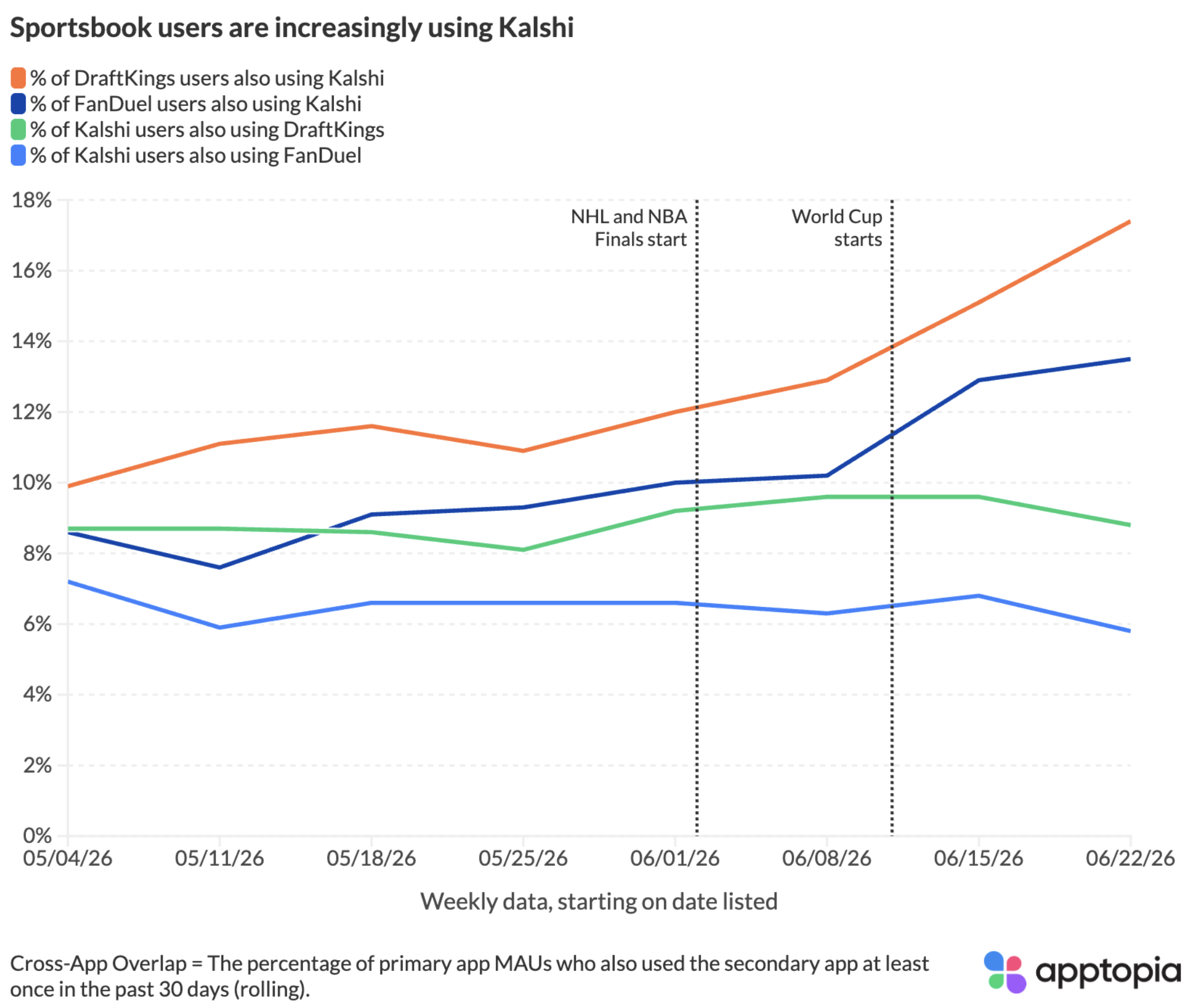
Apptopia’s cross-app data showed sportsbook users increasingly sampled Kalshi during the World Cup, while the share of Kalshi users opening sportsbook apps declined.
The share of DraftKings users who also opened Kalshi rose from 12% on June 1 to 17.4% by June 22, according to Apptopia. FanDuel-to-Kalshi overlap rose 35% over the same stretch.
Source: Apptopia
The reverse flow moved in the opposite direction. Apptopia found that the share of Kalshi users opening DraftKings or FanDuel declined during the same period.
“Sportsbook customers are sampling the prediction markets while prediction-market customers are staying put,” Blacker wrote.
The one-way traffic challenged an earlier theory that prediction market apps could serve as feeder platforms for novice bettors who eventually move to more traditional sportsbook products. Instead, Apptopia said the June data showed sportsbook users increasingly using Kalshi, though it remains unclear whether that pattern will last beyond the World Cup.
Women were Kalshi’s fastest-growing user group
Apptopia said Kalshi’s World Cup growth also stood out because of which user groups were growing fastest. During the tournament, Kalshi’s weekly active users grew across every age bracket, led by users 46 and older, according to Apptopia.
The report also found that Kalshi’s female users grew 106%, more than twice the 54% growth rate among male users.
Kalshi’s latest weekly active user base was 33.3% female, compared with 22% to 23% for DraftKings and FanDuel, according to the report.
“DraftKings can own the most engaged bettor in the country and still be losing the argument for the next one, because the demographic Kalshi is adding doesn’t look like the base the sportsbooks spent a decade acquiring,” Tom Grant, vice president of research at Apptopia, said in the report.
France leads Kalshi’s World Cup winner market after $1B milestone
After topping $1 billion in trading volume, Kalshi’s winner market on Monday had France leading the platform’s World Cup odds at 33.1%, followed by Argentina at 17.9%, England at 14.1% and Spain at 12.6%.
The market has shifted as the knockout stage has narrowed the field. France has strengthened its position after advancing past Sweden and Paraguay without allowing a goal, while England has gained ground during the tournament, especially after its big win against Mexico on Sunday.
Spain, meanwhile, entered the tournament as one of the more heavily favored teams on Kalshi but has slipped behind France and Argentina in the winner market. England’s rise has also pushed it closer to Spain, turning the top of the market into a tighter group behind France.
That gives Kalshi a high-volume benchmark for how traders are pricing the rest of the World Cup, even as the broader app data shows prediction market platforms gaining traction beyond a single contract.
World Cup delivers for sportsbooks and prediction markets
The World Cup has created a near-ideal customer acquisition moment for U.S. sportsbooks and prediction market platforms alike. The tournament is being played in the U.S., Canada, and Mexico, placing matches largely within normal viewing windows for American users, while the U.S. men’s national team remains alive in the knockout stage, adding another domestic hook.
For sportsbooks, that has meant major betting interest around one of the biggest sports events of the year. For prediction market platforms, the tournament has offered a different kind of test: whether global soccer interest can turn into app downloads, repeat usage and sustained trading activity.
Kalshi broke its monthly volume record again in June, posting more than $33 billion in notional trading volume, according to data from Dune Analytics. The World Cup helped drive that record month, with Kalshi’s winner market topping $1 billion as the tournament moved deeper into the knockout stage.
That makes the World Cup more than a short-term traffic bump for prediction markets. It has become a customer acquisition test for Kalshi, Polymarket and other platforms trying to turn sports interest into repeat trading behavior once the tournament ends.
 Becerra Refunds Prediction Markets Donations While Leading California Governor Odds
 Polymarket Promo Code Rate: $25 Bonus for Falcons vs. Saints MNF
 NFL Week 5 Odds: Latest Prices from Kalshi and Polymarket
 Kalshi promo code RATE: Score a $25 Bonus for Lions vs. Panthers SNF