
California Governor Odds 2026: Becerra vs. Hilton
California's June 2 top-two primary is certified: Democrat Xavier Becerra finished first with 28.0% of the vote and Republican Steve Hilton finished second with 24.6%. They advance to the November 3 general election. Xavier Becerra now leads the winner market at 95.9%, ahead of Steve Hilton at 4.1%. DeFi Rate aggregates current pricing from Kalshi, Polymarket Global, Polymarket US and Gemini Predictions; venue-level activity is shown separately because the platforms report volume on different bases.
Top prediction apps to trade on the California governor race

Trade $10, Get $25
T&C’s apply.

Deposit $10 get a $50 trading bonus
Risk Disclaimer
CA Governor odds: Xavier Becerra is the current favorite to win over Steve Hilton
Current probabilities across platforms with liquidity indicators
XBXavier Becerra
Vol —
Spread 0.9%
Agg
95.9%↑ +0.7%
K
95.9%
P
95.9%
U
95.0%
SHSteve Hilton
Vol —
Spread 1.9%
Agg
4.1%↓ -0.1%
U
6.0%
K
4.2%
P
4.1%
APAlex Padilla
Vol $3.2K
Spread —
Agg
0.1%— +0.0%
P
0.1%
AVAntonio Villaraigosa
Vol $4.0K
Spread —
Agg
0.1%— +0.0%
P
0.1%
BYBette Yee
Vol $0
Spread —
Agg
0.1%— +0.0%
P
0.1%
BWButch Ware
Vol $1.0K
Spread —
Agg
0.1%— +0.0%
P
0.1%
CBChad Bianco
Vol $7.4K
Spread —
Agg
0.1%— +0.0%
P
0.1%
DMDaniel Mercuri
Vol $12
Spread —
Agg
0.1%— +0.0%
P
0.1%
EKEleni Kounalakis
Vol $1
Spread —
Agg
0.1%— +0.0%
P
0.1%
ESEric Swalwell
Vol $9
Spread —
Agg
0.1%— +0.0%
P
0.1%
KHKamala Harris
Vol $201
Spread —
Agg
0.1%— +0.0%
P
0.1%
KPKatie Porter
Vol $1.1K
Spread —
Agg
0.1%— +0.0%
P
0.1%
KLKyle Langford
Vol $6
Spread —
Agg
0.1%— +0.0%
P
0.1%
LZLeo Zacky
Vol $6
Spread —
Agg
0.1%— +0.0%
P
0.1%
MMMatt Mahan
Vol $11.0K
Spread —
Agg
0.1%— +0.0%
P
0.1%
MYMichael Younger
Vol $18
Spread —
Agg
0.1%— +0.0%
P
0.1%
NSNicole Shanahan
Vol $18
Spread —
Agg
0.1%— +0.0%
P
0.1%
RCRick Caruso
Vol $3.0K
Spread —
Agg
0.1%— +0.0%
P
0.1%
SCStephen Cloobeck
Vol $1.0K
Spread —
Agg
0.1%— +0.0%
P
0.1%
TSTom Steyer
Vol $21.6K
Spread —
Agg
0.1%↓ -0.1%
P
0.1%
TAToni Atkins
Vol $12
Spread —
Agg
0.1%— +0.0%
P
0.1%
TTTony Thurmond
Vol $94
Spread —
Agg
0.1%— +0.0%
P
0.1%
CAChé Ahn
Vol $0
Spread —
Agg
0.0%—
K
0.0%
EAEthan Agarwal
Vol $0
Spread —
Agg
0.0%—
K
0.0%
RBRob Bonta
Vol $0
Spread —
Agg
0.0%—
K
0.0%
Probability Over Time
Hover for details · Cursor-synced tooltips
Tap "Chart settings" to adjust the chart.
Chart settings
California’s June 2 top-two primary is certified. Democrat Xavier Becerra finished first with 2,591,857 votes (28.0%), Republican Steve Hilton finished second with 2,277,318 (24.6%), and Democrat Tom Steyer finished third with 2,110,707 (22.8%). Becerra and Hilton advanced to the November 3 general election to succeed Gov. Gavin Newsom. See California’s certified Statement of Vote.
The live tracker above is now focused on the general-election winner market. DeFi Rate aggregates pricing from first-party exchange data; because venue volume measures are not always calculated on the same basis, use the venue-level figures rather than treating them as one combined editorial total.
California governor general election: Becerra vs. Hilton
Xavier Becerra (D) is the former US secretary of health and human services and a former California attorney general. He finished first in the certified primary with 2,591,857 votes (28.0%) and entered the general election as the clear prediction-market favorite.
Steve Hilton (R) is a former policy adviser and television host. He finished second with 2,277,318 votes (24.6%), securing the Republican spot on the November ballot. His market price remains well behind Becerra’s, but the live odds above will continue to respond to polling, endorsements, fundraising and campaign developments.
Tom Steyer (D) finished third with 2,110,707 votes (22.8%) and did not advance.
California general election markets
The June 2 primary determined California’s November matchups. Certified top-two pairings referenced on this page include:
- Governor: Xavier Becerra (D) vs. Steve Hilton (R)
- Lieutenant governor: Fiona Ma (D) vs. Gloria Romero (R)
- CA-04: Mike Thompson (D) vs. Eric Jones (D)
- CA-08: John Garamendi (D) vs. Rudy Recile (R)
- CA-11: Scott Wiener (D) vs. Connie Chan (D)
- CA-13: Adam Gray (D) vs. Kevin Lincoln (R)
- CA-17: Ro Khanna (D) vs. Ritesh Tandon (R)
- CA-22: David Valadao (R) vs. Randy Villegas (D)
- CA-40: Ken Calvert (R) vs. Young Kim (R)
See the California Secretary of State’s certified lieutenant governor results and US House results. Exchange inventory changes as venues list, close or settle individual markets, so check each contract’s question, deadline and resolution rules before trading.
Related markets
- 2028 Presidential Election Odds — Track the broader field for the next presidential election.
- 2028 Democratic Presidential Nominee Odds — Follow the Democratic nomination market.
- 2028 Republican Presidential Nominee Odds — Follow the Republican nomination market.
- California Wealth Tax Odds — Track the separate California ballot-measure market.
Where to trade California election markets
The DeFi Rate governor feed compares mapped contracts from Kalshi, Polymarket Global, Polymarket US and Gemini Predictions. Platform access and candidate inventory can vary by user and jurisdiction.
- Kalshi lists candidate contracts for the California governor winner market.
- Polymarket Global lists a global California governor election market.
- Polymarket US lists US-market contracts for Becerra and Hilton.
- Gemini Predictions provides additional candidate pricing represented in the DeFi Rate comparison when mapped and available.
For a broader comparison of platforms, funding methods and California availability, see our California prediction markets guide.
How these markets resolve
California governor winner: Candidate contracts resolve according to the rules published by each exchange for the November 3 general election. Traders should read the named resolution source, deadline and any recount or delayed-certification provisions on the specific contract.
Top-two primary advance: These contracts are resolved. A candidate’s Yes contract paid out if that candidate finished in the top two and advanced to November; Becerra and Hilton were the two successful outcomes.
Primary party composition: This market resolved to one Democrat and one Republican based on the two advancing candidates.
Latest news and updates

Texas Senate Race Continues To Trade Like a Toss-Up as Paxton Holds a Thin Kalshi Edge
More than $10.6 million has traded on Kalshi’s Texas Senate market since the race turned competitive in August, while Polymarket traders now narrowly favor Democrat James Talarico. The split-screen comes as Republicans, including Sen. Ted Cruz, Senate Majority Leader John Thune and President Donald Trump, publicly acknowledge that Texas is no longer a race they can take for granted.


Over $106M Has Been Traded on LA’s Mayor Race as Bass Holds a Narrowing Edge
More than $100 million has traded on Kalshi’s Los Angeles mayor market, where Karen Bass remains near 65%.
Challenger Nithya Raman is gaining ground, has just secured the endorsement of the local Democratic Socialists of America chapter, and is running in a city where the general election is less a fight over party than a fight over what kind of Democrat gets to run Los Angeles.
AOC and Ossoff Overtake Newsom in 2028 Democratic Presidential Nominee Prediction Markets as Money Floods In
The 2028 Democratic primary market is becoming a three-way race, but Gavin Newsom is no longer leading it. With $194 million now traded on Kalshi and nearly $1.3 billion on Polymarket, Alexandria Ocasio-Cortez and Jon Ossoff have surged past the California governor, an early sign that traders are pricing a Democratic future less defined by the old establishment and more by the party’s progressive and battleground-state wings.
Prediction Markets Call Trump Candidate Wins In South Carolina and Oklahoma Runoffs, Margins Show His Grip Still Has Limits
Trump-backed Darline Graham Nordone and Mike Mazzei both won Tuesday’s Republican runoffs, validating the markets that continued to price each as the favorite after shaky first-round performances. But Graham’s earlier failure to clear 50% in deep-red South Carolina, and Mazzei’s 0.6-point Oklahoma win after finishing second in the first round, show that Trump’s endorsement remains powerful without making his candidates invincible.

Trump Doubles Down on Mazzei in Oklahoma Governor Runoff After Prediction Markets Missed First Round
Mike Mazzei entered Oklahoma’s GOP governor primary as a near-90% prediction market favorite, only to finish just behind Attorney General Gentner Drummond, forcing a runoff. Trump is now escalating his support for Mazzei ahead of Tuesday’s vote, while Kalshi and Polymarket again put him at 78%, setting up another test of whether markets and a presidential endorsement can overcome a close, unpredictable Republican electorate.
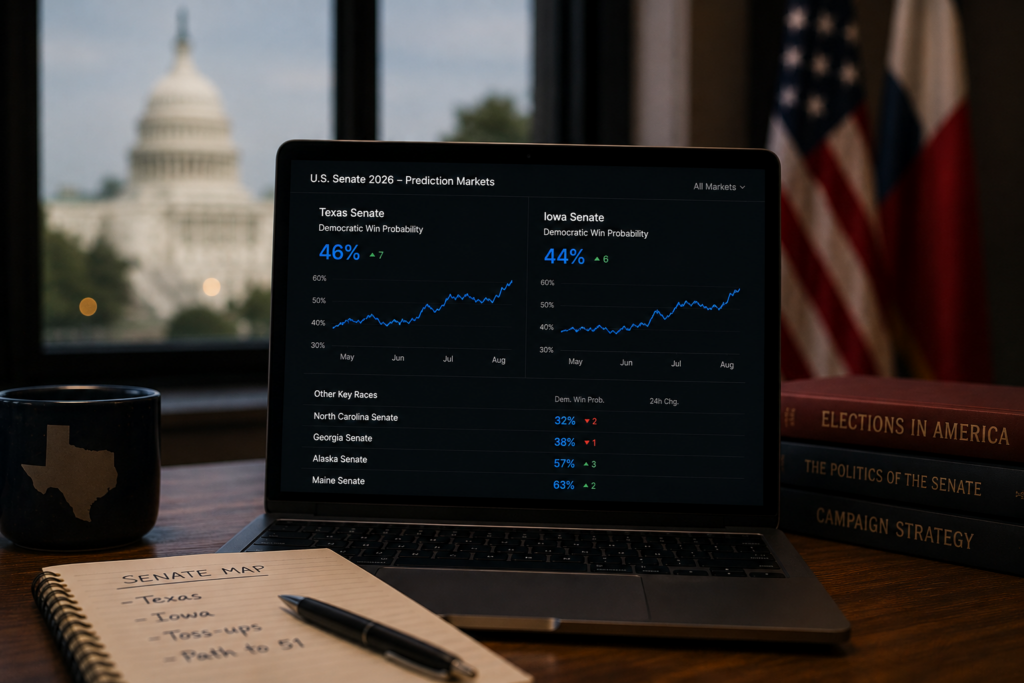
Cook Moves Texas and Iowa Toward Democrats, but Prediction Markets Still See Different November Risks
Cook Political Report just moved the Texas and Iowa Senate races to toss-ups and upgraded the Iowa governor’s race to Lean Democratic, giving Democrats four more favorable ratings in two states that once looked reliably Republican. Prediction markets are reflecting the tighter Senate picture, especially in Texas, where Ken Paxton and James Talarico are neck-and-neck.
Key dates
- June 2, 2026 — California held its top-two primary. Becerra and Hilton advanced, and the primary advance and party-composition markets resolved.
- July 10, 2026 — The California Secretary of State certified the primary Statement of Vote.
- October 5, 2026 — California counties begin mailing vote-by-mail ballots for the general election.
- November 3, 2026 — General Election Day. See the California Secretary of State election page for official deadlines and voting information.
Market integrity and candidate trading
Kalshi previously sanctioned former governor candidate Kyle Langford after he traded on his own race, imposing a five-year trading ban and a $2,000 fine. The case remains a useful reminder that candidates and people with material nonpublic information can face exchange restrictions. Review each venue’s eligibility and prohibited-trading rules before participating.
What the California race could mean for 2028
The next governor will inherit one of the country’s largest state economies and a nationally visible office. The result could affect how both parties discuss California ahead of 2028, but this page’s live pricing is limited to the 2026 governor race. Use the related presidential trackers above for current 2028 probabilities.