


Kalshi and Polymarket captured almost three-quarters of new installs among major sportsbook and prediction market apps in the first half of June, according to new Apptopia data.
The World Cup helped turn a normally quiet stretch for sports betting apps into a major acquisition window for prediction market platforms. The two prediction market apps combined for a 73.5% share of new installs from June 1-15, with Kalshi at 42.3% and Polymarket at 31.2%, according to Apptopia. DraftKings followed at 13.7%, while FanDuel had 8.9%.
“The sportsbooks are defending a base they spent years and a lot of marketing dollars to acquire, and the World Cup is showing up for them as reactivation more than fresh signups,” Tom Grant, Apptopia’s vice president of research, said in the report. “We’ve found Kalshi is mostly pulling in people who never opened a sportsbook account, which is a different and arguably more durable user to acquire.”
Prediction markets push World Cup
The download surge came as prediction market operators leaned heavily into World Cup trading. Kalshi has listed its app as “Kalshi: Trade the Cup” on both Apple’s App Store and Google Play, signed a sponsorship agreement with the Argentine Football Association, and promoted the partnership through a social media campaign featuring superstar Lionel Messi.
Polymarket U.S. also introduced a World Cup trading hub in its app ahead of the tournament as it continues adding users after opening signups more broadly following an initial waitlist period.
The data gives one of the clearest mobile-adoption snapshots yet of how prediction markets are entering the sports betting app race. It also comes during a World Cup push that has shown up in trading activity, with DeFi Rate’s latest volume report finding Kalshi posted a weekly record $6.38 billion in notional volume for the week of June 8, up 43% from the prior week, as World Cup group-stage trading helped drive the platform’s first billion-dollar days.
Prediction market apps lead new installs
“Introducing Kalshi and Polymarket changes things,” Apptopia wrote in the report.
The download-share gap was stark in the comparison from Apptopia, a mobile analytics provider whose download, monthly active user, and time-spent data is available through the Bloomberg Terminal. Kalshi’s 42.3% share of new installs was more than triple DraftKings’ 13.7% share, while Polymarket’s 31.2% was more than three times FanDuel’s 8.9%.
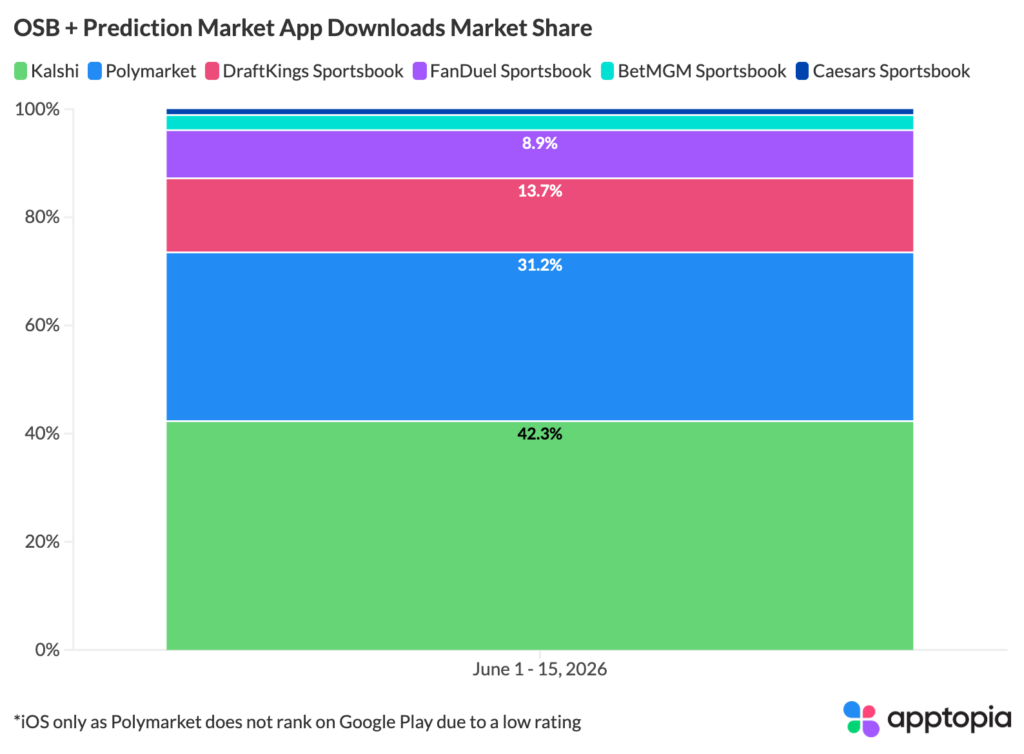
The chart compared selected major online sportsbook and prediction market apps, including:
- Kalshi
- Polymarket
- DraftKings Sportsbook
- FanDuel Sportsbook
- BetMGM Sportsbook
- Caesars Sportsbook
Apptopia said it did not include DraftKings’ and FanDuel’s standalone prediction market apps because those products are relatively small and prediction markets are now features inside the companies’ general sportsbook apps. Because Polymarket does not rank on Google Play due to a low rating, Apptopia based the download-share chart on iOS data. That means the comparison does not capture total U.S. mobile downloads across both major app stores.
World Cup lifts daily active users
The app usage surge began around the opening stretch of the World Cup, which kicked off June 11 in Mexico City. Polymarket hit all-time highs for mobile app daily active users (DAU) on June 13, 14 and 15, according to Apptopia. Kalshi reached its all-time high in mobile DAU on June 14 and 15.
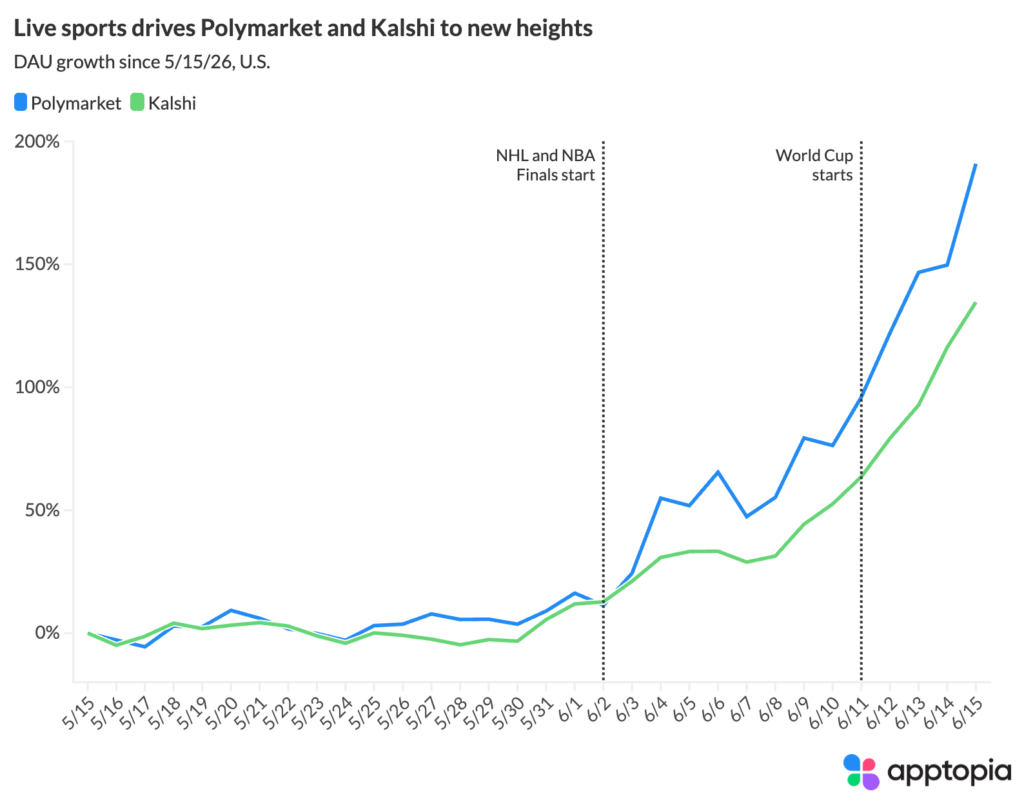
The timing matters because early June is usually a slower window for U.S. sports betting apps. The biggest U.S. betting drivers tend to cluster around football season, March Madness, and other major domestic sports events. By June, the NFL and college football are months away, the NCAA basketball tournament is over, and sportsbooks are usually working with a thinner major-event calendar.
The World Cup changed that seasonal pattern. Apptopia said combined user sessions across sportsbook and prediction market apps rose 35% in the first half of June compared to the same period in 2025. Kalshi and Polymarket went from less than 6% of the group’s combined daily active users last June to roughly 45% this year, showing how quickly prediction market apps have gained ground during major sports events.
Apptopia pointed to the World Cup and a more compelling NBA Finals as the main drivers of the wider lift. But the prediction market gains stand out because Kalshi and Polymarket are newer to sports-focused mobile users, giving the tournament more room to drive first-time app discovery and repeated mobile activity.
Kalshi drew more first-time users
The World Cup brought different types of users to prediction market and sportsbook apps in its opening days. In the first 72 hours after the tournament began, more than half of Kalshi users were new to the app, according to Apptopia. DraftKings and FanDuel, by contrast, saw only about a quarter of their audiences come from first-time app users during the same window.
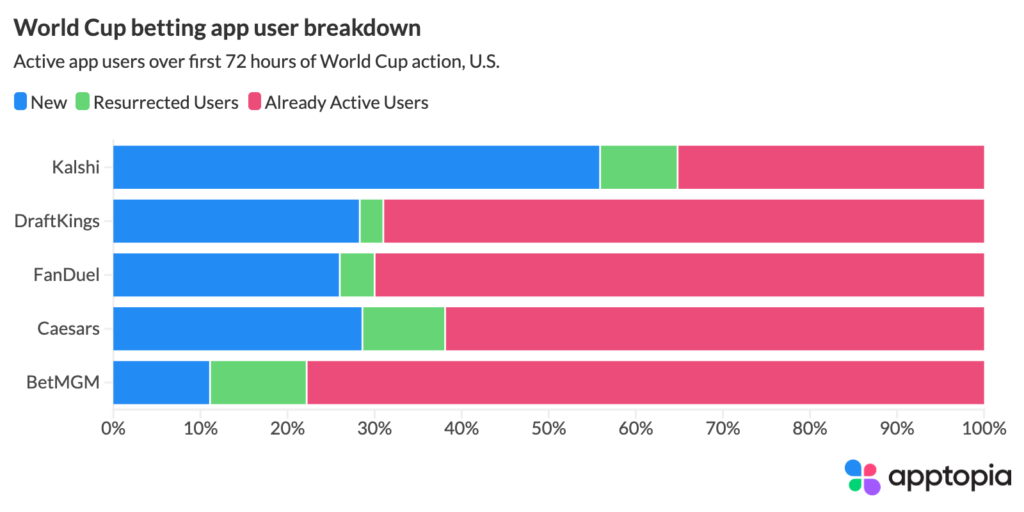
Apptopia defined new users as those who had never had a session before June 11. Resurrected users were users who had been inactive for at least 30 days before returning during the tournament’s first 72 hours. Already active users had used the app within the 30 days leading up to the World Cup.
That split helps explain why the same World Cup surge meant different things across the app category. For DraftKings and FanDuel, the tournament helped reactivate existing sportsbook users around a major global event. For Kalshi, the early user mix suggested the tournament was bringing in people who hadn’t used the app before as the company attempted to introduce sports event contracts to a wider audience.
World Cup surge tests retention
Apptopia’s age data in its latest report points to another reason prediction markets are drawing attention from sportsbook operators. Users ages 18-25 were the fastest-growing segment for Kalshi, DraftKings and FanDuel, according to the report. Kalshi had the highest percentage of users in that youngest bracket, although each app still had its largest share of users in the 46-and-older group. The age comparison is affected by eligibility rules. Kalshi and Polymarket accept users 18 and older, while major sportsbook apps are typically restricted to users 21 and up, giving prediction market apps access to some users in the 18-25 range that sportsbooks cannot serve.
Prediction market apps also have a geographic reach advantage over sportsbooks. Kalshi and Polymarket can accept users in states that have not legalized online sports betting, including California and Texas, the two most populous states in the country.
The World Cup report builds on earlier Apptopia data showing Kalshi’s app momentum around major sports windows. Apptopia reported earlier this year that Kalshi had more than 3 million U.S. downloads in January, as interest in the NFL playoffs and Super Bowl helped push the app past the best monthly download totals of DraftKings and FanDuel. The latest report shows that momentum is extending into the World Cup, this time with Polymarket also taking a large share of new installs among major betting and prediction market apps.
The next question is whether the World Cup surge turns into durable usage after the tournament. For sportsbooks, the event helped reactivate users during a seasonally slow period in the U.S. sports calendar. For Kalshi and Polymarket, the bigger opportunity is converting first-time app users into repeat sports traders as the calendar shifts back toward domestic sports.