



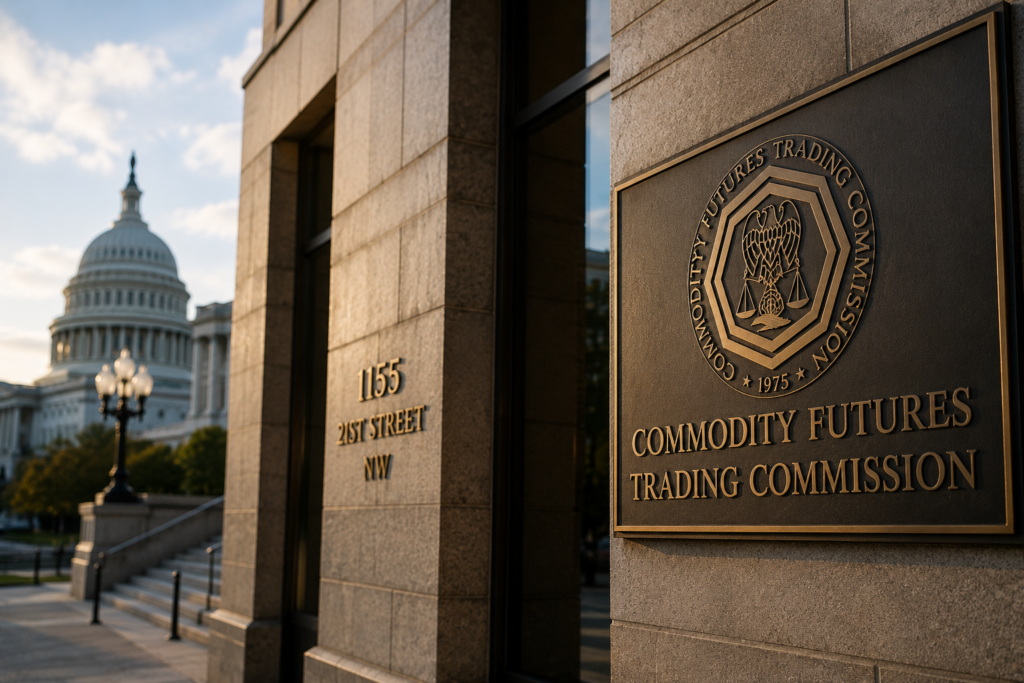




The CFTC today approved the first perpetual futures contract ever listed on a U.S.-regulated exchange, a bitcoin perp on Kalshi, the CFTC-designated contract market that started as a prediction market and is now moving aggressively into derivatives. Three additional releases from the Commodity Futures Trading Commission dropped the same day:
- Policy statement that governs how future perpetual contracts will be reviewed
- No-action letter giving Coinbase a regulated path to offshore perp access
- 24/7 trading advisory that lays out what round-the-clock markets have to look like under CFTC oversight
Together they constitute a policy package that represents the CFTC’s first serious attempt to bring the world’s most traded crypto derivative product under U.S. regulatory jurisdiction.
Noah Zingler-Sternig, Venture Partner at UFO Holdings, explained the significance for both Kalshi and the broader prediction markets category: “Kalshi operates under CFTC jurisdiction, which gives these products a regulatory legitimacy that offshore perp venues have never had. That’s not a small thing. Bringing perps onto a regulated prediction market exchange opens the door to institutional participation that’s been sitting on the sidelines, and that changes the liquidity profile significantly.”
The Commission issued the formal Order for Approval to KalshiEX, LLC for the BTCPERP Contract, “a perpetual contract that references the spot price of bitcoin, as a futures contract” on the morning of May 29. On the same day, Kalshi integrated the product into its platform and launched a waitlist, which has over 12,000 on it as of 1:45 p.m. on May 29. The site also has a “Perps” tab featured prominently in the top navigation and the Crypto section surfaces an “Intro to Perpetual Futures” onboarding banner alongside its existing binary event contracts.



What are perps and how Kalshi’s Bitcoin perpetual futures work
A perpetual futures contract, known as a “perp,” is a derivative that tracks an asset’s price with no expiration date. Unlike a standard futures contract, which settles on a fixed date and requires traders to periodically “roll” into new contracts, a perp stays open indefinitely. What keeps it honest isn’t an expiration date but a funding rate, a periodic payment exchanged between holders of long and short positions based on the gap between the contract’s market price and the spot price of the underlying asset.
That payment creates a self-correcting loop. If the perp is trading above bitcoin’s actual price, longs owe money to shorts, so holding a long position gets more expensive, buyers pull back, and the price drifts down toward spot. If the perp is trading below spot, shorts owe longs, selling pressure eases, and the price climbs back up. The funding rate is always pushing the contract toward the real price, from whichever direction it’s drifted.
“Perpetuals represent a meaningful evolution in how traders access leveraged exposure to assets like Bitcoin without the friction or risk of direct ownership,” Zingler-Sternig told DeFi Rate. “The reality is that most Bitcoin holders aren’t using it as a currency or generating yield through staking; they’re speculating on price. Perpetuals are simply a cleaner, more capital-efficient way to do that.”
Perps are already the dominant crypto derivatives product globally as centralized exchanges processed $86.2 trillion in perpetual futures volume in 2025, up 47% year-over-year. All of it on offshore platforms. Today’s approval creates the first domestic, CFTC-regulated version. Zingler-Sternig provided context for the increasing demand:
“From a pure market structure standpoint, perps are the superior instrument for short-term directional trading. You get leverage without an expiry, tight spreads, and no need to custody the underlying asset. It’s hard to make a compelling case for day-trading spot crypto, equities, or commodities when you can express the same view more efficiently through a perpetual. Over time, I think that dynamic plays out across asset classes.”
The Kalshi BTCPERP tracks bitcoin’s price using the CF Benchmarks Bitcoin Real Time Index (BRTI), a continuously calculated, KPMG-audited index derived from observable transactions across major crypto platforms. The contract trades in units of 1/10,000 of a bitcoin, 24 hours a day, 7 days a week. The order specifies that customer positions and collateral are held in regulated futures accounts at both the FCM (futures commission merchant, the regulated intermediary between traders and the exchange) and the derivatives clearing organization level — protections that don’t exist on offshore platforms.
The Commission’s approval rested heavily on bitcoin’s spot market characteristics. As the order explains: “The bitcoin spot market trades 24/7 across broadly distributed trading venues, which allows for the reference price underlying the BTCPERP Contract to be continuously observable while the contract is trading. This broadly distributed trading and continuous observability protects against settlement payments being calculated against stale or synthesized prices.”
A perp’s funding mechanism only works reliably if the reference price can’t be easily moved, and Bitcoin’s deep, liquid, globally distributed spot market clears that bar. It’s also why the approval is explicitly limited to digital commodities for now.
The policy framework that comes with perps on prediction markets
The Commission also issued a policy statement alongside the Kalshi order making it clear that while the BTCPERP approval applies to Bitcoin and similarly structured digital commodity perps, everything else requires separate Commission review under Reg 40.3 before any exchange can list it. Self-certification, the faster, lighter Reg. 40.2 path that exchanges normally use for new contracts, is explicitly off the table for perps.
The reason is manipulation risk. For a standard cash-settled futures contract, the CFTC evaluates the settlement reference price at one moment in time (expiry). For a perp, the reference price must be reliable continuously. As the policy statement explains it:
“For a perpetual contract, however, the reference must be reliable at every funding interval, without interruption, for as long as the contract remains active.” That’s a higher and ongoing bar, which is why the Commission wants to review each product individually rather than wave them through.
The policy statement also mentions in footnotes which asset classes face the steepest climb. Agricultural perps are described as “particularly ill-suited,” while equity-linked perps “would benefit from review by the Commission and the U.S. Securities and Exchange Commission,” pointing to dual-agency scrutiny, not just CFTC. Gold and other commodities with deep, continuous spot markets are likely next in line, but no timeline is set.
The Coinbase/Deribit no-action letter
Running parallel to the domestic perp approval, the CFTC’s Market Participants Division issued a no-action letter to Coinbase Financial Markets (CFM), a registered FCM and subsidiary of Coinbase Global, which creates a separate, regulated path for U.S. customers to access offshore perps. FM plans to offer U.S. customers access to products listed on Deribit FZE, one of the world’s largest offshore crypto derivatives exchanges, which Coinbase Global acquired last year. The customer order chain runs from CFM to Coinbase Bermuda Limited (CBBM, a Coinbase Global subsidiary) to Deribit, which executes anonymously on a price-time priority basis.
The letter does two things. First, it confirms that Deribit’s perpetual contracts qualify as foreign futures under Commission Regulation 30.1, the legal category that triggers CFTC’s Part 30 customer protection framework, including segregated account requirements and formal acknowledgment letters with depositories. Second, it gives CFM a no-action position to transfer customer-owned digital commodities and stablecoins to CBBM as margin collateral, even where CBBM has a right of re-use (the ability to post those assets onward to Deribit to margin customer positions).
That re-use provision is the notable part. In traditional futures markets, customer margin sits in segregation where the broker can’t touch it. Here, a customer’s bitcoin or USDC can be pledged to a Bermuda entity that has legal rights over it under Dubai and Bermuda law. The CFTC isn’t prohibiting this; it’s permitting it, contingent on nine specific conditions. The most important: CFM, CBBM, and Deribit must all remain wholly-owned subsidiaries of Coinbase Global, a public reporting company subject to SEC disclosure and Sarbanes-Oxley internal controls. That parent-company anchor is what makes the structure work under US regulation. Customers also receive enhanced disclosures and access to Deribit’s audited financials.
The practical result is a regulated wrapper around offshore perp access. U.S. customers who want Deribit exposure can now get it through a registered FCM with CFTC-mandated protections, rather than going around U.S. regulatory infrastructure entirely. That’s a meaningful shift from the current state.
Big day for our US-based traders, and for Coinbase.
— Brian Armstrong (@brian_armstrong) May 29, 2026
Until now, US users have been locked out of ~80% of global crypto markets (perpetual futures and options). But not anymore!
Coinbase is the first and only regulated platform able to connect US users to global crypto options… pic.twitter.com/7EdDUN3Yn6
Kalshi vs. Polymarket: Two regulatory paths to the same product
Both Kalshi and Polymarket announced perps moves in April, weeks before today’s CFTC action, and their different regulatory architectures are shaping what those products can look like and who can access them.
Kalshi is a designated contract market, which requires any new contract to go through the CFTC. The upside is full regulatory legitimacy inside the U.S. including customer protections, segregated margin, exchange-level oversight. The tradeoff is speed and scope. Since every new perp product requires Commission approval, Kalshi is starting with Bitcoin and commodities will come later. The platform’s affiliated FCM, Kinetic Markets, handles the margin infrastructure. U.S. retail traders get a regulated, CFTC-backstopped product and the perp offerings will expand incrementally.
Polymarket’s situation is structurally different. Its primary platform operates internationally, outside U.S. jurisdiction. That explains why, when Polymarket announced perps on April 21 with the tagline “We price the future. Now you can lever it,” it could tease positions on Bitcoin, Nvidia, and gold simultaneously. Polymarket US has DCM approval, but the international platform’s regulatory position for U.S. users trading perps remains unsettled. Polymarket may be able to move faster with expanding perps, but the tradeoff is that those products do not have the same U.S. regulatory oversight and compliance infrastructure as Kalshi now has in place.
One day before Kalshi’s first perps contract approval, Perps beta went live on Polymarket global for select users with plans to roll out to more users over the next four weeks. The divergent paths reflect the two platforms’ different regulatory environments. Unlike Kalshi which is beginning with BTC perps only, Polymarket’s first perp is an equity index product (the S&P 500-USD), an asset class that the CFTC flagged for case-by-case review and potential SEC involvement.
Perps beta is now live on https://t.co/5lywVxdwoA for select users. We’ll be rolling access out to more people over the next 4 weeks. Get ready. pic.twitter.com/dAw8jiwsO3
— Polymarket Traders (@PolymarketTrade) May 28, 2026
The 24/7 trading advisory which also dropped on Friday is relevant to both platforms. Issued jointly by three CFTC divisions, it lays out what continuous markets have to demonstrate operationally including real-time surveillance, margin calibration for multi-day windows without banking access, auto-liquidation disclosures, and staffing coverage at 3 a.m. on Sunday. It’s a detailed expectations document that any DCM running a 24/7 perp is expected to meet.
What perps on prediction markets opens up
With today’s orders, the CFTC has made it clear that digital commodities with deep, liquid, continuously observable spot markets can support perpetual futures on prediction market exchanges under U.S. oversight. Bitcoin is already approved and will launch soon. Ethereum is the obvious next submission with the same infrastructure and similar spot market characteristics. Gold and other broadly traded commodities with 24/7 spot data also have a plausible case. But new perp products will need explicit approval before going live.
For the first time, a federal regulatory agency has codified that perpetual futures belong in U.S. regulated markets. After years of $86 trillion in annual volume flowing offshore, the CFTC has opened a new door, and Kalshi is the first to walk through it.