Kalshi Adds Employment Checks, New Safeguards To Fight Prediction Market Insider Trading
Kalshi says its new safeguards will risk-score contracts, screen some traders before they trade and expand tools for reporting suspicious activity.
Kalshi is adding another layer of market integrity safeguards as prediction markets continue to face questions over insider trading and the use of nonpublic information to place profitable trades.
The federally regulated prediction market exchange said it will begin using a new risk scoring system for markets, collect employment information from some traders before they can participate and expand whistleblower tools for users to report suspicious activity.
The changes, which Kalshi said are effective immediately, come after several high-profile insider trading cases drew attention to how prediction markets can be vulnerable when traders have access to information before the public does. Most recently, federal prosecutors charged a Google employee with using confidential company data to make more than $1.2 million trading on Google search trends on Polymarket’s global platform, which, unlike Kalshi, is not regulated in the U.S. by the Commodity Futures Trading Commission.
Kalshi said the new measures came out of the first report from its independent Surveillance Audit Committee, which the company appointed earlier this year to review its market monitoring and enforcement program.
“By implementing these new integrity measures, we continue to lead the industry on the issue of market integrity amongst federally regulated prediction markets,” Kalshi head of enforcement Robert DeNault said in the announcement.
Kalshi will add controls based on market risk
The new system will give Kalshi a way to apply more scrutiny to contracts where nonpublic information may be especially valuable.
Rather than treating every market the same, Kalshi said it will evaluate contracts individually and decide when extra controls are needed. The review will consider whether a market is tied to corporate information, whether a small group of people could know the outcome before everyone else, whether the contract could attract regulatory concern and whether it could touch on national security issues.
That framework is important for prediction markets because potential insiders are not limited to executives or company employees. Depending on the market, they could include campaign staffers, athletes, government workers, production employees, data vendors or others with early access to information that could move prices.
For markets that Kalshi considers higher risk, the exchange said it will ask traders for employment information before allowing them to trade.
“This lets us identify presumptive insiders — people who have material, non-public information about a market’s outcome — and screen them out before a trade is ever placed,” Kalshi said.
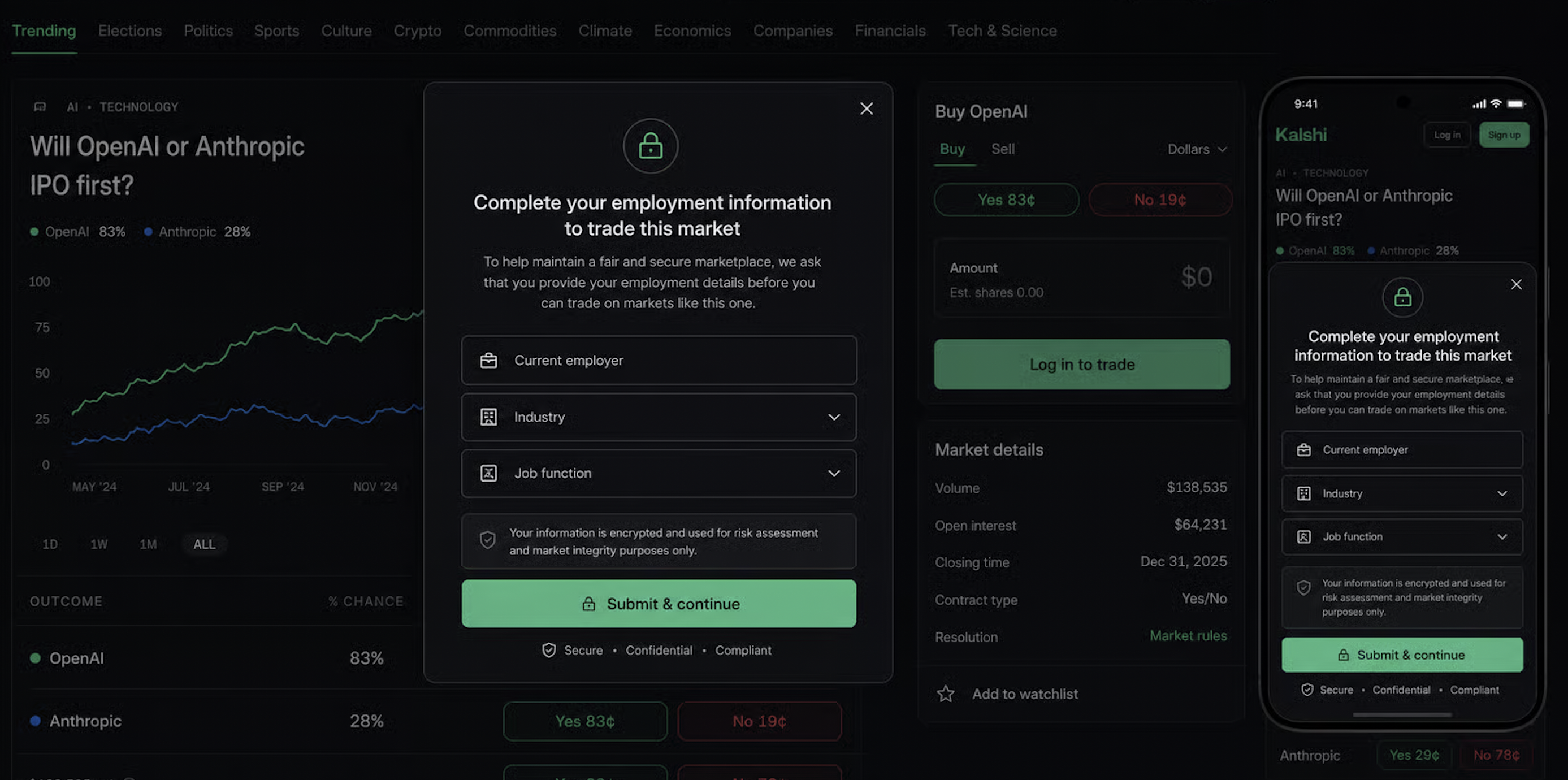
Kalshi employment check example from latest market integrity announcement
DeNault also pointed to the employment checks in a social media post Tuesday, saying market integrity is “more than just a lofty goal” for Kalshi. He said the company already collects identification information from every trader, monitors markets around the clock and is continuing to expand its ability to “prevent, detect, and punish misconduct.”
Today, we announced that Kalshi will now require employment information in order to trade in certain markets.
Market integrity is a more than just a lofty goal for us. It’s the reason we collect identification info from every trader, why we surveil our markets 24/7, and why we…— robertjdenault (@robertjdenault) June 9, 2026
Kalshi also said it is adding new ways for users to flag suspicious activity, including reporting tools attached to individual markets and a separate channel for submitting tips about potential abusive trading.
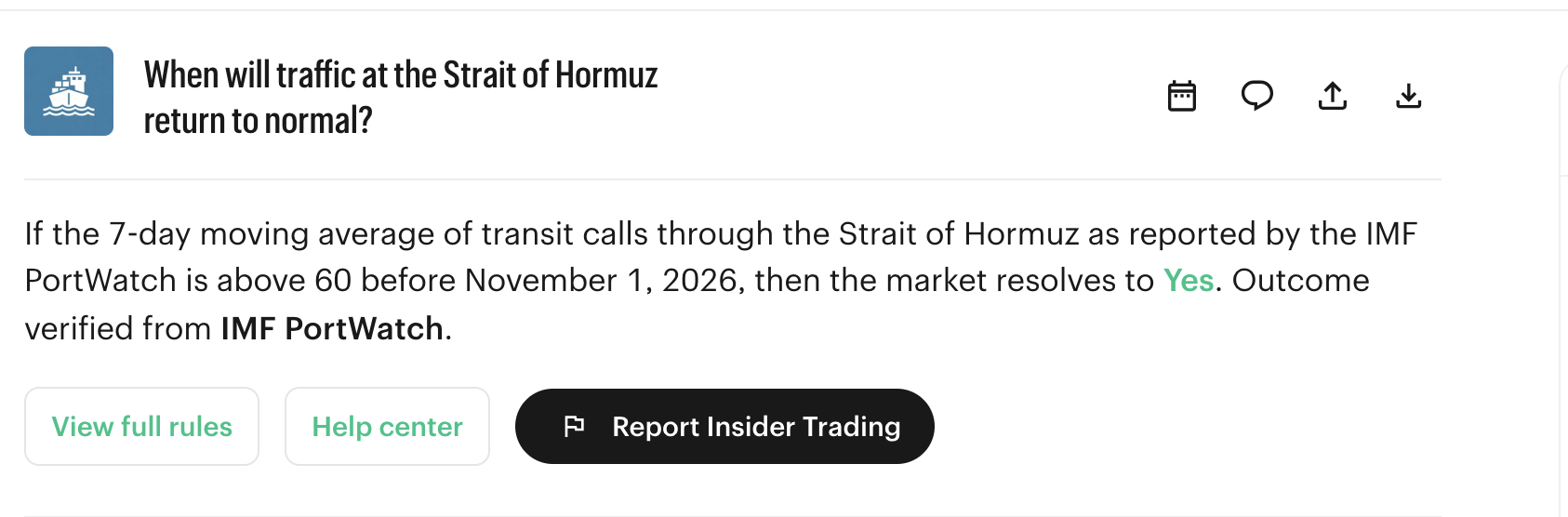
Report Insider Trading button added to Kalshi markets
That could formalize a role traders have already been playing across the industry. Some of the market integrity cases that later drew enforcement action or criminal charges, including the Polymarket Google search trends case, were flagged early by traders and market watchers on social media who noticed unusual timing, pricing or trade patterns.
Kalshi says it blocked more than 100 potential insider trades
Kalshi also used the announcement to put numbers around its enforcement work.
The company said its enforcement team conducted more than 150 investigations in the first quarter, blocked more than 100 potential insider trades, made more than 20 referrals to law enforcement and regulators and took five disciplinary actions.
The disciplinary actions include two cases Kalshi disclosed in February involving a former California gubernatorial candidate and a video editor tied to MrBeast markets. Kyle Langford, who was then running for governor of California, was suspended for five years and ordered to pay $2,246.36 after trading in a market tied to his own candidacy and promoting the trade on social media. Artem Kaptur received a two-year suspension and a $20,397.58 penalty after Kalshi said he traded using nonpublic information connected to MrBeast’s upcoming videos.
Kalshi announced three more political insider trading cases in April involving candidates who traded in markets tied to their own elections. Kalshi suspended Virginia U.S. Senate candidate Mark Moran, Texas congressional candidate Ezekiel Enriquez and Minnesota state Sen. Matt Klein for five years each. Moran was fined $6,229.30, Enriquez settled for $784.20 and Klein settled for $539.85.
Market integrity becomes an industry test
For traders, the changes could mean more friction before entering certain markets, especially those tied to companies, politics, entertainment or other events where a narrow group of people may have early information. But for Kalshi, that friction is also part of the pitch.
As insider trading cases surface in the media and draw scrutiny from critics, regulators and lawmakers, Kalshi is trying to establish itself as the prediction market operator setting the standard for surveillance and enforcement. The company’s message is that more aggressive screening, referrals and disciplinary actions are not a retreat from prediction markets, but a necessary step if the industry wants to keep expanding into sensitive event categories.
The issue has also started to draw attention in Washington. Some members of Congress have pushed legislation to restrict public officials and their staff from trading in prediction markets, and lawmakers have raised concerns about markets tied to government actions, elections and other events where insiders could have an informational advantage.
That means the next stage of prediction market growth may depend not only on which platforms can list the most markets or attract the most trading volume, but which can convince regulators, policymakers and users that those markets are being policed before the damage is done.
 Polymarket Promo Code Rate: $25 Bonus for Chiefs vs. Seahawks SNF
 Kalshi Promo Code RATE: $55 Bonus for Packers vs. Lions
 Polymarket Promo Code Rate: $25 Bonus for Bengals vs. Ravens
 Kalshi Promo Code Rate: $55 Bonus for Ole Miss vs. Texas CFB