Inside the First Polymarket Private Valuation Markets for OpenAI, SpaceX and Anthropic
Polymarket's new contracts use Nasdaq Private Market data to let traders speculate on whether OpenAI, SpaceX, Anthropic and others hit valuation thresholds.
Polymarket launched a new set of prediction markets Tuesday that let users trade on whether major private companies will hit specific valuation thresholds by set dates, expanding the platform into a market category tied to some of the most closely watched companies outside of the public stock market.
The markets are powered by Nasdaq Private Market (NPM) data under an exclusive agreement, according to a Tuesday announcement from Polymarket. NPM will help determine outcomes for contracts tied to valuations, potential public listings and trading activity in markets where private shares change hands.
The launch gives traders a way to take positions on valuations without owning equity in the underlying companies. That is especially notable for names like OpenAI, Anthropic and SpaceX, which remain private despite intense interest from public market investors.
Polymarket has already seen demand for markets tied to private company outcomes. Bloomberg reported that a market on OpenAI’s closing market capitalization on its first day of public trading has drawn roughly $1.6 million in trading volume since September. The new NPM-linked contracts move that speculation earlier in the company lifecycle, before a public listing.
“Prediction markets are one of the most powerful tools we have for democratizing access to financial information and opportunity,” Polymarket founder and CEO Shayne Coplan said in the announcement. “Today’s launch brings that power to one of the last frontiers of financial markets that retail participants have never been able to access. For the first time, anyone can engage with the outcomes driving value at the world’s most consequential private companies.”
We're excited to announce our exclusive partnership with Nasdaq Private Market.
Retail traders can now get exposure to private companies, one of the historically most profitable asset classes, exclusively through Polymarket. pic.twitter.com/ThotQNwlzW— Polymarket (@Polymarket) May 19, 2026
NPM adds private market data to Polymarket’s valuation markets
Nasdaq Private Market’s involvement gives the new contracts a stronger link to the existing private company trading ecosystem. NPM provides liquidity, data and infrastructure for private markets, where company valuations are often less visible than in public equities.
Polymarket and NPM framed the partnership around the growing value of private companies and the limited access most investors have to them. Polymarket said nearly 1,600 private companies valued at $1 billion or more now hold more than $5 trillion in combined value, while direct access to private company shares remains largely limited to institutions, wealthy investors, employees and existing shareholders.
The contracts do not change who owns private company equity. But they could create a public pricing layer around companies whose valuations are usually visible only through funding rounds, secondary transactions or eventual IPO filings.
“Nasdaq Private Market has established itself as a trusted source of liquidity and investment infrastructure across the private market ecosystem,” Tom Callahan, CEO of NPM, said in the announcement. “Polymarket has built the platform that can open access to a broader audience. We are proud to provide the data that ensures every market resolves accurately. When retail participants enter any market, high-integrity data matters.”
Rodolfo Sanchez, vice president of data at NPM, framed Polymarket trading activity as a potential data signal for investors.
“The data flows in both directions,” said Sanchez. “We anchor every market with institutional-quality data on the underlying companies, and the activity in those markets becomes a real-time signal that institutional investors can use on private company performance reflected back through a much broader market.”
A look at Polymarket’s first valuation markets
Polymarket’s new private company markets were listed Tuesday under a dedicated “Privates” section inside the platform’s finance category, with 23 markets live as of Tuesday afternoon.
The first batch included contracts tied to OpenAI, SpaceX, Anthropic, Stripe, Kraken, Anduril, Canva, Databricks, Epic Games, Lambda, Neuralink and Perplexity. Polymarket said additional private company markets will be added on an ongoing basis.
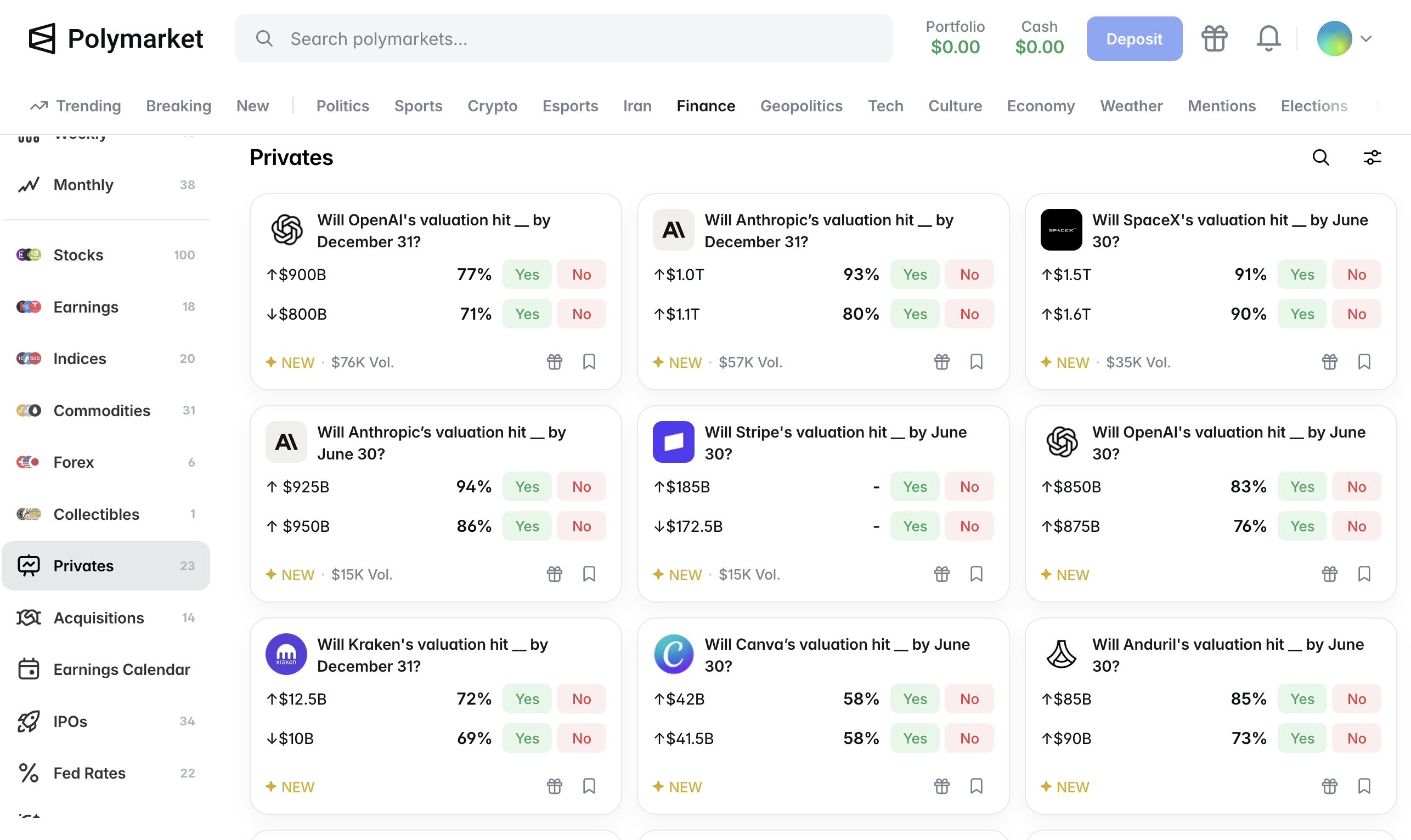
Polymarket’s new ‘Privates’ section
The markets are structured as valuation ladders, giving traders multiple thresholds for each company rather than a single yes-or-no outcome. OpenAI’s “by Dec. 31” market includes thresholds from $500 billion to $3 trillion, while SpaceX’s “by June 30” market includes thresholds from $1.3 trillion to $4 trillion.
Some early pricing showed how traders were valuing the most closely-watched private technology companies shortly after launch.
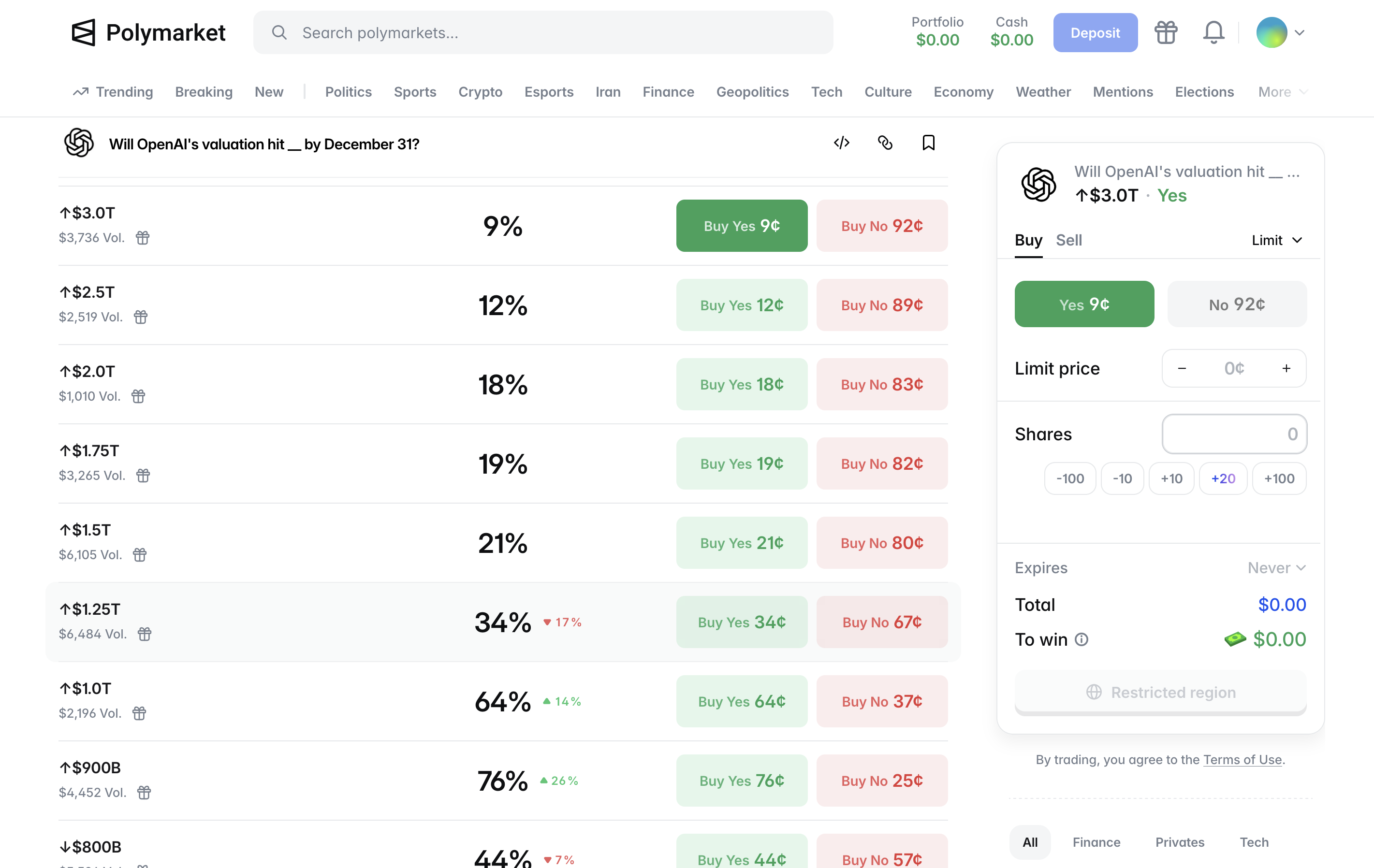
OpenAI’s Dec. 31 market showed a 77% chance of reaching $900 billion and a 64% chance of reaching $1 trillion, while Anthropic’s Dec. 31 market showed a 93% chance of reaching $1 trillion and an 80% chance of reaching $1.1 trillion.
SpaceX’s June 30 market showed a 91% chance of reaching $1.5 trillion and a 90% chance of reaching $1.6 trillion.
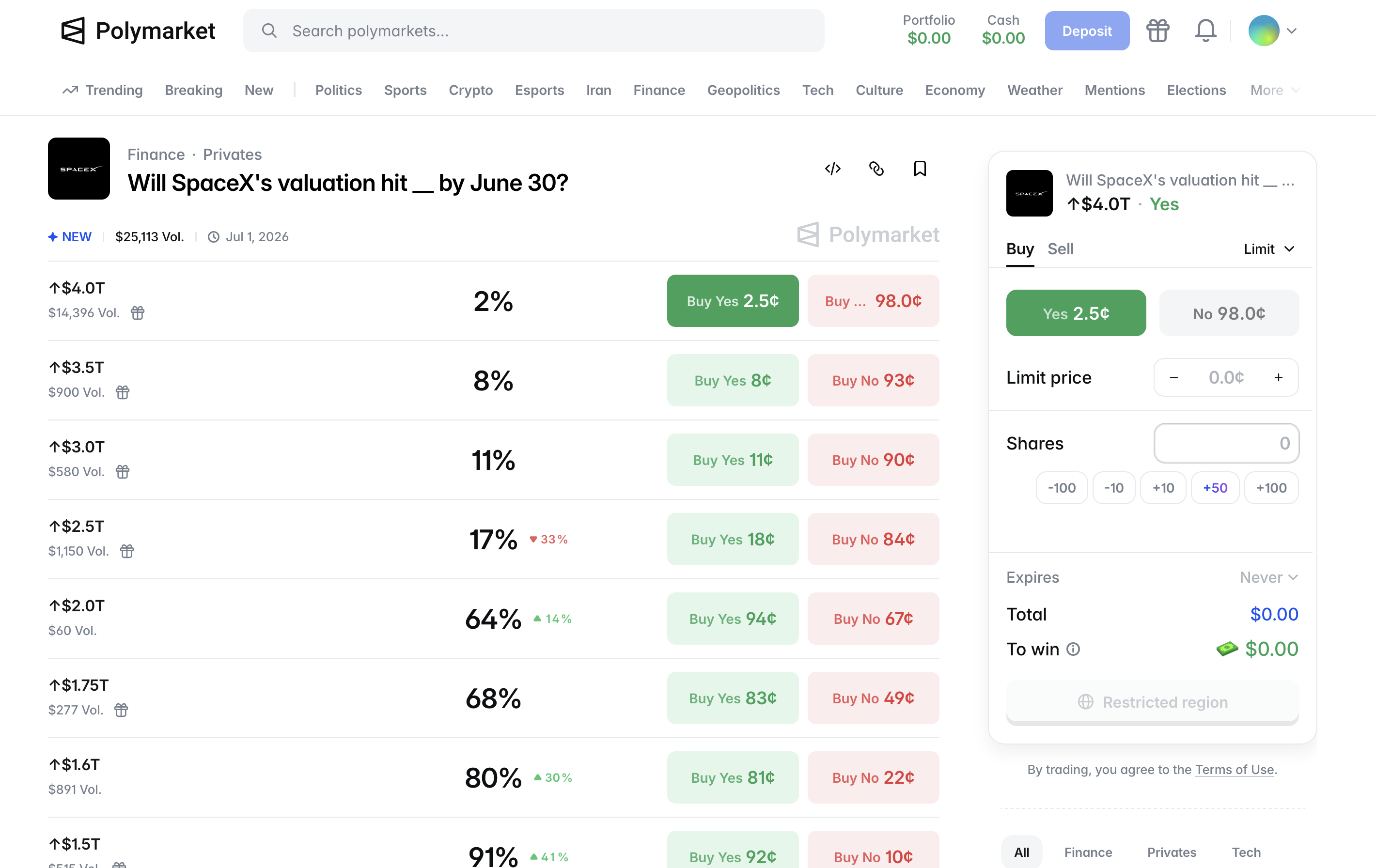
Private company markets are on Polymarket’s global platform
The new valuation markets are on Polymarket’s international platform, not its CFTC-regulated U.S. venue, which is still largely limited to sports markets.
That distinction drew criticism Tuesday from Amanda Fischer, who works on financial policy at Better Markets, a financial-reform nonprofit that has been critical of prediction markets. Fischer previously served as chief of staff to former SEC Chair Gary Gensler and as an adviser in the U.S. House and Senate.
“Why is Nasdaq partnering with an offshore war gambling website to offer betting on illiquid, hard to value private companies?” Fischer wrote on X. “What about the recent past makes them comfortable that Americans aren’t illegally trading on Polymarket’s global platform?”
Why is Nasdaq partnering with an offshore war gambling website to offer betting on illiquid, hard to value private companies?
What about the recent past makes them comfortable that Americans aren't illegally trading on Polymarket's global platform? https://t.co/CZOUK7no7S— Amanda Fischer (@amandalfischer) May 19, 2026
Fischer’s criticism points to concerns over Nasdaq’s role in supplying data for offshore prediction markets and whether Polymarket can keep U.S. users away from markets that are not listed through its regulated U.S. venue.
The valuation markets also involve private companies, where pricing can be less transparent than in public equities. That makes NPM’s role central to the product, but also raises the stakes for how the contracts are resolved and how traders understand the data behind them.
 CFTC Approves Coinbase as a Derivatives Clearing Organization
 Kalshi Promo Code Rate: Get a $25 Bonus for Steelers vs. Browns TNF
 Raman Overtakes Bass in LA Mayor Prediction Markets as $98M Trades on Kalshi
 Peltola Holds 70% on Kalshi Despite Staff Allegations as Alaska Senate Race Tightens