Democratic Presidential Race Tops $1.1B in Trades with Two Years of Turbulance Ahead
With no declared candidates, 2028 Democratic nomination markets show Gavin Newsom leading Alexandria Ocasio-Cortez, Jon Ossoff and Kamala Harris in a wide-open field.
Key Takeaways
- Traders are heavily engaged in a race with no declared candidates and primaries still two years away.
- Newsom leads, but field is still wide open with AOC, Ossoff, and Harris clustered behind and no clear consensus.
- Odds reflect momentum and media cycles. not fundamentals, setting up sharp swings ahead.
Prediction markets are already treating the 2028 Democratic presidential race as a high‑volume, high‑volatility story with over $1.1 billion in trading volume, even though the field has barely taken shape and the primaries haven’t even begun. The result contributes to the broader picture for the 2026 US elections.
On both Kalshi and Polymarket, California Governor Gavin Newsom leads the pack, with New York Rep. Alexandria Ocasio‑Cortez and Georgia Sen. Jon Ossoff also in the money, but anyone calling this a settled race is ignoring how much can change in two years.
Kamala Harris, the 2024 Democratic nominee, Pennsylvania Gov. Josh Shapiro and Pete Buttigieg are also trading high in the enormous field traders are looking at for the 2028 Democratic presidential nomination.
Democratic nominee prediction markets snapshot
On Polymarket’s Democratic Presidential Nominee 2028 board, Newsom is priced at 27.5%. The contract has already attracted approximately $1.04 billion and nearly $47 million in liquidity, a staggering number for a race this far out.
The next‑closest candidate is Ocasio‑Cortez at 8.3%, followed by Harris at 6.2% and Ossoff at 5.9%.
Kalshi’s parallel 2028 Democratic Presidential Nominee contract, with over $88.6 million in trading volume so far, lines up with the same basic hierarchy. Newsom still leads, while Ocasio-Cortez shows up as one of the more tradable dark‑horse candidates, and the market also reflects Ossoff’s relatively strong positioning compared to the rest of the field.
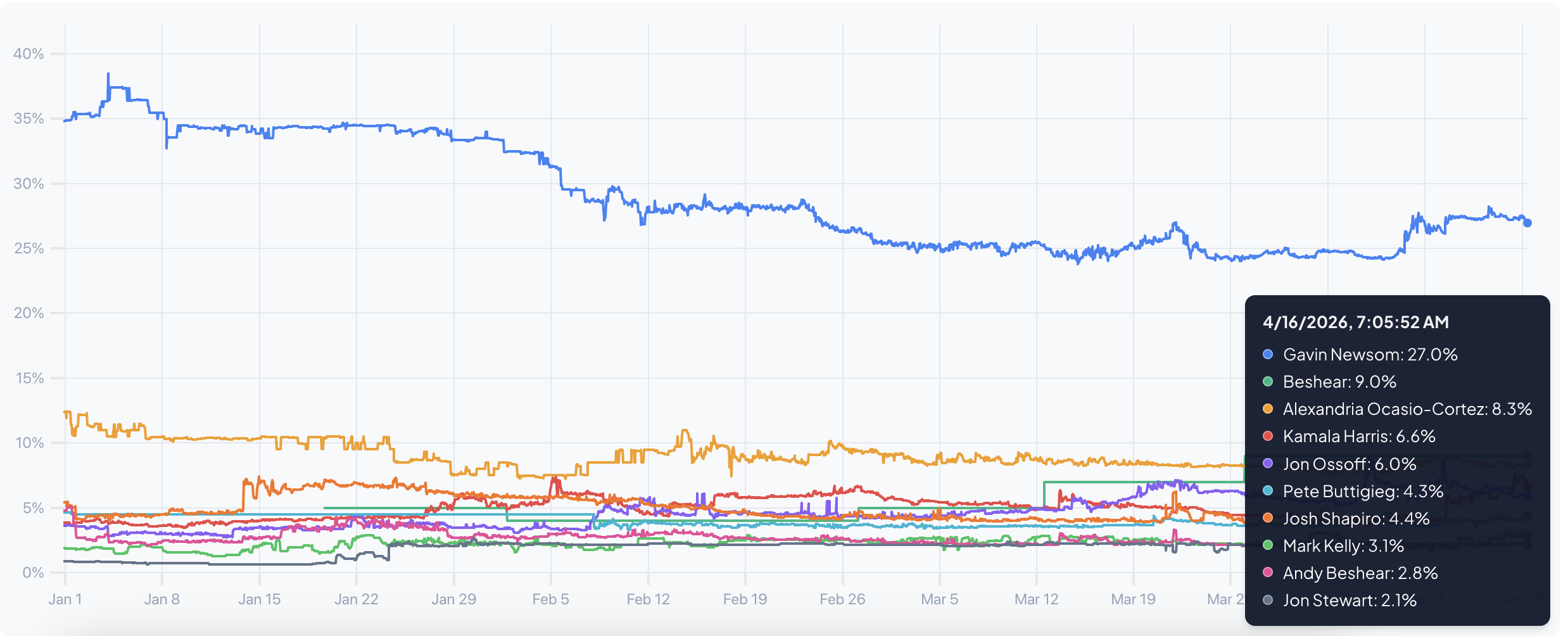
2028 Democrat nominee market snapshot from DeFi Rate
What’s driving early 2028 presidential market trading
Traders are pricing a narrative that doesn’t exist yet. No one has officially declared for the 2028 Democratic presidential race. The party hasn’t even started booking venues for the convention, and the first primaries are still nearly two years away.
Polling‑only models are still low‑resolution, while prediction markets are already assigning odds to specific outcomes. Traders are effectively betting on:
- Who can withstand a long primary cycle, including the early‑state grind and the fundraising treadmill?
- Who can build and sustain national momentum over two years, especially as the GOP narrative coalesces around a Trump‑centric 2028 landscape?
The result is that a short‑term media‑driven storyline can swing the 2028 odds board in a way that polling‑only models cannot, which is exactly the kind of “market‑ahead‑of‑polls” story this beat likes.
Democratic presidential race dynamics
The current market structure is also telling you something about the generational and geographic fault lines inside the Democratic party:
- Newsom represents the establishment‑governor wing
- Ocasio-Cortez represents the progressive wing
- Ossoff represents a younger establishment Democratic wing
Polls and press coverage still lean heavily toward traditional establishment figures, but the odds boards suggest that traders are already pricing the progressive wing as a viable threat, especially Ocasio-Cortez, who sits in a band well ahead of the rest of the field. Ossoff’s relatively high placement reflects the market’s sense that his broad‑left appeal might make him a compelling late‑cycle candidate.
Harris, who said this week she is contemplating another run, also represents the establishment wing and provides a familiar face early in the process. Then there is a long list of names who could throw their hat in the ring, from big-name Democratic politicians to Oprah and Dwayne Johnson.
Two years is a long time
The 2028 nominee market is also a story that can blow up in any direction. The same dynamics that can make this a fun, early read on the party’s direction can also make it a terrible substitute for real-world polling and party indicators, especially once primaries actually start.
Traders may be pricing Newsom as the clear frontrunner today, but that could vanish in a few months if he stumbles in a high‑profile debate, or if a new figure emerges and the market recalibrates around that narrative.
The same applies to Ocasio-Cortez and Ossoff. Their current positioning is based on perceived momentum, not actual votes, and it could evaporate once the primary calendar exposes them to real‑world competition.
Over the next two years, expect sharp swings as narratives shift and the field evolves.
Prediction markets takeaway
The 2028 Democratic presidential race market is both a fun macro‑level read on the party’s direction and a very early‑cycle indicator that could turn out to be dramatically wrong.
Traders are already putting real money on candidates, but that’s exactly the kind of early narrative bet that prediction market fans love, and that the rest of the world will try to unwind over the next two years. The 2028 presidential election odds are showing the crowd is already placing a lot of faith in Newsom, Ocasio-Cortez, and Ossoff, while still leaving plenty of room for someone else to crash the party, creating repeated opportunities for traders to buy low and sell high if they can anticipate candidate surges.
 Kalshi Asks Full Sixth Circuit to Review Panel Decision Favoring Ohio and Tennessee Officials
 Ramaswamy Gets a Polling Boost, but Ohio Traders Still Back Acton
 Kalshi Promo Code RATE: Get a $25 Bonus for Esports Trading This Week
 Democrats Put $5M Into Kansas Senate Race as Traders Still Favor Marshall