



- ▸ Polymarket’s new fee structure rollout triggered a ~10x revenue jump, with daily revenue rising from ~$30K–$80K in January to ~$550K–$700K in April.
- ▸ Volume surged despite new fees, climbing from ~$1.97B to ~$2.48B (+~26% WoW), showing the expanded fee model hasn’t slowed trading activity.
- ▸ A broader platform overhaul includes the launch of Polymarket USD token and a rebuilt matching engine, new order book system, and smart contract updates aimed at improving execution and reducing slippage.
Polymarket is rapidly increasing how much revenue it captures from its international prediction market platform, as it expands trading fees across more markets types.
Data from Dune Analytics shows the shift clearly. Daily revenue on the platform has climbed from roughly $30K-$80K in January to about $550K-$700K in early April following a major March 30 fee expansion, roughly a 10x increase in just a few months.
Polymarket generated around $6.8 million in fees during the week of April 6, according to Dune’s data, marking its highest weekly total on record. Over the same period, the platform recorded roughly $4.5 million in revenue, with a portion of those fees distributed to traders through maker rebates. The week of March 30 produced the platform’s highest weekly revenue total at approximately $5 million, generated from roughly $6.6 million in fees.
The change unfolded in stages. Through January and early February, revenue remained relatively low, even as trading activity continued to surge across the platform. That began to shift around Feb. 11, when fees were expanded beyond a limited set of markets, driving a steady rise in revenue through the rest of February and March.
The most significant move came on March 30, when Polymarket rolled out fees across most market categories. Just three days later, on April 2, daily trading fees surged to about $1.9 million, while platform revenue reached roughly $1.5 million, the highest levels recorded on the Dune dashboard.
Those peaks did not hold, but they marked a clear turning point. In the days following the spike, revenue pulled back and stabilized at several times its pre-expansion levels.
From “no fees” to fuller fee rollout
For most of its history, Polymarket built its user base around a simple pitch: no trading fees.
That began to change on Jan. 5, when the platform introduced taker fees on 15-minute crypto markets, alongside a maker rebate program funded by those fees, according to its changelog. The rollout was narrow, and most of the platform, including many of its highest-volume categories, remained fee-free.
Fees expanded again on Feb. 11, when Polymarket applied the same taker fee and rebate structure to select sports markets, including college basketball and Italy’s Serie A soccer league. A day later, the platform extended the model further with the launch of fees on 5-minute crypto markets.
The full transition came on March 30, when Polymarket rolled out its updated fee structure across nearly all categories, including crypto, sports, finance, politics, economics, culture, weather, and tech, according to Polymarket documentation.
That shift brought the platform’s largest and most active markets into the fee system for the first time. Within days, both fees collected and revenue jumped sharply.
The rollout drew immediate scrutiny from traders over how the new fee model behaved in practice. PokerNews’ Tanner Lux reported that users first flagged unexpectedly high fees on very low-priced contracts, particularly in markets like weather and economics. According to the report, the issue stemmed from how fees were initially calculated, which tied costs to the total dollar value of a trade, rather than the actual size of the position, and created pricing issues in markets priced very low or very high. That meant fees could appear out of proportion to the potential profit or risk of a trade, particularly at the extremes. Polymarket quickly adjusted the system by shifting to a share-based calculation, according to the report, bringing fees more in line with actual position size.
Despite the broader fee rollout, trading activity has continued to climb. Weekly notional volume reached approximately $1.97 billion during the week of March 30, when fees were expanded across most markets, and then surged to $2.48 billion for the week of April 6–11, an increase of nearly 26% week-over-week. The increase suggests that expanding fees across most markets has not deterred trading activity on the platform.
How Polymarket taker fees work
Polymarket uses a taker fee model, meaning the trader who executes against an existing order pays a fee. Traders who post orders that get filled, known as makers, do not pay fees and instead receive a small rebate. That rebate is funded by the fees collected from takers, creating an incentive for traders to provide liquidity to the market.
Fees are calculated using a formula based on trade size, contract price, and a category-specific fee rate. Because the formula factors in price, costs are highest when contracts are near 50% probability and lower at the extremes.
The category rate is what determines how expensive a market is to trade. Crypto markets carry the highest rate at 0.072, while sports markets are much lower at 0.03. Politics, finance, tech, and similar categories are set at 0.04, while economics, culture, weather, and other general markets are slightly higher at 0.05. Geopolitical markets remain fee-free.
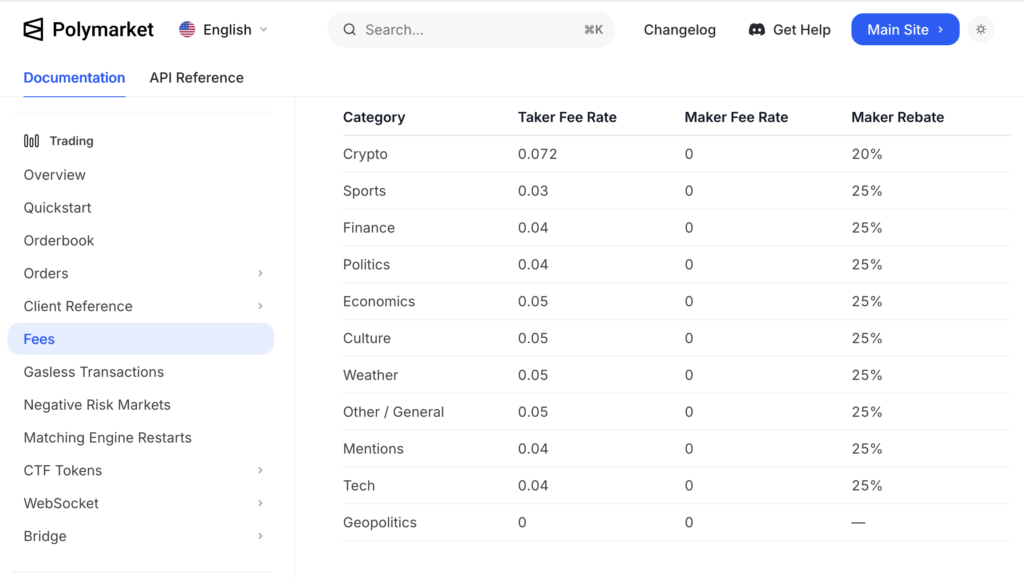
Those differences show up clearly in actual trading costs. At a 50% price, a $100 trade in a crypto market generates about $1.80 in fees, compared with roughly $0.75 in sports markets and about $1-$1.25 across most other categories.
For individual traders, the cost of each trade is relatively small. But because these fees are applied to a large volume of trades across the platform, they generate significant revenue for Polymarket.
Infrastructure upgrade rolls out alongside fee expansion
Just days after expanding fees across most markets, Polymarket began rolling out a full rebuild of its exchange infrastructure.
In an April 6 post, the company said the upgrade would take place over the following two to three weeks, introducing a new matching engine and updated smart contracts. The upgrade also introduces a new order book system and changes to how fees are collected and distributed within the platform’s core trading system, according to Polymarket developers. The changes are being deployed gradually and are not yet fully complete.
A key part of the transition is the introduction of Polymarket USD, a new collateral token backed 1:1 by USDC, which replaces the platform’s previous reliance on bridged USDC.e. For most users, the conversion is handled automatically through the interface. Traders using APIs or automated systems will need to manually convert their USDC into Polymarket USD before trading on the upgraded system.
For traders, the changes are mostly about execution and infrastructure rather than pricing. The upgraded matching engine and order book are designed to process trades more efficiently, which can reduce price slippage and make it more likely trades execute at the expected price, particularly in fast-moving and high-volume markets.
The shift to Polymarket USD also simplifies how funds move through the platform. Instead of using a transferred version of USDC, trades now use a token issued within Polymarket, allowing transactions to be processed in a more standardized way.
The upgrade will also reset the order book during the transition. Polymarket said all existing order books will be cleared during a short maintenance window, meaning any open orders will be canceled and traders will need to place them again once trading resumes. The company said it will announce the timing of that window at least one week in advance.
Polymarket US fee structure
Polymarket’s U.S. platform uses the same core idea, taker fees, but applies them in a more standardized way. The platform was soft-launched late last year, featuring a variety of sports markets. Polymarket US recently began rolling out non-sports markets like politics and economics. Because the product is still expanding into new market types, fees are not yet differentiated by category, with all markets currently following the same pricing structure.
Unlike the international platform, which applies different fee rates by market type, the U.S. platform uses a single fee parameter across all markets. That parameter is set at 0.05, and it is applied within the platform’s pricing formula rather than as a flat percentage.
Like the international exchange, fees still depend on both trade size and contract price. Costs are highest when contracts are near 50% probability and lower at the extremes. The difference is that, on Polymarket US, the pricing curve is identical across all markets.
What comes next for Polymarket fee models
The contrast between the two platforms highlights how Polymarket’s approach to fees is still evolving. The international exchange now applies different fee rates depending on the type of market, while Polymarket US uses a single pricing structure across all markets.
As the U.S. platform continues to expand beyond sports into culture, economics, and other categories, it could eventually adopt a similar approach.
More on Polymarket