







- ▸ Repeated timeline misses contrast with behind-the-scenes progress and a potential compromise nearing committee review.
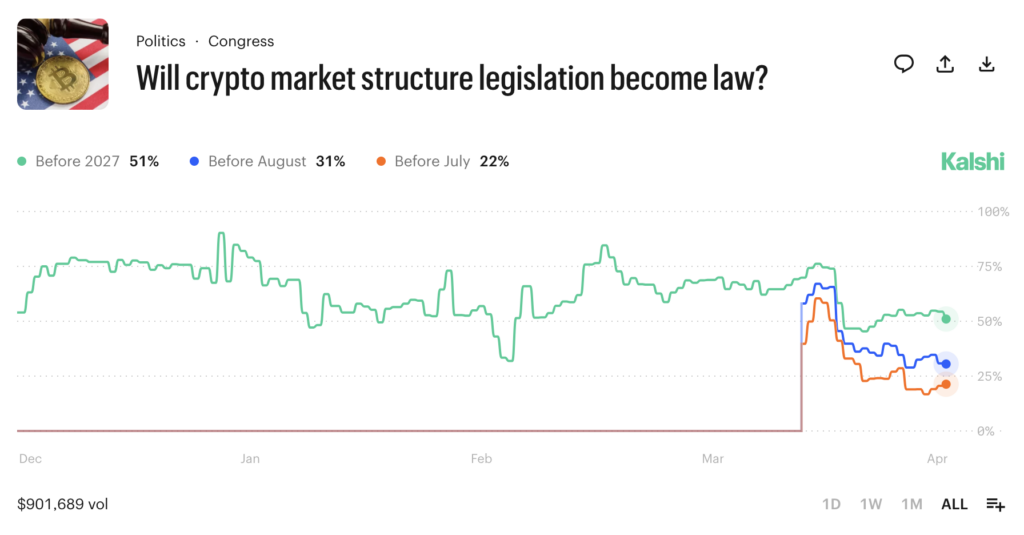
- ▸ Odds of passage this year have dropped to 51%, down from 76% on March 21.
- ▸ Disputes over regulatory authority and stablecoin yield rules remain the biggest obstacles to finalizing the bill.
- ▸ Midterm timing and credit-claiming dynamics could matter as much as policy, with failure risking prolonged regulatory uncertainty.
Preliminary timelines for when the Clarity Act will finally be signed into law continue to emerge from industry insiders, only to pass without result. Now, experts point to “unresolved turf wars,” control over the rulebook, and optics ahead of midterms as key influencing factors on potential passage.
Last Wednesday, Coinbase Chief Legal Officer, Paul Grewal, told Fox Business he was “very confident” the industry would see progress on the Act in the next 48 hours. Yet, with that window now elapsing, uncertainty over when, or whether, the legislation will advance is only deepening.
However, behind the scenes, negotiations appear to have entered a critical phase. Senators are entering what may be their final window before a surge of legislative activity, with the crypto market structure bill now competing for attention alongside the confirmation of Federal Reserve Chair nominee Kevin Warsh and a broader reconciliation package.
Whether crypto companies can offer rewards or yield to users on stablecoin holdings without triggering a migration of deposits out of the traditional banking system remains at the center of the Clarity Act debate.
A compromise on the horizon
According to industry sources familiar with discussions, a revised compromise was reviewed late last week following a second round of meetings with Senate staffers. While details of the proposal remain undisclosed, both banking and crypto stakeholders are said to be cautiously optimistic that a workable solution has finally been reached.
🚨UPDATE: CLARITY Act Markup Expected SECOND HALF OF APRIL — Sources Say Deal Was FINALIZED ON FRIDAY 🤯🔥
— Diana (@InvestWithD) April 6, 2026
After weeks of delays, negotiations around the CLARITY Act may have just reached a BREAKTHROUGH. 👀
According to industry sources, a new CLARITY Act compromise version was… https://t.co/9KdZZDo4bb pic.twitter.com/SEigiTtNk1
Speaking at the Digital Assets and Emerging Tech Policy Summit at Vanderbilt, Senator Bill Hagerty noted that politicians on the banking committee side are “very close” to bringing the bill together.
“… My expectation is that we get it into committee in this next work period that starts on Monday of next week, so that over the next several weeks we should have this into the banking committee.”
The timeline reinforces a growing sense of urgency on Capitol Hill. With midterm elections approaching, lawmakers face a shrinking window to pass what many consider one of the most consequential pieces of crypto legislation to date, one that would shift primary oversight from the SEC to the CFTC and establish a broader regulatory framework for digital assets in the United States. The Kalshi market currently has the odds of legislation passing this year just above a coin flip at 51%, down from a March 21 spike to 76%.
Delays may point to deeper power struggles
For some industry observers, the missed deadlines reflect more than routine legislative delay. Speaking of Grewal’s 48-hour insight, Joshua Kim, the CEO of DonaFi, said it could be akin to “wishful thinking.”
“Now that [the deadline] slipped, it screams unresolved turf wars more than anything dramatic. You’ve got agencies still fighting over who gets to define what’s a security, and lobbyists quietly pushing carveouts…”
Kim pointed to ongoing disputes between regulators and lobbying pressure as key factors slowing progress.
“Everyone agrees something needs to pass, but nobody wants to lose control of the rulebook, and that’s the real holdup,” he said.
The debate over stablecoin rewards illustrates that tension. Banks have warned that allowing yield-bearing digital dollars could draw deposits away from the traditional financial system, while crypto firms argue such restrictions would stifle innovation and limit user incentives.
If tighter rules are adopted, similar to those introduced under the Genius Act, the impact on the industry could be significant.
“Exchanges would probably lean harder into brokerage-style roles, maybe less market-making risk. Stablecoin issuers? They’d start looking more like narrow banks, holding safer assets, cutting yield tricks.”
Kim noted this could result in users getting safer products, but also fewer choices.
Political clock is ticking
Beyond policy disagreements, political timing may ultimately shape the bill’s fate. With President Donald Trump backing the legislation and Republicans eager to secure a legislative win, the coming weeks could prove decisive. At the same time, Democrats may be reluctant to hand over a bipartisan victory ahead of the midterms.
“I think people underestimate how much timing drives this stuff. Policy disagreements matter, sure, but elections warp everything. With Trump backing it, Republicans want a win, but not at the wrong moment,” Kim explained.
He added that the Democrats will also be less likely to “[hand] over an easy headline before midterms.”
“You might think it’s about crypto rules, but it’s really about optics, and who gets credit when voters are watching.”
If lawmakers fail to capitalize on the current momentum, the consequences could extend well beyond this legislative cycle.
Kim noted that if the Senate Banking Committee does not restart conversations around the Clarity Act soon, it could get stalled even further, pointing to the likelihood of regulators such as the SEC and CFTC continuing to shape the market through enforcement rather than legislation.
“A full legislative freeze could drag for years, honestly. And that uncertainty? It pushes companies offshore, or at least makes them hedge. I don’t love that outcome, but it’s realistic. Washington can stall forever, while regulators just keep filling the gaps, imperfectly.”
For now, the industry is left watching closely. While signs of progress are emerging behind closed doors, the absence of public detail and missed deadlines underscore a familiar reality: even when a deal appears close, consensus in Washington is never guaranteed.