









Prediction markets are now pricing Democrats as clear favorites to retake the House and showing the Senate as a narrow toss-up in the 2026 midterm elections.
That market data comes while polls show a historically normal midterm shift against the president’s party, but not yet the full‑blown “wave” that would guarantee a flip. President Donald Trump’s Republican Party currently controls both the House and the Senate.
Both Kalshi and Polymarket are effectively telling the same story: that House control is the surest bet against the president’s party and Senate control is a toss‑up.
Kalshi midterm 2026 predictions
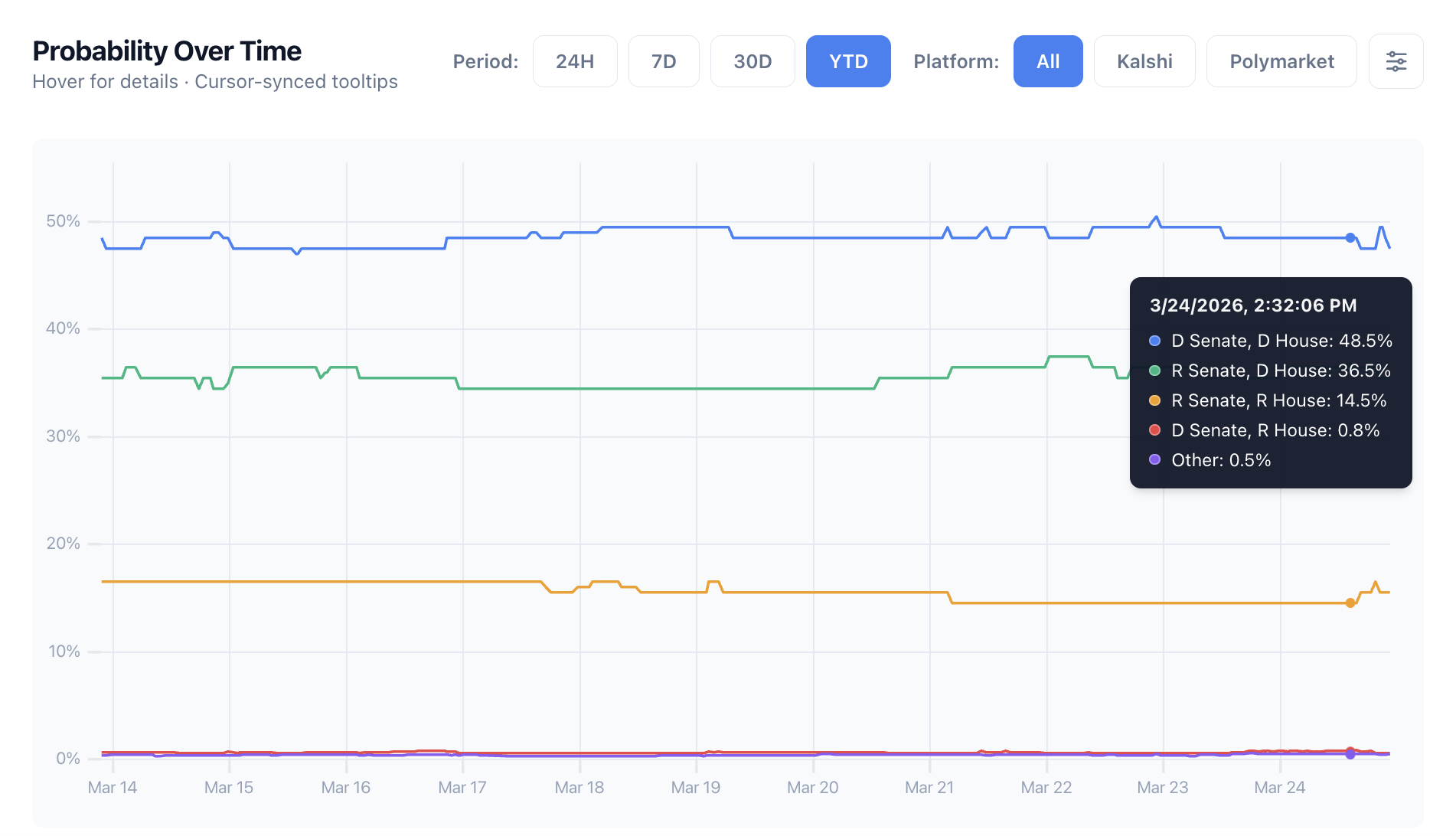
The specific 2026 House control market on Kalshi, with more than $7.1 million in notional trading volume, is predicting a Democratic flip at 84%. In Kalshi’s broader “2026: Midterms: Congress Balance of Power,” a Democratic sweep is tracking at 48% in the market with just over $2 million in volume. A Democratic House flip with the Senate staying Republican is second at 37%.
The market is pricing a Democratic House majority not just as probable but as the default outcome.
Meanwhile, Kalshi’s Senate contract is a true nail‑biter, with Republicans leading at 51% in the $2.6 million market, reflecting a chamber that could easily flip either direction on a handful of races. Last year, the Republicans were holding 80% to retain the Senate, but the Democrats recently briefly surpassed the 50% threshold.
A recent Kalshi write‑up frames this as “Democrats now slightly favored to retake the chamber,” with the balance of power orbiting around toss‑up states like Ohio, Wisconsin, and Arizona.
Polymarket tracks midterm 2026 similarly
Polymarket’s “Balance of Power: 2026 Midterms” multi‑outcome market tilts most heavily toward a Democratic sweep, at around 49%, with a Republican Senate and Democrat House coming in next at about 36%. Full GOP control is trading at 15% or lower.
The “Balance of Power” has attracted just under $4 million in volume with months left to go before November’s election.
In individual markets, the Republicans are trending at 53% to keep the Senate, with trading volume of about $1 million, while Democrats are tracking at 85% in the $4 million market to win the House.
Taken together, that’s a prediction that:
- House flips to Democrats.
- Senate is a relative toss-up.
- A full Republican sweep is the least probable of the stylized outcomes.
Prediction markets are treating Midterm 2026 as a targeted blow to House Republicans, with the Senate left as a messy, seat‑by‑seat brawl.
How prediction markets compare to midterm 2026 polls
The New York Times ballot tracker and other polling averages consistently show Democrats ahead on the national House‑level preference by roughly 4-6 points. That’s a solid, but not huge, lead relative to historical norms.
That aligns well with Kalshi’s House leaning blue prediction, but markets are pricing a higher probability than pure polling‑spread models would often assign this far out.
Individual Senate race polls remain split. Some toss‑up states show Democrats slightly ahead, while others show Republicans holding firm. Some polls show the Senate running dead even rather than a Democratic slam‑dunk. That tracks with Kalshi’s Senate market, suggesting no runaway advantage for either party.
Historical context: What midterms do to the presidential party
Historically, the president’s party almost always loses ground at midterms, but the magnitude and direction of change vary by chamber.
Since at least 1950, the president’s party typically loses an average of 20–30 House seats at midterms, with wave‑style turnovers of more than 40 seats occurring in especially bad years. That dynamic fuels the automatic assumption that Trump’s first‑term GOP‑held House is vulnerable in 2026, given recent polling following the start of the war with Iran.
Senate flips are much less frequent because only about one‑third of seats are up in any given cycle. Over the last 75 years, the Senate has flipped hands in roughly six election cycles, but remained stable in the others.
Right now, the prediction markets suggest that the House will flip to Democrats in the midterm 2026 elections, and the Senate could sway that way too. That’s consistent with the historical pattern that midterm elections tend to hollow out the president’s House majority, and that a Senate flip is the rarer, higher‑risk move.
Volume note: Kalshi lists notional trading volume, attributing $1 per contract regardless of contract price. Polymarket lists USD-at-price, or actual USD exchanged.
