



- ▸ In its Q1 earnings release, DraftKings said April annualized prediction markets trading volume topped $2.3 billion while customer acquisition costs fell more than 80%.
- ▸ DraftKings said it expects to launch its own Railbird exchange in the coming weeks, a move that could reduce DraftKings Predictions’ reliance on third-party exchanges, along with parlay-style “combos.”
- ▸ DraftKings and FanDuel are moving in the same direction, with both planning major second-half prediction-market spending, market-making expansion and product buildouts ahead of the World Cup and NFL season.
DraftKings gave investors its clearest look yet at its prediction markets business on Thursday. The company’s Q1 earnings release disclosed new volume and customer-acquisition metrics and said DraftKings expects to launch its proprietary prediction market exchange, Railbird, and begin offering parlays (or “combos”) in the coming weeks.
The update shows that DraftKings is trying to move quickly from solely distributing third-party event contracts toward a prediction market model it controls more directly. DraftKings Predictions launched in December and currently relies on contracts listed by outside exchanges Crypto.com and CME Group.
CEO Jason Robins said DraftKings Predictions is now live in DraftKings’ flagship “Super App,” helping cut the product’s customer acquisition cost by more than 80% in April. Robins said they’ve more than doubled the number of markets available to trade, pushing Predictions volume per customer above sportsbook handle per customer.
DraftKings did not provide total Q1 trading volume for Predictions, but said April activity pointed to a faster start in Q2. Annualized consumer volume exceeded $1 billion in April, up 38% from March, while annualized total trading volume topped $2.3 billion, up 43% from March.
“Predictions, especially in sports, is a strategic priority for DraftKings,” Robins said in his opening remarks during Friday’s Q1 earnings call. “This category is still in its first inning, and we believe DraftKings is best positioned to define it. We are planning significant investment in the coming months to improve our offering, build liquidity, and scale customer acquisition. We intend to execute with urgency and establish a leadership position in sports predictions before year-end.”
On Friday’s call, Robins also said DraftKings expects market making to involve third-party prediction market platforms as well as Railbird, calling it one of the fastest paths to profitability the company has ever launched.
Railbird Exchange to launch in Q2, give DK more control
DK Predictions currently operates through GUS III LLC, DraftKings’ registered introducing broker. That lets DraftKings onboard customers and route orders for federally regulated event contracts listed on outside exchanges. Because GUS III is not yet a futures commission merchant (FCM), DraftKings has relied on Wedbush Securities as the outside FCM for customer-account and clearing access functions.
DraftKings’ Predictions roadmap points to an “in-house FCM” in Q3, after the company applied for FCM status in February. If approved, that would reduce DraftKings’ reliance on Wedbush and give the company more direct control over the customer-account side of DK Predictions.
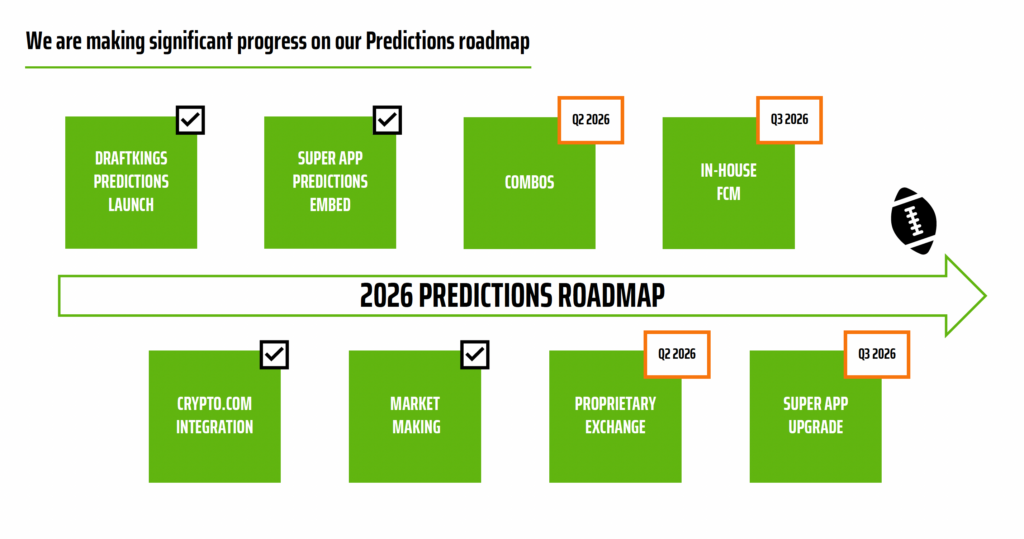
Railbird would address DraftKings’ reliance on outside exchanges for the contracts DK Predictions offers. DraftKings acquired the CFTC-regulated designated contract market (DCM) last year, and launching it in Q2 would allow DraftKings to list its own event contracts instead of relying on third-party exchanges. That could give DraftKings more control over the markets it offers, how contracts are structured, how liquidity is supported and how much revenue it keeps from prediction-market trading.
Recent regulatory filings also show Railbird may be moving closer to a more active role in DraftKings’ prediction market strategy.
A revised Railbird rulebook dated May 14 lays out how firms and customers can access the exchange, how trades will be executed and cleared, and how market makers can help provide liquidity. Railbird also filed FCM and self-clearing member agreements set to take effect May 13 and a market-maker program set to take effect May 14, with materials saying the program is scheduled to commence June 1. The market-maker filing also says that Railbird’s “doing business as” name is DKeX.
CFTC staff also recently cleared a regulatory path for Railbird to use Bitnomial as its clearinghouse. In a May 4 notice, the agency said staff would not recommend enforcement against Railbird, Bitnomial or their participants for certain swap reporting and recordkeeping requirements tied to fully collateralized event contracts traded on Railbird and cleared through Bitnomial.
The clearing change is notable because the earlier Railbird setup involved QC Clearing, the clearinghouse tied to QCEX, which Polymarket acquired last year as part of the U.S. regulatory strategy for its Polymarket US app.
DraftKings says Predictions can expand sports reach
The prediction market updates came alongside stronger first-quarter results overall. DraftKings reported $1.65 billion in revenue, up 17% from the same quarter last year, and $168 million in adjusted EBITDA, up 64%. The company said adjusted EBITDA would have topped $200 million without its investment in Predictions and the launch of sportsbook operations in Arkansas.
Robins also said prediction-market spending is expected to be in the $200-$300 million range, with much of that investment coming in the back half of the year. That adds context to DraftKings’ unchanged full-year guidance. The company is signaling stronger core profitability, but also a heavier investment cycle as it tries to scale Predictions, Railbird, market making and parlays before the end of the year.
DraftKings also pushed back on the idea that prediction markets are meaningfully hurting its sportsbook business. Robins said the company continues to see “no discernible impact” from Predictions on its own sportsbook, while internal and third-party data suggest prediction markets are having only a slight effect on industry sportsbook handle, mostly among low-margin wagers.
The company’s Q1 presentation framed Predictions as an expansion of DraftKings’ sports reach. Beginning next quarter, DraftKings said it will report a combined sports revenue line that will include both the sportsbook and sports event contracts. DraftKings said that its combined sports business could reach more than 95% of the U.S. population by the end of 2026.
DraftKings also cited Eilers & Krejcik data showing that nearly 70% of sports prediction market consumer volume comes from states without legal sportsbook access. In fully competitive sportsbook states, the company said regulated sportsbook operators still account for 98% of sports betting volume, compared with 2% for the leading prediction market operator, Kalshi.
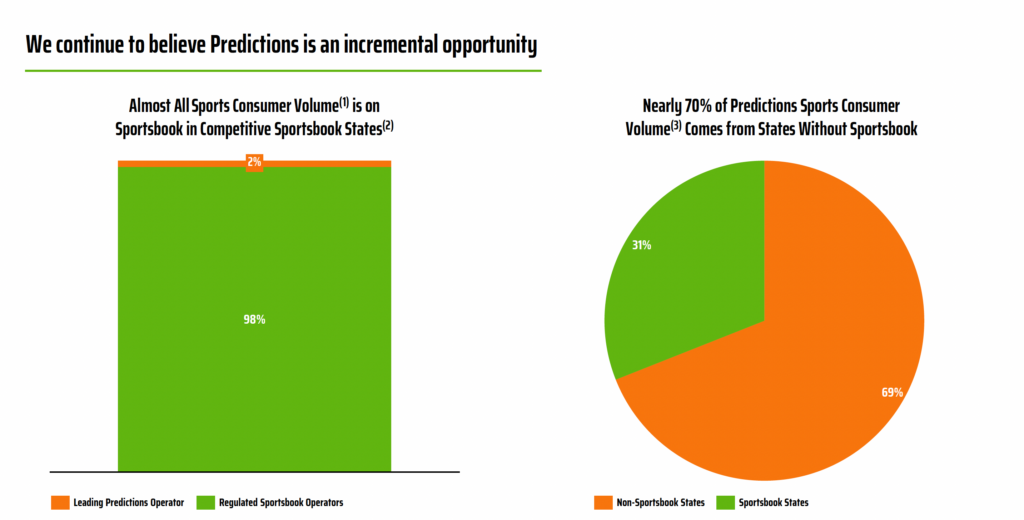
During Friday’s call, Robins also said that prediction markets could pressure states to revisit sports betting legalization. He said that states without legal sportsbook access may still see prediction markets operate inside their borders, but without the same state-level tax revenue that regulated online sports betting would generate, perhaps leading to a legislative push.
Market making becomes a bigger part of DraftKings’ prediction market plan
DraftKings’ market-making strategy also came into sharper focus on the call, with Robins saying the company expects to participate on third-party prediction market platforms in addition to its own exchange.
Robins said DraftKings stood up its market-making operation in the last couple of months and is already making money from it.
“So far so good, we’re making money,” Robins said. “It’s one of our fastest to profitability business lines we’ve ever launched.”
Robins said DraftKings’ market making will focus on its own exchange, but added that the company sees value in participating across multiple platforms, both to increase volume and to manage risk across more venues.
“I do think (market making) will involve being on third-party platforms,” Robins said. “We will obviously focus on our own exchange (Railbird) as well, which is launching in the coming weeks and we’re excited about that.”
DraftKings and FanDuel race toward same prediction market playbook
DraftKings’ update came two days after Flutter reinforced a similar prediction market push at FanDuel, giving the two largest U.S. online sportsbook operators parallel strategies as sports event contracts move closer to the center of the industry.
The similarities are becoming clearer. Both companies are preparing heavier prediction market spending in the second half of 2026, with DraftKings pointing to a $200-$300 million investment range and Flutter keeping a roughly $300 million investment plan tied to FanDuel Predicts. Both are building around major sports events like the World Cup and upcoming NFL season and both are moving into market making as a way to drive up prediction market revenue.
FanDuel Predicts and DraftKings Predictions launched within weeks of each other late last year and are being folded into each company’s main app experience. Flutter said FanDuel’s “One App” routes customers to sportsbook products in legal betting states and prediction markets where online sports betting is not available. DraftKings said Predictions is now live inside its flagship app, helping reduce customer acquisition costs.
The early financial picture looks more favorable for DraftKings. Flutter said FanDuel Predicts produced immaterial Q1 revenue, while DraftKings did not disclose standalone Predictions revenue but reported April annualized total trading volume above $2.3 billion and said its market making business is already profitable.
Still, both companies are telling investors the same basic story: Prediction markets are no longer a defensive experiment, but a major part of their sports strategy ahead of the World Cup and NFL season.