


When President Trump delivers his State of the Union address tonight, millions of people will be watching. A significant number of them will also be trading on what he will say, and who he’ll mention.
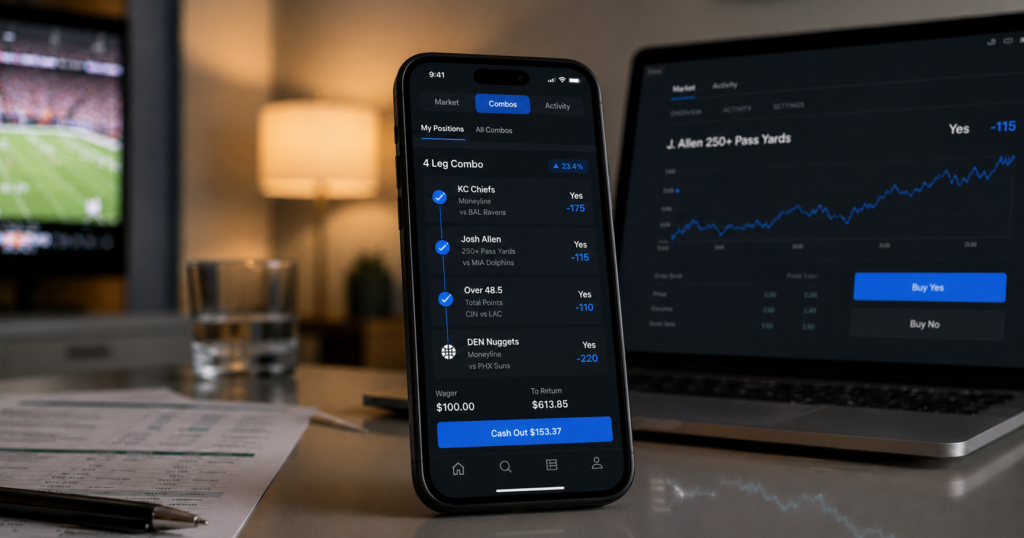
Mention markets, binary contracts that resolve based on whether a specific word or phrase appears during the broadcast, have turned the State of the Union address (SOTU) into one of the biggest prediction market events of the political calendar. The Kalshi “What will Trump say?” market has surpassed $7.6 million in trading volume as of 2 p.m. ET, with the “Who will he mention?” market adding another $1.6 million. That’s more than $9 million on Kalshi alone, before counting duration markets, attendance contracts, or the dozens of related props. And volume was still pouring in six hours ahead of the big speech.
“Trump is the right president for this prediction markets moment we’re in because of how he tends to veer off script and in particular how he fixates on media buzzwords,” former political speechwriter and Georgetown McCourt professor Michael Ricci tells DeFi Rate.
Interest in Trump mention markets has built steadily, and the SOTU is the biggest edition yet. To understand where the real edge is tonight, DeFi Rate analyzed 1,312 resolved contracts spanning 93 unique terms across Trump’s mention market history. We also spoke with a professional mention market trader and a former White House speechwriter about what to watch for, pitfalls to avoid, and how to find the signal in the noise when trading on these types of events. Let’s start with some important nuances that could mean the difference between a winning and a losing trade.
Market rules and SOTU nuances
Before getting into potential picks and trading tips, a few mechanics to know for prediction markets based on mentions. On Kalshi, contracts resolve ‘Yes’ if Trump says the specified word or phrase during the live broadcast. The exact phrase — or a plural or possessive form — must appear, and that includes in official transcripts. Tense inflections don’t count. Pre-recorded clips aired within the speech also don’t count (only the live broadcast).
That last rule is important. It means Trump showing a campaign ad or archival footage doesn’t help your position. And the exact-phrasing rule means the difference between “transgender” and “trans” or “transitioning” can determine whether a contract settles as Yes or No.
The “State of the/our Union is strong” contract is the live dispute risk tonight. During a pre-speech livestream, traders debated whether “Our union is strong” would satisfy the contract’s slash notation — with strong disagreement from experienced players on both sides. Traders on the livestream flagged this as structurally similar to the Cardi B Super Bowl controversy, where contract language ambiguity led to a contested resolution. Anyone holding a position on this contract should be aware of potential market resolution disputes that can turn a winning trade into a loss and vice versa.
Another important structural point to consider when analyzing Trump’s rhetorical tendencies and previous mentions hit rate is the format of the event. The fact that the SOTU is a prepared speech, not a rally is a distinction that shapes everything.
Michael Ricci, partner at Seven Letter, Georgetown McCourt professor, and former speechwriter for Speaker John Boehner, put it plainly:
“While the baseline expectation for deviation from the script is always high with Trump, his scripted speeches — and this is certainly one of the more scripted ones — tend to be more populist,” he told DeFi Rate. “[Trump] speaks in more of an ‘us vs. them’ tone about fighting for regular Americans against the swamp or the machine. The tone is sharper, and less roaming and care-free. He talks more about himself and other leaders when he’s off the cuff. We can also bake in that he will recite some of his accomplishments, so you can go back and look at how he talks about tax cuts and the southern border.”
Terms Trump casually drops at rallies or press availabilities are structurally less likely to appear in a teleprompter speech. That context is essential to reading tonight’s market.
Top volume drivers for State of the Union mention market
The mentions generating the most buzz provide indications as to where the money is concentrated in the hours leading up to the address. Some of the terms are Trump favorites (see hit rate data below), while others reflect narratives of the moment (“Olympics,” “hockey,” etc.). See below the top volume drivers and strike prices as of 2 p.m. ET for both the What will Trump say and Who will Trump mention markets on Kalshi.
Who will Trump mention?
SOTU mention market volume leaders — Who will he mention
Top contracts by trading volume | Kalshi data | As of 2 p.m. ET, Feb. 24, 2026
| Name | Volume | Odds | Note |
|---|
Regarding name mentions, Ricci points out Trump has some specific tendencies that could come into play during the SOTU:
“[Trump] calls out countries and their leaders at will. In this speech, people should watch for which cabinet members he praises and which Democrats he attacks. That’s one of the ways he creates moments in these big speeches.”
Trending terms and odds moves: Pre-speech intelligence
Serious traders don’t wait for the speech. They work the information environment for days beforehand, and information and hints can continue pouring in as a speech approaches.
The clearest signal this cycle came from White House press secretary Karoline Leavitt, who confirmed in her Tuesday morning briefing that the speech will lean heavily on the economy and affordability: Trump will make the case that three more years with him and Republicans in Congress can restore the American dream. She also confirmed he will tout his tax cuts, call on Democrats to reopen DHS, and explicitly named Operation Midnight Hammer, the June 2025 U.S. strikes on Iranian nuclear facilities, as a planned highlight. When a press secretary names a specific phrase in a pre-speech briefing, that’s about as close to a confirmed mention as you get without seeing the script. Traders call these “bonds,” but remember, there is always risk involved, no matter how certain an outcome might look.
The Wall Street Journal separately reported that Trump will use the address to sell his economic agenda and address the Supreme Court’s recent tariff ruling. Economy first, then likely immigration, then foreign policy and military accomplishments — that’s the speech order multiple traders on Tuesday’s livestream coalesced around, and it matters for timing any live trades.
Another big market-moving drop on the day of the speech came from the Daily Caller, which published an exclusive confirming Trump has invited Sage Blair, a Virginia woman who was secretly transitioned by school officials at age 14, as a guest. The report confirmed Trump plans to tell her story and call on states to ban youth gender transition procedures. The “Transgender” contract moved in real time on this news. That’s the guest-list effect: when a guest’s story is confirmed hours before the speech, the associated term becomes close to a lock.
On gathering speech intel in advance, Ricci advised: “You could look at what he’s been saying on Truth Social the last few days. You should also watch what key commentators like Scott Jennings are saying — they have likely been briefed on some of the speech’s contents. Excerpts trickle out in the early evening, but the full text is generally not released until he starts speaking.”
Contracts to watch: Case for specific Trump mentions
Near-locks (or “bonds”) based on confirmed intel:
Hockey (95¢) — Jack and Quinn Hughes, stars of Team USA’s first men’s Olympic hockey gold since 1980, are confirmed as Trump’s guests after he spoke to the team over speakerphone via FBI Director Kash Patel, who was in the Milan locker room. The Miracle on Ice anniversary angle, 46 years to the day, is exactly the kind of historical callback Trump leans into in scripted moments. Traders on the livestream noted he almost always says “hockey,” not “ice hockey,” so don’t confuse this with the ICE/National Guard contract.
TrumpRX (87¢) — Guests representing TrumpRX are confirmed in attendance per the Leavitt briefing. Trump uses these addresses to narrate his gallery guests directly; when the guest is there for a specific program, the program gets named.
Transgender (94¢) — Sage Blair’s invitation is publicly confirmed. Her story is expected to be a centerpiece. This one moved hard after the Daily Caller article and is now priced to reflect its near-lock status.
Midnight Hammer (68¢) — Explicitly named by Leavitt. At 68 cents, traders on the livestream flagged this as underpriced given that level of pre-confirmation. The Iran context — ongoing geopolitical tension and Trump’s recent Truth Social posts bragging about the strikes — makes this a topic that’s clearly fresh in his mind.
Foster (~76¢) — Two foster children are sitting with the First Lady as part of her Fostering the Future initiative. Sierra Burns, a named beneficiary of Trump’s Foster Youth to Independence program, is confirmed as a guest. This is the kind of narrative moment Trump uses to introduce his gallery — the word will almost certainly appear.
The narrative-driven plays:
AI (90¢) — The Wall Street Journal reported that Trump is set to announce new AI-related policies during the address, including electricity cost rules for data centers. On the pre-speech livestream, traders noted that even without this specific policy angle, AI has been a consistent Trump talking point across recent speeches whenever he discusses the economy, manufacturing, or the race against China. At 90 cents, this looks appropriately priced.
Sleepy Joe (90¢) — Surged dramatically from 32 cents earlier today. Traders on the livestream noted that Trump has been noticeably moving away from Biden references in recent weeks. Leavitt’s briefings have barely mentioned Biden, and he skipped it entirely at a recent Supreme Court presser. One participant put fair value closer to 70/30 toward No on the “10+ mentions” contract specifically (which is on Polymarket, not Kalshi). The single-mention contract at 94+ cents is a different question.
DOGE (18¢) — The program is defunct. Trump has said the word in public roughly twice since August. Traders on the livestream were strongly positioned No and saw 18 cents as potentially still overpriced. He may reference efficiency or spending cuts, but “DOGE” as a specific term has largely left his vocabulary.
Fake News (52¢) — The highest-volume term in the dataset at $300,465. The counter-argument to Yes: Trump has never said “Fake News” in a State of the Union. No Q&A tonight removes the spontaneous media-bashing moment that often produces this phrase. Experienced traders on the livestream were positioned on No and noted the order book shows significant ‘sharp’ activity on the No side — which they read as a signal. “Look at the order book and see where the sharps are,” one participant said. “If you’re not in the secret chats, at least do yourself a favor and look.”
Ethereum (3¢) — PMT’s comment on this one was straightforward: “Trump doesn’t know that word.” At 3 cents, it’s priced to reflect that, but the point stands.
Top 20 hit rate vs. today’s ddds — What will Trump say?
Based on our historical data dive into Trump mention markets at Kalshi, the following have the highest hit rates (resolving to ‘Yes’ most often). That said, speaker and narrative trends change, and some traditional Trump favorites like “Sleepy Joe,” “Autopen,” and “Fake News” have fallen out of favor, or may be reserved for specific contexts only. If you’re using historical trends to trade, be sure to use them as just one data point, not as your entire strategy.
Top 20 Trump mention hits by historical resolution rate
Terms with 10+ resolved contracts | Ranked by hit rate | Kalshi odds as of 2 p.m. ET, Feb. 24, 2026
Top 20 Trump mention hits — data table
Terms with 10+ resolved contracts | Ranked by historical hit rate | Kalshi odds as of 2 p.m. ET, Feb. 24, 2026
| Term | Yes | No | Historical hit rate | Today’s odds |
|---|
While historical tendencies can only take you so for
How to trade the speech live
The meta on mention markets has evolved. These are no longer inefficient novelty bets; experienced traders are doing real research and the obvious edges have compressed. But they haven't disappeared.
"PredictionMarketTrader" (@PredMTrader on X), who trades mention markets professionally, offered this guidance to DeFi Rate:
"For new traders, it's important to view these mention markets probabilistically instead of binary yes or no — price is king. I would also recommend checking out some of the alternate State of the Union markets like who will attend, what countries will be mentioned, and who will be mentioned, as they can sometimes have more opportunities to find edges."
On his current positions: "The main strikes I like are Yes on Midnight Hammer, Transgender, and Woke. No on Fake News, Woke/DEI, DOGE, Crypto, and Ethereum. I entered most of these at better prices than they are now, so I probably would not buy them at current prices. Fake News: No is probably my favorite strike at current prices sub 50 cents."
The live trading angle is where things get interesting. As the speech progresses, time decay becomes a real factor. For example, if Trump opens on the economy and hasn't said "Highest Inflation" in the first ten minutes, that contract can drop hard even if traders still believe it's coming. Experienced traders flagged buying oversold dips on topic-dependent terms once the relevant section passes, then watching whether Trump circles back.
Order book reads also matter live. Large walls of No-side resting orders on a contract that looks like a Yes suggest the sharp money sees something the retail market doesn't. Retail players disproportionately buy Yes — they want action and may put too much weight on memorable Trump classics, driving Yes prices above fair market price. Sharp traders will often quickly correct those mispricings by buying up contracts on the opposite side. Understanding these dynamics are key to playing the game.
SOTU mention market in the bigger picture
A few years ago, betting on whether a president would say "Drill Baby Drill" during a State of the Union was a novelty. Tonight, it's a $9 million regulated market.
Our dataset of 1,312 resolved contracts shows that even as markets mature, inefficiencies remain. The edge is combining historical base rates with real-time narrative intelligence, and digging deep to find your own edges. What has Trump been talking about lately, what has the White House pre-confirmed, who's sitting in the gallery, and where is the sharp money moving?
The speech starts at 9 p.m. ET. The volume is pouring in and will continue as the speech unfolds, and millions of dollars rest on what words Trump chooses as he addresses the nation.
DeFi Rate analyzed 1,312 resolved contracts across 93 unique terms for this report. Odds reflect Kalshi pricing as of 2 p.m. ET on February 24, 2026. Michael Ricci is a partner at Seven Letter and professor at Georgetown's McCourt School of Public Policy; he previously served as chief speechwriter and deputy communications director for House Speaker John Boehner and communications director for Maryland Gov. Larry Hogan. PredictionMarketTrader (@PredMTrader on X) provided quotes exclusively to DeFi Rate.