

With a true perpetual contract, you can hold the position for minutes, months, years or, in theory, indefinitely. The contract itself isn’t usually what forces you out. Your margin is.
As long as you maintain enough margin to keep the position open, continue meeting funding obligations and the exchange keeps the contract listed, there is no fixed maximum holding period.
Your position can still be liquidated at any point if losses push your account below its maintenance margin requirement. That makes the better question less about how many days you can hold a perpetual and more about what it costs, and what has to go right, to keep it open for that long.
Perpetual futures holding periods by platform
Most major platforms with perps don’t impose a fixed holding period. But the amount of equity you need to keep the position alive can be vary from one to the next.
The other consideration is maintenance margin. This is not always one fixed percentage. Some platforms set it by contract, others use leverage tiers, position size or account type. The figures below show how each platform currently handles it.
| Platform | Max period | Funding frequency | Maintenance margin requirement |
|---|---|---|---|
| Kalshi | Indefinitely | Every 8 hours for crypto | Typically around 90% of initial margin; can change with volatility. |
| Polymarket | Indefinitely | Hourly | 0.5 ÷ market max leverage. A 20x market has a 2.5% MMR; a 10x market has a 5% MMR. |
| Kraken Derivatives | Indefinitely | Hourly on many global perps | Starts from 1%; current linear contracts generally set maintenance margin at half of initial margin. Varies by contract and position size. |
| Kraken U.S. | Indefinitely | Funding aggregated and settled daily | Contract-specific / exchange-set. Check the individual contract specification. |
| Binance | Indefinitely | Usually every 8 hours; can move to shorter intervals | Tiered by contract and position size. BTCUSDT has historically started at 0.40% in the lowest tier; live schedules can change. |
| OKX | Indefinitely | Usually every 8 hours; some contracts use 1-, 2- or 4-hour intervals | Tiered by contract, position size and account mode. |
| Hyperliquid | Indefinitely | Hourly | 1.25% to about 16.7%, depending on asset max leverage; maintenance margin is half the initial margin required at maximum leverage. |
| Coinbase International | Indefinitely | Hourly | Product- and portfolio-specific. Coinbase does not publish one universal maintenance percentage across all perps. |
| Coinbase U.S. | Indefinitely | Calculated hourly; processed during clearing cycles | Contract- and account-specific. The current requirement is shown in the Margin Ratio tool; a 100% margin ratio puts the account into liquidation territory. |
The maintenance margin column is important because “indefinitely” doesn’t mean you can deposit your opening margin and forget about the position. On Polymarket, for example, a market with 20x maximum leverage has a 2.5% maintenance margin rate regardless of whether you personally choose 20x, 10x or 5x leverage. Your initial margin changes when you lower your leverage, but the market’s maintenance threshold doesn’t.
Kalshi handles it differently. Its maintenance margin is typically around 90% of the initial margin requirement, although Kalshi says the requirement can change with volatility. Then there are platforms such as Binance and OKX where trying to quote one maintenance margin number would be misleading. Both use tiered systems. As your position gets larger, the maintenance margin rate can rise and the maximum available leverage falls.
The real limit is margin, not time
Removing a fixed end date doesn’t mean you can simply open the trade and forget about it. You have to maintain enough collateral to satisfy the platform’s maintenance margin requirement. If the market moves far enough against your position, your equity can fall below that threshold and liquidation can begin. That’s the limit on most perpetual positions.
Say you’re long Bitcoin with leverage. If you’re right over six months, there’s nothing inherent in the contract that requires you to close after a week, a month or a quarter. But getting through those six months means surviving every drawdown along the way.
A 20% drop in Bitcoin isn’t necessarily a problem if you’re holding spot Bitcoin. You still own the same Bitcoin. At 5x leverage, it’s a very different problem.
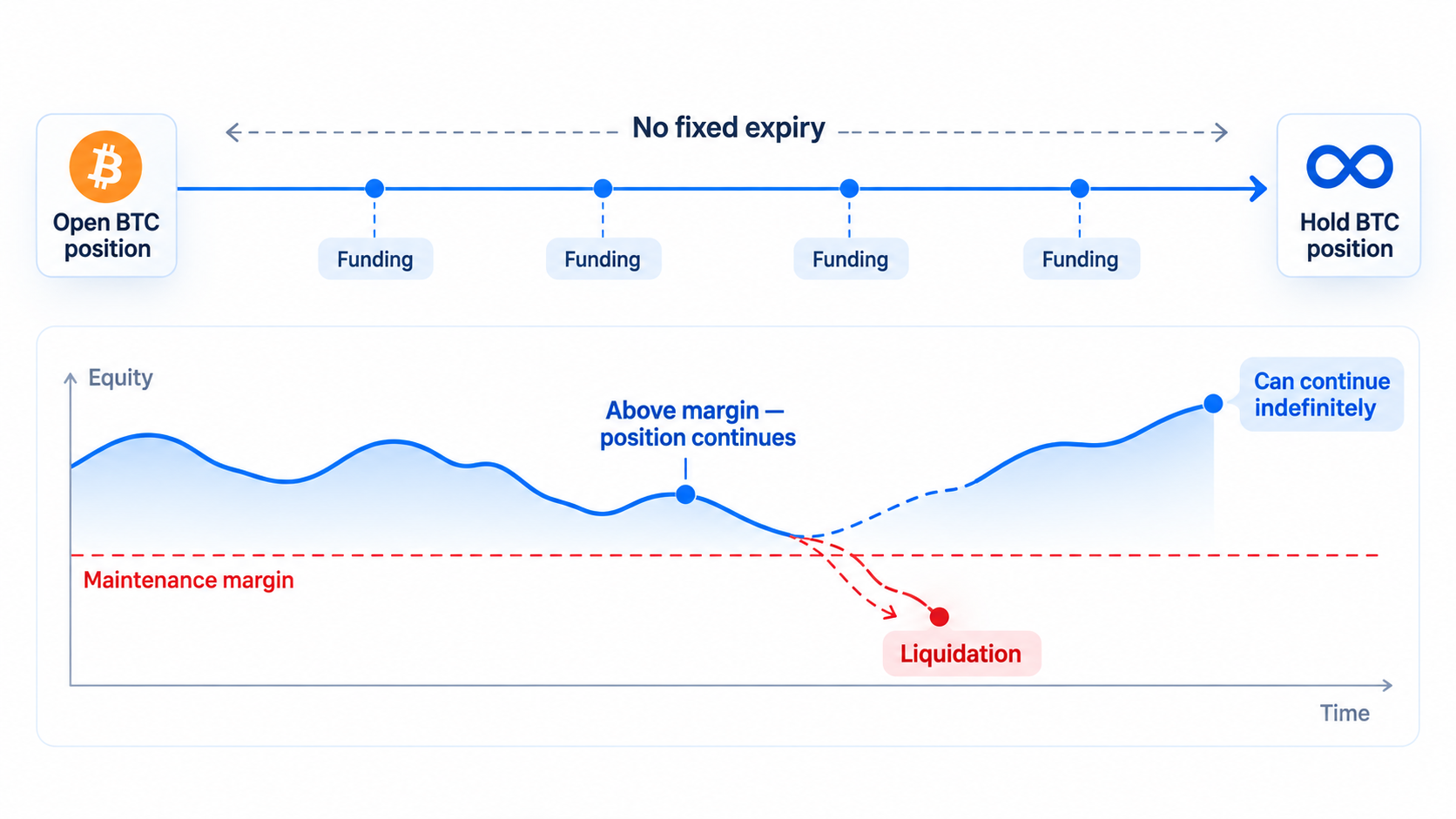
Leverage magnifies the movement of the underlying asset against the capital backing your trade. Maintenance margin also means you don’t normally get all the way to a zero balance before liquidation starts. Your platform wants a buffer. Once your remaining equity reaches that maintenance threshold, it can start reducing or closing the position rather than waiting for every dollar of margin to disappear.
Funding will change the cost of staying open
Funding is where long-term perp positions start to look different from short trades. Unlike dated futures, perpetuals don’t settle on a maturity date, so exchanges need another way to keep the contract close to spot. Funding payments do that.
When funding is positive, longs generally pay shorts. When it is negative, shorts generally pay longs. How often that happens depends on where you trade.
Polymarket and Hyperliquid settle funding hourly. Kalshi currently settles crypto funding every eight hours. Binance defaults to eight-hour intervals but can shorten them, while OKX supports eight-, four-, two- and one-hour schedules depending on the contract and market conditions.
And funding keeps happening for as long as you keep the position open. If you’re in a position for a few hours, it may barely register. Keep the same exposure for three months during a period of consistently expensive funding and it becomes a much bigger part of the trade.
A small eight-hour funding rate can become a meaningful cost when it repeats across a long hold.
Funding cost and break-even over time
| Holding period | Cost at 0.005% / 8h | Cost at 0.01% / 8h | Cost at 0.03% / 8h | BTC gain needed to offset 0.01% funding |
|---|---|---|---|---|
| 7 days | $10.50 (0.105%) | $21 (0.21%) | $63 (0.63%) | ≈ 0.21% |
| 30 days | $45 (0.45%) | $90 (0.90%) | $270 (2.70%) | ≈ 0.90% |
| 90 days | $135 (1.35%) | $270 (2.70%) | $810 (8.10%) | ≈ 2.70% |
| 180 days | $270 (2.70%) | $540 (5.40%) | $1,620 (16.20%) | ≈ 5.40% |
| 365 days | $547.50 (5.475%) | $1,095 (10.95%) | $3,285 (32.85%) | ≈ 10.95% |
Assumptions: $10,000 constant notional position; funding settles every eight hours; rate stays unchanged for the full holding period; positive funding is paid by the long. Excludes trading fees, slippage and changes in notional value. Real funding can rise, fall or turn negative.
Rates don’t stay fixed either. You could pay funding today and receive it next week. That’s why taking today’s funding rate, multiplying it out for 365 days and calling that your expected annual cost can give you a pretty bad answer.
DeFi Rate’s live perp data lets you compare current funding rates across platforms and estimate the cost for your own position size and intended holding period. For a position you’re expecting to hold for weeks or months, the current rate is only part of the picture. Recent funding history matters too.
Funding can push your position toward liquidation
Funding isn’t separate from your margin. If funding payments are taken from the collateral supporting your position, they reduce the buffer between your current equity and maintenance margin.
The market doesn’t necessarily need to collapse against you in one move. You can be slowly losing some of that buffer to funding while smaller adverse price moves are also eating into unrealized P&L. Eventually those two things can meet the maintenance threshold.
There are a few moving pieces here: price, funding, your available collateral and the maintenance requirement itself. Some maintenance requirements can also change.
Kalshi says its margin requirements can move with volatility. Binance and OKX can change leverage and margin tiers. Coinbase U.S. can apply higher margin requirements outside its intraday margin window. So your liquidation buffer isn’t necessarily something you calculate once when you open the position and never look at again.
Leverage reduces your room for a long hold
Leverage doesn’t create a maximum holding period. It changes how much market movement you can survive while getting there. If you put up $1,000 against $1,000 of exposure, you have far more room than if that same $1,000 is supporting $10,000 of exposure.
The same BTC drawdown has a much larger effect on your equity as leverage rises.
BTC drawdown impact by leverage
| BTC price move | 1x perp | 2x perp | 5x perp | 10x perp |
|---|---|---|---|---|
| -5% | ≈ -5% equity impact | ≈ -10% | ≈ -25% | ≈ -50% |
| -10% | ≈ -10% | ≈ -20% | ≈ -50% | Theoretical -100%; liquidation would usually occur earlier |
| -20% | ≈ -20% | ≈ -40% | Theoretical -100%; liquidation would usually occur earlier | Beyond viable range for a 10x long |
| -30% | ≈ -30% | ≈ -60% | Beyond viable range for a 5x long | Beyond viable range for a 10x long |
| -50% | ≈ -50% | Theoretical -100%; liquidation would usually occur earlier | Beyond viable range for a 5x long | Beyond viable range for a 10x long |
Assumption: simplified long-position illustration. Approximate equity impact is price move × leverage before maintenance margin, funding, fees and platform-specific liquidation mechanics. It is not an exact liquidation-price table.
Use the platform table above for venue-specific maintenance-margin and liquidation rules.
Funding is also based on the size of the position, not simply the cash you deposited. That’s why leverage matters so much for a long hold. At higher leverage, a relatively small price move can consume a much larger percentage of the equity supporting the position. You also have more notional exposure generating funding payments relative to the amount of your own capital you put down.
There isn’t a rule saying you can’t hold a 10x perpetual for six months. Whether the position survives six months is the other part.
Holding 1x perps
At 1x leverage, your liquidation risk looks very different. If the capital backing your position is roughly equal to its notional value, you’ve got much more room for adverse price movement than you would at 5x, 10x or 20x.
It still isn’t the same thing as owning the asset. Funding continues. Margin rules still apply. You hold a derivative rather than the underlying asset and the exchange can change certain risk parameters or eventually discontinue a contract. A 1x position can therefore still be liquidated, although it generally takes a much larger deterioration in your equity than a highly leveraged position.
For a long holding period, the bigger question may eventually become why you’re using a perp instead of spot exposure in the first place. If you need short exposure, capital efficiency or the ability to hedge another position, there may be a clear reason. If all you want is unleveraged long exposure for several years, paying or receiving variable funding the entire time changes the equation.
Contract delisting and forced settlement
Indefinite doesn’t mean an exchange promises to operate the same perpetual contract forever. Markets can be suspended or delisted.
Coinbase U.S., for example, currently says its perpetual-style contracts have no expiration date or final settlement date. But its rules still allow a contract to be delisted or terminated, at which point open positions can be closed or cash settled. Kraken makes a similar distinction in its current linear contract specifications. Its contracts trade perpetually, but Kraken reserves the ability to suspend or settle a contract under certain circumstances.
For a position you expect to keep open for a weekend, this probably isn’t high on your list of concerns. For something you expect to hold for years, it belongs there.
How perps and spot work over longer periods
The lack of an expiration date makes perps look a little more like spot than traditional dated futures, but the mechanics are still different.
Spot BTC vs. 1x BTC perp vs. 5x BTC perp
| Feature | Spot BTC | 1x BTC perp | 5x BTC perp |
|---|---|---|---|
| Scheduled expiry | No | No | No |
| Own the underlying BTC | Yes | No | No |
| Recurring perp funding | No | Yes | Yes |
| Maintenance margin | No* | Yes | Yes |
| Liquidation risk from price decline | No* | Possible, but much more room than higher leverage | Materially higher |
| Can take short exposure | Not directly | Yes | Yes |
| Approx. BTC exposure per $1,000 capital | $1,000 | ≈ $1,000 | ≈ $5,000 |
| Funding exposure | $0 perp funding | Based on ≈ $1,000 notional | Based on ≈ $5,000 notional |
| Long-hold mechanics | Price exposure without perp margin/funding | Funding + margin remain active | Funding + margin + tighter liquidation buffer |
Assumes unleveraged spot purchased without borrowed funds. A margined or borrowed spot position has different liquidation and financing mechanics. Perp funding direction and amount vary over time.
With spot, you own the asset. Assuming you didn’t borrow to buy it, a fall in price doesn’t trigger liquidation and there is no perpetual funding payment.
With a perp, you have derivative exposure to the price. That lets you go short. It lets you use leverage. It can also make hedging a lot easier.
But margin and funding stay attached to the trade for however long you keep it open. Over a few hours, that distinction might be small. Over a year, not so much.
Your limit on a perpetual position
There isn’t a standard 30-day, 90-day or one-year limit for true perps. You could theoretically keep one open for years. In reality, the life of your position comes down to margin, funding, leverage and whether the contract remains listed.
Maintenance margin is the line to pay particular attention to. Initial margin tells you what you need to get into the trade. Maintenance margin tells you how far your account can deteriorate before the platform begins taking control of how you get out.
For a short trade, having no expiration mostly gives you flexibility. For a long hold, there’s more going on. Funding has longer to accumulate, your position has to survive more volatility, and your margin requirements may not stay exactly where they were on day one. The contract has no clock. Your position still does, in a sense.
FAQ
A true perpetual futures contract has no scheduled end date, so you can theoretically hold it indefinitely. You still need enough equity to meet the platform’s maintenance margin requirement, funding continues to apply and the contract has to remain listed.
BTC perps on major platforms can generally be held indefinitely when the specific contract has no scheduled expiration. Your actual holding period depends on whether your position continues to meet its maintenance margin requirement.
Maintenance margin is the minimum equity you need to keep a perp open. It is lower than the initial margin needed to open the position on many platforms. If your equity falls below the maintenance requirement, liquidation can begin.
No. Polymarket calculates it from each market’s maximum leverage, Hyperliquid ties it to maximum leverage by asset, Kraken uses contract-level schedules, and Binance and OKX use tiered systems. Kalshi says its maintenance margin is typically around 90% of initial margin. Coinbase’s requirements vary by product and account structure.
You pay or receive funding according to the platform’s settlement rules while your position remains open. Some platforms settle hourly while others normally use eight-hour intervals. On platforms that assess funding only at a settlement point, closing before that settlement can mean you don’t participate in that particular funding payment.
Funding can contribute to liquidation because funding debits can reduce the equity supporting your position. If the combination of funding costs and trading losses takes your equity below maintenance margin, liquidation can begin.
Yes. Lower leverage gives you considerably more room for an adverse price move, but it doesn’t remove maintenance margin requirements. A large enough loss, funding costs or changes in collateral value can still take your equity below the required level.
Yes. No scheduled expiration doesn’t mean a contract can never be discontinued. Exchanges can suspend or delist perpetuals according to their rules, and open positions may then be closed or cash settled.
There is no set deadline on a true perpetual future. You can close it after a few minutes or keep it open for months or years, provided you continue meeting the platform’s margin requirements.
You can, but keeping a perp open means staying exposed to funding payments, margin requirements and liquidation risk. For unleveraged long-term exposure, holding the underlying asset can be simpler because there is no perpetual funding payment.
No. A funding time isn’t an expiration date. If your position remains open when funding is settled, you may pay or receive funding depending on the rate and your side of the trade.
Yes. There is no requirement to close simply because the position is profitable. You still need to maintain sufficient margin, and funding continues for as long as the position remains open.