


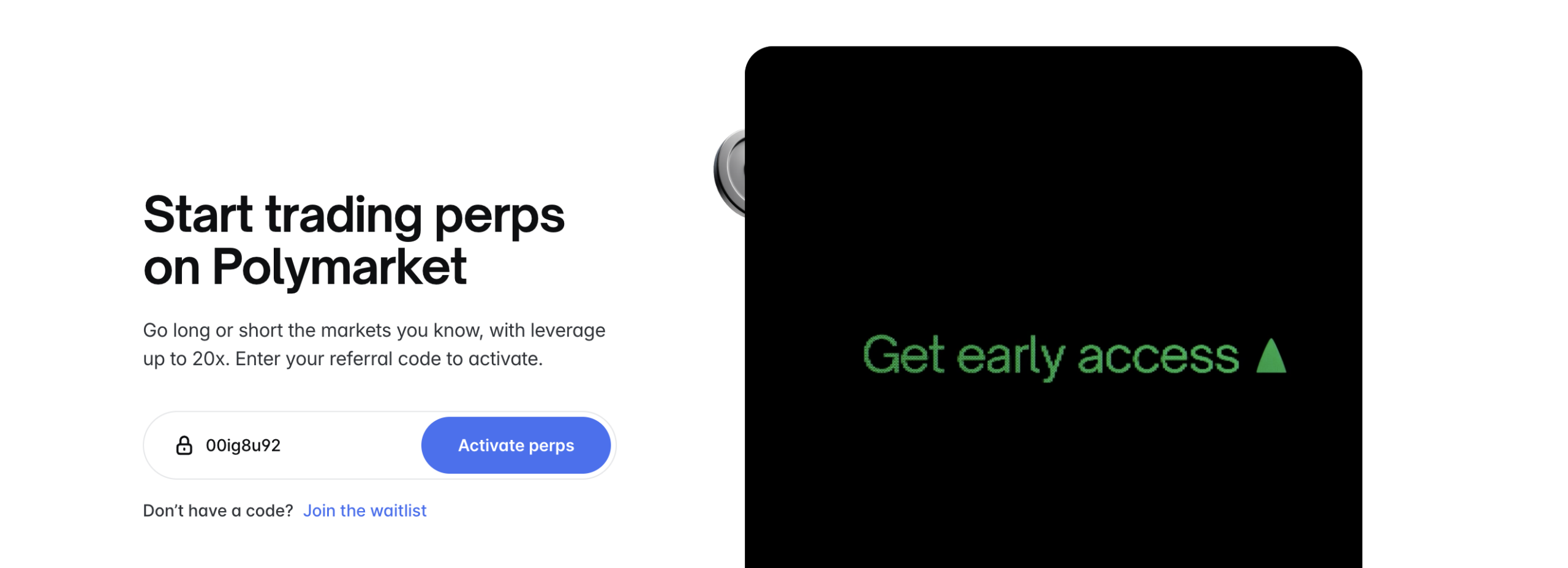
Polymarket is about to launch perpetual futures across crypto, stocks, indices and commodities. You can gain early access by visiting Polymarket here, clicking on Perps and using the Polymarket invite code 00ig8u92 to gain early access.
Perps are separate from the prediction markets Polymarket is known for. Instead of buying Yes or No shares on an outcome, you can go long or short on an asset’s price, use leverage and keep the position open without an expiry date.
Below, we break down the code, current markets, how the contracts work, leverage, margin, liquidation, funding, fees and what we will be watching once public trading opens.
Polymarket perps invite code for early access
Our exclusive Polymarket perps access code is 00ig8u92. Polymarket labels the activation field a referral code; you may also see the same code described as a Polymarket perps promo code. The table below provides the details you need to get started.
| Polymarket Perps | Details |
|---|---|
| Polymarket invite code | 00ig8u92 |
| Launch date | August 2026 |
| Early-access offer | Activate perps without joining the waitlist |
| Markets | Crypto, stocks, indices and commodities |
| Maximum leverage | Up to 20x; lower on some markets |
| Trading | 24/7 |
| Funding | Hourly |
| Collateral | pUSD |
There is currently no advertised cash bonus or free trading credit attached to the code. Ahead of launch, the main benefit is access to the perps product.
How to use Polymarket perps invite code
- Open Polymarket perps: Go to the perps section of Polymarket. This is where you can access the perps markets and enter your invite code.
- Enter invite code 00ig8u92 and activate perps: Enter the code in the access code field and select Activate perps. This will give you instant access vs. signing up for the waitlist.
- Fund your balance: Add funds to use as collateral for your trades. Polymarket uses pUSD as collateral for perps.
- Choose what you want to trade: Select a market such as BTC-USD, ETH-USD, SP500-USD or GOLD-USD. Check the current price, funding rate, open interest and order book before you trade.
- Choose long or short: Go long if you expect the market to rise or short if you expect it to fall. You’re trading the price of the underlying market, not choosing Yes or No as you would with a Polymarket prediction.
- Set your position size and leverage: Decide how large you want your position to be and how much leverage you want to use. Polymarket offers up to 20x leverage on markets including BTC-USD, ETH-USD, SOL-USD, SP500-USD and GOLD-USD, while markets such as AMZN-USD and SPCX-USD currently offer up to 10x.
- Review the trade: Check your entry price, position size, leverage, liquidation price, funding rate and fees before you submit the order. You should also check the spread and available order-book depth, particularly on less active markets.
- Place and manage your position: Submit your order. Once it fills, you can track your P&L, margin and liquidation price from the trading interface. Your perp has no fixed expiration date, so you can close the position when you choose as long as you maintain the required margin.
What is Polymarket perps?
Polymarket perps is a perpetual futures trading product. A perp lets you trade the price of a market without owning the underlying asset.
Go long if you expect the price to rise. Go short if you expect it to fall. Unlike a traditional futures contract, a perp has no fixed expiration date. You can keep the position open until you close it, provided you continue to meet Polymarket’s margin requirements.
Polymarket currently advertises leverage of up to 20x, although the limit is set by market and can be lower. Leverage makes it possible to open a position larger than the collateral behind it, but it also brings the liquidation price closer to your entry.
What can you trade on Polymarket perps?
Polymarket perps currently spans crypto, stocks, indices and commodities. Each instrument has its own order book, funding rate, open interest and leverage limit. The lineup can change, so the tables below should be treated as current markets rather than a permanent list.
Crypto perps
Crypto is the most familiar part of the product. Current Polymarket markets include major assets such as Bitcoin, Ethereum and Solana, along with smaller crypto markets.
| Asset | Market | What you trade | Leverage shown |
|---|---|---|---|
| Bitcoin | BTC-USD | Bitcoin price | Up to 20x |
| Ethereum | ETH-USD | Ethereum price | Up to 20x |
| Solana | SOL-USD | Solana price | Up to 20x |
| Hyperliquid | HYPE-USD | HYPE price | Market-specific |
| Lighter | LIT-USD | LIT price | Up to 10x |
BTC-USD lets you take a direct long or short position on Bitcoin. You do not need to pick a target price or resolution date, as you would with a prediction market. The position remains open until you close it or it is liquidated. For event-based BTC contracts instead, see DeFiRate’s crypto prediction markets.
Stock perps
Polymarket also lists equity-linked perps. These let you trade a company’s reference price without owning shares in the company.
| Asset/company | Market | What you trade | Leverage shown |
|---|---|---|---|
| Amazon | AMZN-USD | Amazon share price | Up to 10x |
| SpaceX | SPCX-USD | SpaceX reference price | Up to 10x |
| Micron Technology | MU-USD | Micron share price | Market-specific |
| SK Hynix | SKHY-USD / SKHYNIX-USD | SK Hynix reference price | Market-specific |
Pay attention to the leverage as not all are equal. Amazon is a good example of a perp with less than the advertised 20x leverage, showing a 10x maximum.
SpaceX is also different from a normal listed-stock perp because SpaceX is private. For markets like this, the reference price and methodology matter as much as the ticker. We will verify the live market specification at launch rather than treating it as identical to an exchange-listed stock.
Stock perps remain open when the primary US stock market is closed. That makes spread, depth and fills outside regular trading hours particularly important.
Index perps
Index perps let you trade a broader market rather than one company.
| Index | Market | What you trade | Leverage shown |
|---|---|---|---|
| S&P 500 | SP500-USD | S&P 500 index price | Up to 20x |
| Nasdaq 100 | NAS100-USD | Nasdaq 100 index price | Up to 20x |
| DRAM index | DRAM-USD | DRAM-related reference/index | Market-specific |
SP500-USD lets you go long or short the S&P 500 without buying an ETF or using a dated futures contract. Polymarket’s live SP500 page currently shows mark price, oracle price, 24-hour volume, open interest and funding alongside the order book.
The perp stays open outside regular US market hours, which makes overnight and weekend liquidity one of the areas we will watch after launch.
Commodity perps
Polymarket also lists commodity markets, including precious metals and energy.
| Commodity | Market | What you trade | Leverage shown |
|---|---|---|---|
| Gold | GOLD-USD | Gold price | Up to 20x |
| Silver | SILVER-USD | Silver price | Up to 20x |
| WTI crude oil | WTIOIL-USD | WTI oil price | Up to 20x |
A GOLD-USD position gives you long or short exposure to gold without owning physical gold, an ETF or a traditional futures contract. WTI works the same way for oil.
These markets are especially worth watching outside normal underlying-market hours. The Polymarket order book can remain open even when liquidity in the traditional market is thinner.
Polymarket doesn’t use the same leverage for every market
Up to 20x is the platform maximum, not a guarantee that every market offers 20x. Polymarket sets leverage at the instrument level and can apply lower limits as position size increases. The live market should be checked before placing a trade, but the chart below gives you a quick illustration of what you’re looking at.
| Market | Current maximum |
|---|---|
| BTC-USD | 20x |
| ETH-USD | 20x |
| SOL-USD | 20x |
| SP500-USD | 20x |
| GOLD-USD | 20x |
| AMZN-USD | 10x |
| SPCX-USD | 10x |
| LIT-USD | 10x |
How do Polymarket perps markets work?
Buyers and sellers place orders in the Polymarket order book. Your fill depends on the bids and asks available there, while separate reference prices help keep the contract tied to the market it tracks. Each perp is designed to track another market, but your actual trade happens on Polymarket.
There are three prices worth knowing:
- Fill price: where your order actually executes.
- Index/oracle price: an external reference for the underlying market.
- Mark price: Polymarket’s reference for P&L, margin and liquidation.
Those prices can differ. If Bitcoin is trading around $120,000 elsewhere, that does not mean a Polymarket market order will fill at exactly $120,000. The spread and available depth in Polymarket’s order book determine the fill.
How Polymarket crypto perps work
Crypto is the simplest case because the underlying market already trades around the clock.
Say Bitcoin is trading at $120,000 and you open a $1,000 BTC-USD long. If BTC rises 5% to $126,000, the position gains about $50 before fees and funding. If BTC falls 5% to $114,000, the position loses about $50.
At 10x leverage, you would need roughly $100 in initial margin to open that $1,000 position. The P&L is still based on the $1,000 position: the higher leverage changes how much collateral supports it and brings the liquidation price closer to your entry.
A $1,000 BTC-USD short works in reverse. It would gain about $50 if BTC fell 5% to $114,000 and lose about $50 if BTC rose 5% to $126,000, before fees and funding.
If you want to trade a defined Bitcoin price outcome instead of continuous BTC price exposure, DeFiRate also tracks Bitcoin price predictions across prediction markets.
The Polymarket contract has its own order book. Its index and mark pricing keep the perp connected to the broader BTC market, while hourly funding helps limit sustained gaps between the perp and its reference price.
How Polymarket stock perps work
Stock perps let you go long or short a company’s price without receiving shares or shareholder rights.
Take Amazon around an earnings report. Suppose AMZN closes regular trading at $220 and Amazon releases results after the bell. If the Polymarket AMZN-USD perp moves to $231 as traders react, a $1,000 long opened at $220 would be up about 5%, or roughly $50 before fees and funding. A short would be down by roughly the same amount.
The important part is when that move happens. Polymarket keeps the perp order book open outside regular US stock-market hours, so traders can react while the primary exchange is closed rather than waiting for the next cash-market session.
Polymarket changes the external pricing sources it uses depending on whether the underlying market is in a regular, overnight, weekend, disrupted or halted session. Its own order book remains open, while funding, margin checks and liquidation continue. That means a stock perp can keep moving and a leveraged position can still be liquidated when the primary exchange is closed.
How Polymarket index perps work
An index perp lets you trade a broad market move rather than the fortunes of one company.
Suppose the S&P 500 reference is at 6,500 before a major inflation report. The data comes in hotter than expected and the index falls 1% to about 6,435. A $2,000 SP500-USD short would gain roughly $20 before fees and funding; a $2,000 long would lose roughly $20.
That position reflects the move in the broader index. You are not buying an S&P 500 ETF or shares in the 500 companies, and you do not need to decide which individual stock will drive the move.
Polymarket keeps SP500-USD trading outside regular US market hours. Its external reference data helps maintain the index and mark pricing while the Polymarket order book determines the price where your trade actually fills.
How Polymarket commodity perps work
Commodity perps let you trade markets such as gold, silver and WTI crude oil without owning the physical commodity, an ETF or a dated futures contract.
Gold around a Fed decision is a useful example. Suppose GOLD-USD is at $3,400 before the announcement and you open a $1,500 long because you expect a dovish decision to push gold higher. If gold rises 2% to $3,468, the position gains about $30 before fees and funding. If gold falls 2%, the position loses about $30.
That trade is separate from a Polymarket prediction on what the Fed will do. The gold perp tracks the price move; the prediction market prices the outcome of the Fed decision.
The Polymarket order book determines your fill, while external pricing helps anchor the contract to the underlying commodity market. Because commodity perps remain open 24/7, spread and depth can become especially important when the traditional underlying market is quieter or closed.
How to trade Polymarket perps
Once your perps account is active, choose the market you want to trade. The market page surfaces information such as mark price, oracle price, 24-hour volume, open interest, funding and the order book.
Choose long or short, enter your position size and set your leverage. Before submitting the order, check:
- Position size: Check the total notional value of the position you are opening, not just the margin you are putting behind it. This determines how much your P&L changes when the market moves.
- Leverage: Check how much leverage you are using and how much margin is supporting the position. Higher leverage puts your liquidation price closer to your entry.
- Entry/order price: Check the price you are asking to trade at and, once filled, the actual entry price. On a market order, the final fill can differ from the price first shown if the book moves or liquidity is thin.
- Estimated liquidation price: Check the mark price at which your available margin would no longer meet Polymarket’s maintenance requirement. The closer it is to your entry, the less room the trade has to move against you.
- Current funding rate: Check whether funding is positive or negative and whether your side of the trade is currently paying or receiving. Funding settles hourly and can add up if you keep a position open.
- Spread and available depth: Check the gap between the best bid and ask and how much size is available near your intended price. A wide spread or shallow book can make your entry or exit more expensive, particularly on larger orders.
- Take profit or stop loss: If you are using either, check the trigger prices before submitting the trade. A take-profit order can close the position at your target, while a stop loss is intended to limit how far a losing trade runs before you exit.
How leverage works on Polymarket perps
For a leveraged trade, liquidation price is one of the most useful numbers on the ticket. It tells you how much room the position has to move against you before Polymarket can start closing it. Leverage lets you control a larger position with less margin.
| Leverage | $100 margin controls |
|---|---|
| 2x | $200 |
| 5x | $500 |
| 10x | $1,000 |
| 20x | $2,000 |
At 10x, $100 of margin supports a $1,000 position. A 1% move in the underlying represents roughly a $10 move in the position before fees and funding.
The same applies in the other direction. Higher leverage means less room for the market to move against you before liquidation becomes a risk. You do not have to use the maximum leverage available.
Perps are one way to create leveraged crypto exposure. Borrowing against crypto can also be used to increase market exposure, but the interest costs, collateral requirements and liquidation mechanics are different.
- How margin and liquidation work: Margin is the collateral supporting your position. Polymarket uses an initial margin requirement to open or increase a trade and a maintenance margin requirement to keep it open. If you no longer have enough margin to support the position, Polymarket can begin liquidation. It uses the mark price, not simply the last traded price, when evaluating margin.
- Isolated and cross margin: With isolated margin, collateral is assigned to an individual position. A problem in that trade is contained to the margin allocated to it. Cross margin shares available collateral across supported positions. That can give a losing position more room, but it also puts more of the account behind the group of positions. Polymarket’s interface currently uses isolated margin by default.
What happens during liquidation?
If margin falls below the required maintenance level, Polymarket starts reducing the affected position through the order book. Available liquidity matters because liquidation is not guaranteed to happen in one clean fill at the exact price shown when the process starts.
Liquidation fills can carry an additional fee. Polymarket also documents an insurance fund and auto-deleveraging system for more severe cases.
The practical number to watch before any of that happens is your liquidation price.
How Polymarket perps funding works
Funding is one of the costs to check before leaving a position open. Polymarket settles funding every hour.
If funding is positive, longs pay shorts. If funding is negative, shorts pay longs.
The payment moves between traders. Funding helps keep the perp close to its reference market by making the more crowded side of the trade more expensive to hold.
Funding also affects P&L. A long can be moving in the right direction while positive funding is still reducing the return.
How Polymarket calculates funding
Polymarket checks each market’s order book every five seconds to measure whether the perp is trading above or below its index price. It averages those readings over a one-hour window and settles the resulting funding rate against open positions at the end of the hour.
| Funding settling | Polymarket default | What it means |
|---|---|---|
| Order-book sample | Every 5 seconds | Checks the gap between the perp and index throughout the hour |
| Impact notional | 1,000 quote notional | Uses this amount of order-book depth to calculate impact VWAP |
| Funding settlement | Every 1 hour | Open positions pay or receive funding hourly |
| Crypto funding scale | 1.0 | Full funding formula applies to crypto markets |
| Non-crypto funding scale | 0.5 | Stocks, indices and commodities use half the crypto scale |
| Interest component | 0.01% per 8 hours | Fixed component in the funding formula |
| Interest clamp | ±0.05% | Limits the interest-versus-premium adjustment |
| Maximum funding rate | ±4% per hour | Caps funding during extreme dislocations |
A positive funding rate means longs pay shorts; a negative rate means shorts pay longs. Funding is transferred between traders rather than kept by Polymarket.
| Market condition | Funding rate | Longs | Shorts |
|---|---|---|---|
| Market condition | Funding rate | Longs | Shorts |
| Perp trading above index | Positive | Pay | Receive |
| Perp trading below index | Negative | Receive | Pay |
Between hourly settlements, Polymarket publishes the rolling premium and implied funding rate, so traders can see funding pressure building before the next payment. You can also compare current perps funding rates on DeFiRate.
How maker and taker fees are calculated
Polymarket perps uses maker and taker fees. A maker adds liquidity to the order book. A taker trades against liquidity already available.
Perps fees are separate from Polymarket prediction-market fees. The live perps fee schedule should be treated as the source of truth for the perps product.
| 30-day perps volume | Taker fee | Maker fee |
|---|---|---|
| $0+ | 0.0400% | 0.0125% |
| $1M+ | 0.0370% | 0.0100% |
| $5M+ | 0.0350% | 0.0080% |
| $25M+ | 0.0300% | 0.0050% |
| $100M+ | 0.0270% | 0.0020% |
| $500M+ | 0.0250% | 0.0000% |
| $1B+ | 0.0200% | -0.0050% |
Fees are based on the notional value of the trade, not only the margin behind it. If $100 of margin controls a $1,000 position, the relevant trading value is $1,000.
The real cost of a trade can include trading fees, funding and spread/slippage. Liquidation can add further costs.
Mark price vs. index price
Polymarket uses several prices for the same perp, and they do different jobs. Your fill comes from the order book, the index estimates the underlying market’s fair value, and the mark is the price used to calculate P&L and liquidation risk.
| Price | Where it comes from | Used for | Why |
|---|---|---|---|
| Fill / last price | Polymarket order book | Records where trades execute | This is the price you actually get when your order fills |
| Index price | Weighted external price feeds | Reference for the underlying asset’s fair value | Shows where the broader underlying market is trading |
| Mark price | Median of three Polymarket price candidates | Unrealized P&L, margin, liquidation, funding premium and risk checks | This is the key price to watch against your liquidation price |
The index price is built from external feeds such as Pyth, Chainlink Data Streams and Hyperliquid. Polymarket drops stale prices, filters outliers and uses a weighted average of the remaining feeds. The feed set can change with the market session.
The mark price is more defensive. Polymarket updates it every 200 milliseconds and takes the median of three candidates:
| Mark-price input | How it is built | What it adds |
|---|---|---|
| C1: Smoothed order-book mid | Index plus a 150-second EMA of the local midpoint versus index | Tracks the Polymarket book but resists short-lived moves |
| C2: Local market activity | Median of best bid, best ask and a recent last trade | Responds to what is actually trading on Polymarket |
| C3: External mark | Filtered and weighted external mark feeds | Adds an independent price signal outside the local book |
Polymarket then uses the median of C1, C2 and C3. At least two of the three signals generally need to move for the mark to shift, which reduces the chance that one thin trade or one bad feed moves the liquidation reference on its own.
If a local input is unavailable, Polymarket falls back toward the index price. In the worst case, when the local book, recent trades and external mark feeds are unavailable, the mark tracks the index directly.
For a leveraged position, the practical rule is simple: check your fill price to know where you entered, but watch the mark price when you are monitoring P&L, margin and liquidation.
Are Polymarket perps the same as predictions?
No. Polymarket perps and Polymarket prediction markets are separate products. Prediction markets let you trade an outcome. Perps let you trade a price.
| Polymarket Perps | Polymarket Predictions | |
|---|---|---|
| You trade | Asset/reference price | Event outcome |
| Position | Long or short | Yes or No / outcome shares |
| Example | BTC-USD | Will BTC hit $150K? |
| Expiration | None | Defined resolution |
| Leverage | Up to 20x | No perps-style leverage |
| Funding | Yes | No |
| Margin | Yes | No |
| Liquidation | Possible | No margin liquidation |
| Payout | Based on price move | Winning share settles at $1 |
If you think Bitcoin is going up, you can go long BTC through perps. If you think Bitcoin will hit a specific price before a specified date, that is a prediction-market trade.
The products remain separate, even as prediction markets and perpetual trading increasingly sit alongside each other on the same platforms.
What we like so far
- Market selection: Polymarket is not building a crypto-only perps product. Stocks, indices and commodities give the product a broader use case.
- 24/7 trading: Being able to trade stock, index and commodity perps outside their normal underlying-market hours is useful when news breaks overnight or on a weekend.
- Trading data: Mark price, funding, volume and open interest are surfaced directly on the market pages.
What we’re watching after launch
- Liquidity and order-book depth on the largest markets.
- Bid-ask spreads, especially on stock and commodity perps.
- Slippage between the expected price and actual fill.
- Funding on positions held through multiple hourly cycles.
- Off-hours liquidity for stocks, indices and commodities.
- Whether lower-volume markets have enough depth for practical position sizes.
We will update the review with live trading observations after the public launch rather than treating early-access liquidity as the final picture.
FAQ
What is the Polymarket perps promo code?
The Polymarket perps invite code is 00ig8u92. Polymarket calls the activation field a referral code, while traders may also search for it as a Polymarket perps promo code. Enter 00ig8u92 when activating perps.
When does Polymarket perps launch?
Polymarket perps launches publicly on August 14, 2026. The product has been available to selected users through early access before the public launch.
Does the Polymarket perps invite code give you a bonus?
No cash or trading-credit bonus is currently advertised for Polymarket perps invite code 00ig8u92. Ahead of the August 14 public launch, the code is used to activate access without joining the general waitlist.
Are Polymarket perps prediction markets?
No. Polymarket perps and Polymarket prediction markets are separate products. Perps let you go long or short an asset or reference price using margin, leverage and funding; prediction markets let you trade the outcome of a defined event.
Do Polymarket perps expire?
No. Polymarket perps do not have a fixed expiration date. A position can remain open until you close it or it is liquidated, provided you continue to meet the margin requirements.
How much leverage does Polymarket perps offer?
Polymarket perps offers up to 20x leverage on BTC-USD, ETH-USD, SOL-USD, SP500-USD and GOLD-USD. Current markets with lower limits include AMZN-USD, SPCX-USD and LIT-USD at up to 10x. The leverage cap is set for each individual perp, and Polymarket can reduce the leverage available as position size increases through its risk tiers.
Can you short Polymarket perps?
Yes. Polymarket perps supports both long and short positions. Go long when you expect the reference price to rise and short when you expect it to fall.
How often is Polymarket perps funding charged?
Polymarket perps settles funding every hour. When funding is positive, longs pay shorts; when it is negative, shorts pay longs.
What is pUSD?
pUSD is the collateral used to support positions on Polymarket perps. Your pUSD balance backs the margin required for open perp positions.
Can you trade Polymarket perps in the US?
Polymarket’s international perps product is separate from Polymarket US. US availability should be checked against Polymarket’s current perps geographic restrictions before trading.
Can you trade Polymarket perps in Canada?
Polymarket perps availability in Canada should be checked against Polymarket’s current geographic restrictions before trading. The perps product has its own access rules.
Does Polymarket perps trade on weekends?
Yes. Polymarket perps trades 24/7, including weekends. Crypto already trades around the clock, but Polymarket also keeps its stock, index and commodity perp order books open when their primary underlying markets are closed. This is also an area where Polymarket and Kalshi overlap: Kalshi offers 24/7 crypto perpetual futures trading to approved US-based traders, with scheduled maintenance exceptions. On Polymarket, funding, margin checks and liquidation continue outside regular underlying-market hours, while the external pricing inputs used for its reference prices change with the market session.
Is Polymarket perps the same as futures?
Not exactly. Polymarket perps are perpetual futures: futures-style derivatives with no fixed expiration date. Traditional futures expire on a set date, while a Polymarket perp can remain open as long as margin requirements are met; hourly funding helps keep the contract aligned with its index price. For more context, DeFiRate covers the perpetual futures regulatory debate.