Wisconsin Sues Kalshi, Polymarket, Crypto.com Over Sports Contracts in ‘Race to the Courthouse’
Wisconsin sued Kalshi, Polymarket and Crypto.com, and named Robinhood and Coinbase, arguing sports event contracts are indistinguishable from ordinary sports bets.
Key Takeaways
- State also names Robinhood and Coinbase in Kalshi case, seeking injunctions and forfeitures as it argues prediction markets function as illegal sports betting.
- Wisconsin says sports event contracts are “indistinguishable from an ordinary sports bet,” underpinning its claim that prediction markets violate state gambling law.
- The actions reflect an evolution in states’ strategy which includes what gaming attorney Daniel Wallach calls a “race to the courthouse.”
The Wisconsin Department of Justice has filed a series of lawsuits against major prediction market operators and their distribution partners, alleging that sports event contracts offered by Kalshi, Polymarket, and Crypto.com amount to illegal sports betting under state law. The complaints, announced April 23 by Attorney General Josh Kaul, include a case against Kalshi that also names Robinhood and Coinbase (which offer Kalshi markets on their platforms), while separate filings target Polymarket and Crypto.com individually.
The state is seeking to block the companies from offering sports event contracts to Wisconsin residents and is pursuing civil forfeitures tied to the alleged violations, but is not seeking monetary damages.
The filings come days after New York’s Attorney General filed separate lawsuits against Coinbase and Gemini, marking the latest escalation in a growing state-level push to classify prediction market contracts as gambling rather than federally regulated derivatives. Wisconsin’s approach, however, is more narrowly focused on shutting down sports markets and securing a legal determination, rather than pursuing sweeping financial penalties.
“Our position in this case is that event contracts are no different than ordinary sports bets,” Kaul said during a virtual press conference Thursday according to the Milwaukee Journal Sentinel. “The companies collect a fee, we allege, for every bet that’s made, leading them to earn significant revenue from Wisconsinites through violations of our state’s gambling regulations.”
The Wisconsin suits reflect a broader shift in state strategy against prediction markets. Gaming attorney Daniel Wallach told DeFi Rate that states have clearly recalibrated their strategy, which a year ago mostly consisted of sending cease-and-desist letters often resulting in the non-ideal position of becoming defendants in litigation. The primary strategy now, Wallach says, is to win the “race to the courthouse” by striking first.
Wisconsin’s tribal betting framework shapes legal challenge
Sports betting in Wisconsin is tightly restricted and largely limited to tribal gaming operations, a framework that underpins the state’s legal challenge. Under Wisconsin law, most forms of betting remain illegal, with exceptions carved out through tribal-state compacts that allow wagering on tribal lands.
The complaints repeatedly emphasize that non-tribal operators cannot offer sports betting in the state, pointing to long-standing statutes that prohibit receiving or facilitating bets on sporting events for profit. While lawmakers recently passed legislation allowing certain online wagers routed through servers located on tribal land, that carveout does not apply to the platforms named in the lawsuits, which the state argues are operating entirely outside the authorized system.
“Sports betting and other forms of commercial gambling have long been illegal in the state of Wisconsin,” Kaul said during the press conference. “No company is above this law no matter how creatively those companies try to disguise the activity they’re engaged in.”
Wisconsin says event contracts function as illegal sports wagers
The complaints frame prediction market contracts as functionally identical to traditional wagers, arguing that users are “betting on the outcome of sporting events” regardless of how the products are labeled. In each filing, the state points to contracts that pay out $1 if a specified outcome occurs and nothing otherwise, saying that structure is “indistinguishable from an ordinary sports bet” under Wisconsin law.
The Wisconsin DOJ is asking the court to formally declare that offering those contracts to users in the state violates Wisconsin’s commercial gambling statute, Wis. Stat. § 945.03(1m), and constitutes a public nuisance. The lawsuits seek both preliminary and permanent injunctions that would bar the companies from making sports-related event contracts available to customers located in Wisconsin.
The state also dismisses the platforms’ peer-to-peer structure as irrelevant, arguing that companies still profit from the activity by charging transaction fees on each trade. The filings liken that model to a sportsbook or poker operator taking a cut of wagers, alleging the platforms are “engaging in criminal gambling activity” by facilitating bets for gain.
In the Kalshi suit, Wisconsin extends that theory to access points, alleging that Robinhood and Coinbase provide users with access to contracts executed on Kalshi’s platform, making them part of the same underlying activity.
Next steps in the Wisconsin cases
Each complaint is accompanied by a summons requiring the defendants to respond within 20 days of being served, setting an early procedural timeline for the cases. If the companies fail to file a response, the court could issue a default judgment granting the relief sought by the state, including injunctions and civil forfeitures, a form of statutory financial penalty that allows Wisconsin to recover money tied to alleged illegal gambling activity, rather than pursuing traditional damages.
From there, the cases are likely to move quickly to early motions, including potential requests for preliminary injunctions that could determine whether the platforms can continue offering sports event contracts in Wisconsin while the litigation proceeds. Because the lawsuits are framed as public nuisance actions, the state is positioned to argue for immediate relief rather than waiting for a full trial on the merits.
Wisconsin’s filings are the latest in a series of state-level actions targeting prediction market platforms over sports-related contracts. Officials in states including Arizona, Nevada, and Ohio have taken steps to challenge or restrict such offerings, reflecting increasing pressure on platforms as states move to classify sports event contracts as illegal gambling under local law.
 Polymarket Promo Code RATE: $25 Bonus for Patriots vs. Bears Thursday Night Football
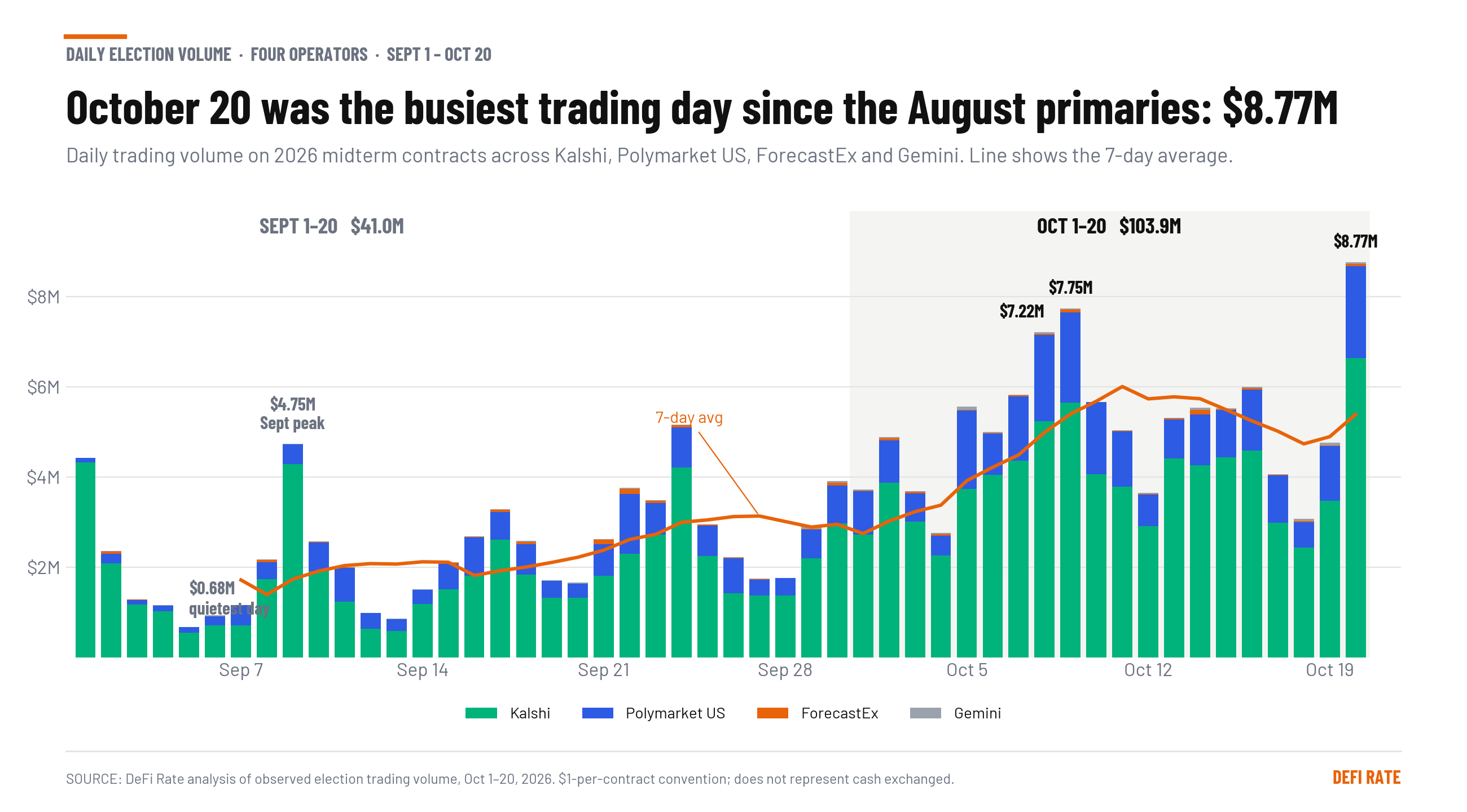 US Election Trading on Kalshi and Polymarket Jumps 153% to $104M Ahead of the Midterms
 Talarico Climbs to 66% on Kalshi as Texas Senate Trading Hits $35M
 Acton Hits 76% on Kalshi in Ohio Governor Race as Ramaswamy Ad Sparks Republican Backlash