







Robinhood’s prediction market revenue surpassed both crypto and equities in the second quarter as event contract activity climbed to another record for the company.
The brokerage reported $156 million in prediction market revenue for the quarter, compared with $100 million from crypto and $129 million from equities. Only options generated more transaction-based revenue.
Robinhood disclosed the results Wednesday in its second-quarter earnings release and discussed the business further during its earnings call event later in the day.
Customers traded 13.6 billion event contracts during the quarter, up 55% from 8.8 billion in the first quarter. The results marked another sharp increase for a business that generated $104 million in revenue during the first three months of the year.
Executives also said Robinhood plans to direct more prediction market activity through Rothera, its designated contract market (DCM) joint venture with Susquehanna International Group, while continuing to connect with outside exchanges.
Robinhood CEO Vlad Tenev said Rothera had “rapidly become a top three DCM” after it began supporting Robinhood’s prediction market business in late May.

Rothera handles 2.1 billion contracts in first month
Prediction market activity accelerated throughout the quarter. Robinhood customers traded 3.2 billion event contracts in April and 3.9 billion in May before volume climbed to 6.4 billion in June, accounting for nearly half of the company’s quarterly total.
Rothera’s first Robinhood-linked contracts went live near the end of May, and the brokerage announced a broader rollout ahead of the World Cup in early June. During roughly its first month of operation, Rothera handled 2.1 billion contracts and accounted for $17 million of Robinhood’s prediction market revenue.
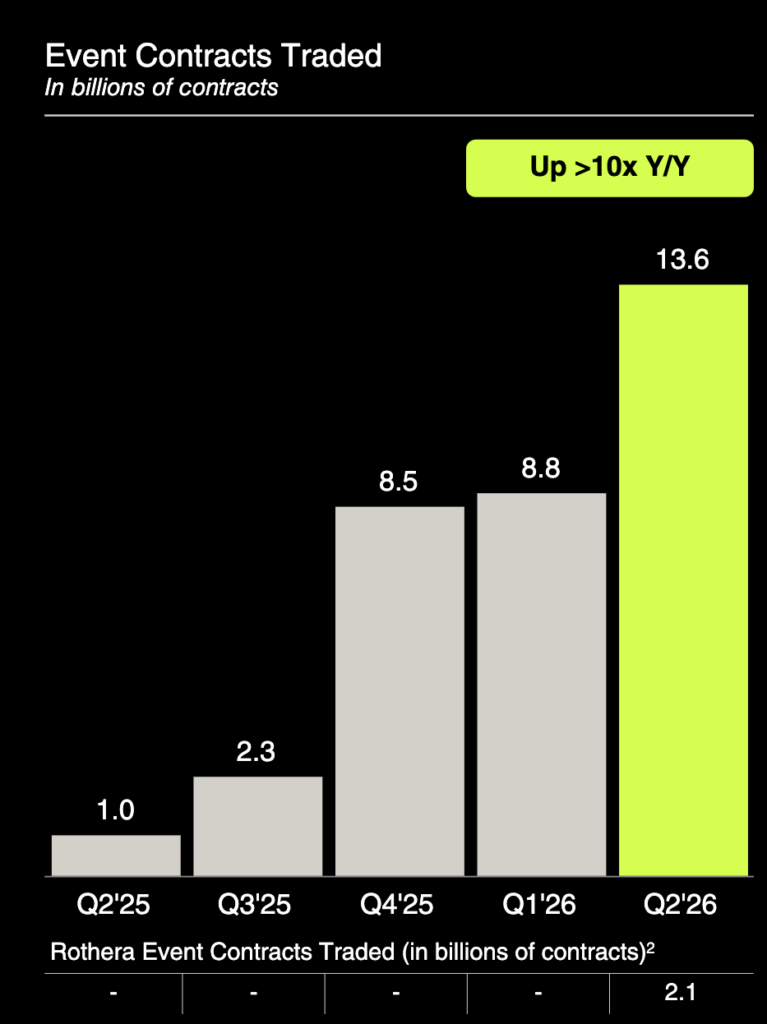
Kalshi remained the primary source of event contracts offered through Robinhood, while ForecastEx played a smaller role. Robinhood is now directing a growing portion of that activity through Rothera, which it jointly owns with Susquehanna.
Tenev said the World Cup provided an early test of Rothera’s ability to handle significant trading volume.
“Rothera has gone live, and I think the World Cup was really a proof of concept there,” Tenev said. “And we’re looking to scale that rapidly and make it much bigger.”
Robinhood expects more event contract flow to shift to Rothera
Robinhood expects Rothera to take on an increasing share of its event contract activity over the near to medium term, though the company is still testing the exchange’s ability to scale.
“More than the majority or a good portion will flow through it there,” CFO Shiv Verma said in response to a question about Robinhood’s routing plans.
“We’re still making sure it can scale, and after one month, it’s already doing tremendous volume,” Verma added. “But yeah, you should expect that more and more of it will start to go through [Rothera].”
Routing more customer activity through Rothera would allow Robinhood to capture more of the revenue generated by prediction market trading rather than sharing the economics with outside exchanges. The executives made clear, however, that Rothera will not become Robinhood’s exclusive venue.
Asked whether Robinhood would prioritize moving activity to Rothera or continue adding exchange partners, Tenev said, “It’s both.”
Tenev said Robinhood intends to send more volume to Rothera because of the more attractive economics while continuing to work with other exchanges to provide a wider range of contracts, competitive pricing and diversification among counterparties.
The question followed a recent Wall Street Journal report that Robinhood was discussing a partnership to offer contracts from Crypto.com. Tenev did not confirm the reported talks, but said Robinhood plans to maintain a multi-exchange strategy while expanding its own venue.
Nearly 2 million customers have used prediction markets
Nearly 2 million Robinhood customers have now used prediction markets, up from the approximately 1.5 million figure Verma cited at an investor conference in late May.
Robinhood said those customers frequently move into other parts of its platform rather than using event contracts as a standalone product.
“If you’re a prediction markets customer, for example, you’re actually more likely to have a retirement account with Robinhood,” Verma said. “And so any vector you come in, whether it’s banking, prediction markets, credit card, you tend to adopt others.”
The company did not break down how much of the recent growth came from new Robinhood customers, existing customers trying prediction markets for the first time or established prediction market users increasing their activity.
Trading also remained elevated after the World Cup-driven increase in June. Verma said average daily volumes so far in July for equities, options and prediction markets were all “in the similar area” of their second-quarter averages.
Asked whether prediction market activity could remain strong after the World Cup, Tenev said other big events are on the horizon.
“I think that the great thing about prediction markets is there’s events all the time,” Tenev said. “You mentioned football season. That’s coming up. There’s also the midterms, which I think are extremely important.”
Robinhood plans to bring perpetual futures to US
Robinhood also signaled that it intends to bring perpetual futures to its U.S. brokerage, although Tenev declined to provide a timeline.
Perpetual futures, commonly called perps, are derivatives that track an underlying asset and can be traded with leverage but, unlike traditional futures, do not expire. The Commodity Futures Trading Commission opened a path for domestic offerings in May when it approved a bitcoin perpetual futures contract submitted by Kalshi and issued guidance calling for other products to be reviewed individually.
Asked about Robinhood’s plans, Tenev said the company has been discussing the product with the regulator.
“We’ve been in conversations with CFTC, and they’ve been constructive, and yeah, we are making progress,” Tenev said. “I don’t have specific things to share, but I think we feel really good about our customers having a great perps experience.”
Robinhood already offers perpetual futures in Europe, with orders routed through Bitstamp. Eligible users in select jurisdictions can also access perps offered by decentralized exchange Lighter through Robinhood Wallet.
Pressed later on why Robinhood had not moved more quickly while competitors entered the market, Tenev rejected the suggestion that the company was hesitant about the product.
“I wouldn’t take that to mean that we don’t like perps,” Tenev said. “In fact, we like them quite a bit and we intend to offer them to our customers.”
He added that the lack of an announced launch date should not be interpreted as a lack of urgency, saying Robinhood prefers to unveil product timelines at its own events rather than during earnings calls.
Robinhood reports strong overall quarter
The prediction market growth came during a strong quarter for Robinhood overall. Total net revenue rose 32% from a year earlier to $1.31 billion, while adjusted EBITDA increased 35% to $741 million. The company reported $573 million in net income and record levels of funded customers, platform assets and Robinhood Gold subscribers.
The results leave prediction markets as one of Robinhood’s largest transaction-based businesses, while the expansion of Rothera could allow the company to retain more of the revenue generated by that activity.