



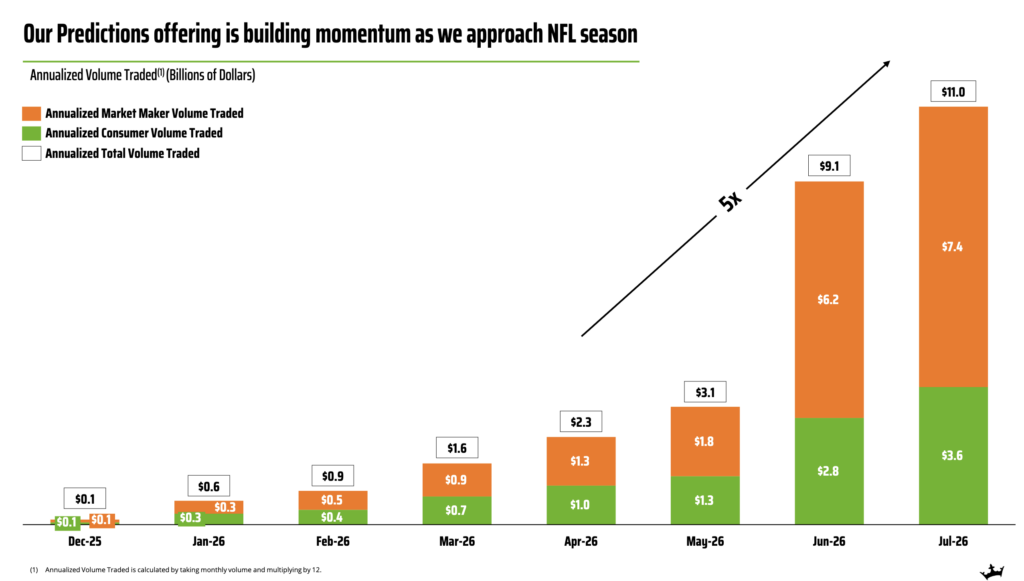
DraftKings’ prediction market business accelerated sharply through the second quarter and into July, with annualized total trading volume reaching $11 billion as the company prepares to move much of its major sports activity onto its own exchange ahead of football season.
More than 600,000 customers have used DraftKings Predictions this year, according to the company’s Q2 investor letter. Annualized consumer trading volume rose from about $1 billion in April to $3.6 billion in July, while DraftKings’ market making volume increased from $1.3 billion to $7.4 billion. Combined annualized volume climbed from $2.3 billion to $11 billion over the four-month period.
More than half of Predictions customers have used parlay-style combos, which are now approaching 20% of consumer volume.

DKeX investment expected
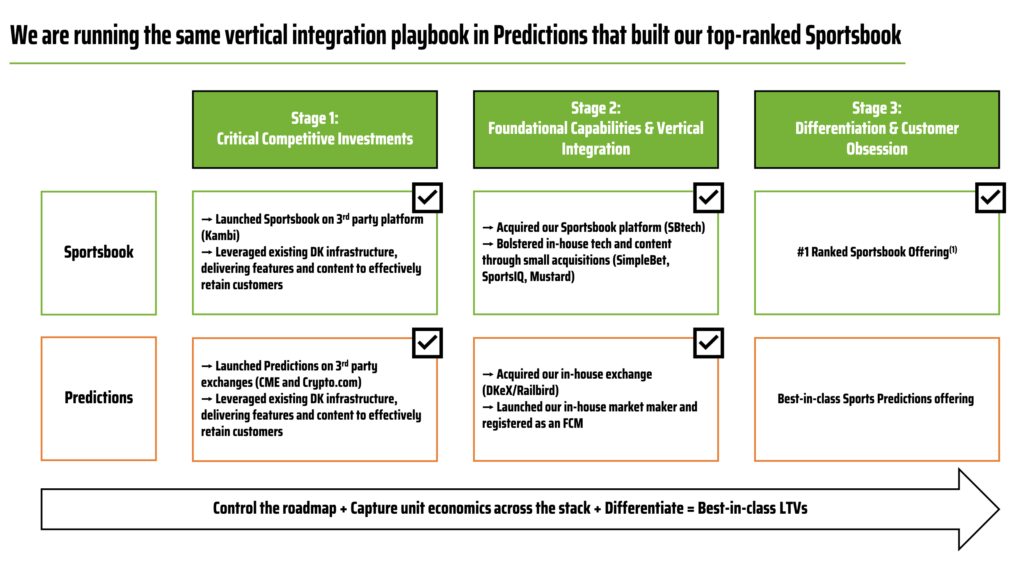
DraftKings launched its proprietary DKeX exchange in late June and received approval in July to operate as a futures commission merchant (FCM). On Friday morning’s Q2 earnings call, CEO Jason Robins laid out how those pieces will increasingly fit into the company’s Predictions operation.
“So what we will do is we will phase DKeX in,” Robins said. “Our expectation is that the vast majority of our sports content, at least in the major sports that are going on this fall, starting of course with CFB and NFL, we’re going to try to port as much of that volume over to the exchange as fast as is reasonably possible. But the really important thing — the number one thing that we are making sure — is that we feel like we have the best possible consumer offering out there.”
DraftKings expects to continue using outside exchanges for some smaller sports and non-sports contracts during the transition, but Robins said the company ultimately believes more of that activity can move in-house as well. The company still expects to invest $200 million to $300 million in Predictions this year and could spend more if customer-acquisition economics remain particularly favorable this fall.
DraftKings looks to keep more Predictions revenue in-house
DraftKings’ push to move more activity in-house is aimed at keeping a larger share of the economics generated by its Predictions customers.
Until recently, Wedbush Securities served as the FCM carrying DraftKings Predictions customer accounts. With DraftKings now approved to act as its own FCM, the company can take over that function itself rather than relying on Wedbush.
DraftKings Predictions launched with contracts listed on CME Group and added Crypto.com | Derivatives North America as a second third-party exchange in February. When DraftKings routes customer activity to its own exchange instead of one of those outside venues, it can also retain exchange fees that would otherwise go elsewhere.
Robins said DraftKings is already incorporating both changes into its Predictions assumptions.
“We just got our FCM license … that changes our unit economics by bringing more to us, and we are assuming some timelines for when we’ll be able to migrate volume over to our exchange,” Robins said.
The company believes that structure should increase the lifetime value (LTV) of a Predictions customer — essentially, the amount of value DraftKings can generate from that customer over time.
Robins compared the strategy to DraftKings’ sportsbook business, where the company gradually brought more technology, pricing and trading under its own control. DraftKings now prices and trades about 95% of its sports content internally, he said, and expects the Predictions transition to move faster because much of the necessary infrastructure is already in place.
Market making becomes a major part of Predictions volume
DraftKings’ market making business now accounts for most of the trading volume the company reports for Predictions. A market maker supplies liquidity by continuously offering prices at which it is willing to buy and sell contracts, seeking to earn money from the spread between those prices while managing the risk of the positions it takes.
The company said its market maker is now active on three unnamed exchanges, has been profitable on both single contracts and combos, and has achieved double-digit share in markets where it participates.
Robins described DKeX and the market making operation as mutually reinforcing.
“As DKeX grows, it will create more opportunities for our market maker, while deeper and more diverse liquidity will make our own offering more attractive to customers,” Robins said.
Market making represented roughly two-thirds of DraftKings’ July annualized Predictions trading volume run rate, but that volume measures contracts traded, not money earned by the company. The company has not disclosed standalone Predictions revenue or the revenue and profit generated by its market making operation, making the business’ financial contribution difficult to isolate.
DraftKings remains cautious despite strong acquisition
DraftKings spent about 10% more than planned on customer acquisition companywide in Q2, while customer acquisition costs came in about 25% better than expected. Robins cited that efficiency in explaining why the company could put additional money behind Predictions if similarly favorable conditions emerge this fall.
DraftKings also believes its existing national advertising relationships with companies like ESPN, NBC and Amazon, along with sports league partnerships, can help it reach consumers in states where Predictions is available without a massive increase in marketing spending.
Still, Robins acknowledged that DraftKings is not approaching Predictions with the same aggressiveness it would bring to the launch of its sportsbook in a newly legalized state.
“We are obviously still learning and we are taking a little bit more of a cautious approach in Predictions investment for various reasons,” Robins said. “One, we’re still learning about the numbers and what the ultimate LTVs can look like. Two, there are some regulatory questions that make the future and exactly what that’s going to look like not entirely certain. So we aren’t leaning in quite as hard as we would in, say, a new state launch at this point.”
That caution comes amid an unsettled legal landscape for sports event contracts, as states continue to challenge federally regulated prediction market platforms in multiple jurisdictions.
At the same time, he said DraftKings sees a substantial untapped acquisition opportunity in states like California and Texas, where its sportsbook is unavailable, and consumers may not yet realize they can access DraftKings through Predictions. He expects that awareness to increase as the company adjusts its national marketing around the NFL season.
Prediction markets causing little sportsbook cannibalization
DraftKings said it has so far found little evidence that prediction markets generally are taking meaningful business away from its sportsbook in states with legal online sports betting.
The company said there is only about 1% customer overlap between DraftKings Sportsbook and the largest prediction market operator, an apparent reference to Kalshi, in states with legal online sports betting. That figure is based on Carbon Arc deposit data. Separately, based on its own internal analysis, DraftKings estimates that 80% to 90% of prediction market consumer volume in sportsbook states comes from professional syndicates and institutional traders, activity the company says largely would not have gone to sportsbooks anyway.
Robins said DraftKings reached that conclusion after examining several different sources rather than relying on a single measure.
“We’ve triangulated various metrics to come to the same conclusion, which is … there is very minimal, if any, cannibalization happening,” Robins said.
DraftKings maintains 2026 outlook
Overall, DraftKings reported $1.44 billion in Q2 revenue, down 4.6% from a year earlier, while adjusted EBITDA fell to $114.6 million from $300.6 million. Customer-friendly sports outcomes and higher-than-planned customer-acquisition spending weighed on the quarter.
The company maintained its full-year guidance of $6.5 billion to $6.9 billion in revenue and $700 million to $900 million in adjusted EBITDA. DraftKings said its core business remains on track to produce approximately $1 billion in adjusted EBITDA in 2026, with its planned $200 million to $300 million Predictions investment accounting for the main gap between that figure and the companywide outlook.
That makes Predictions a meaningful near-term drag on companywide profitability even as DraftKings builds the customer base, exchange and market making infrastructure it believes can improve the business’s economics over time. The next major test comes this fall, when football season will test both that investment strategy and DraftKings’ increasingly in-house prediction market operation at a much larger scale.