Prediction Markets Saw Becerra’s California Governor Win Coming
Xavier Becerra and Steve Hilton are set for a November showdown for California governor, but prediction markets already have a winner.
The California governor race is exactly where prediction markets thought it would end up. The race is one of the major statewide contests taking place alongside the midterm elections.
After a long, winding primary campaign, the official showdown in November will be between a Democratic favorite and a Republican finalist. Democrat Xavier Becerra is now the frontrunner against Republican Steve Hilton.
Traders are pricing Becerra as a heavy November favorite at around 90%, which aligns with the broader view that this was always going to be a Democrat-leaning statewide race once the field sorted itself out. It was just the journey to get that Democratic candidate that took some time, but prediction markets kept their read solid throughout.
How prediction markets read the California governor primaries
California’s primary is a top-two advance contest, and that usually ends up with one Republican and one Democrat. But a crowded Democratic field kept traders on their toes throughout the 2026 midterm election primary season.
The Republican side was the easier part to read. Hilton had been treated for much of the campaign as the likely GOP finalist, and the markets were early to lock onto the idea that California would ultimately produce one Democrat and one Republican for the general. That part played out pretty cleanly, which is usually how these top-two races look once the noise clears.
The Democratic side took longer to settle because the race kept shifting around the bigger-name candidates. Becerra’s late surge mattered because it came after former U.S. Rep. Eric Swalwell’s scandal pushed the field into a reset late in the campaign. Still, markets caught that movement before many people wanted to admit it.
Billionaire Tom Steyer had been near the top for much of the race, but Becerra’s rise took shape fast enough that the contracts were already adjusting before election night made it official.
Prediction markets got the shape right
This is one of those cases where prediction markets didn’t just get the winner right, they got the structure of the race right. There were real fears that the Democratic vote could splinter so badly that it might hand Republicans a weird opening, maybe even two Republican finalists in a worst-case scenario for Democrats.
That never happened, but the fact that people were even talking about it tells you how volatile the field looked at times.
Through all of that, the governor winner contracts still leaned Democratic, and that proved to be the right read.
Prediction markets saw the eventual endpoint before the final pair was fully locked in, which is exactly what these contracts are supposed to do when a race is messy but still has an underlying partisan foundation.
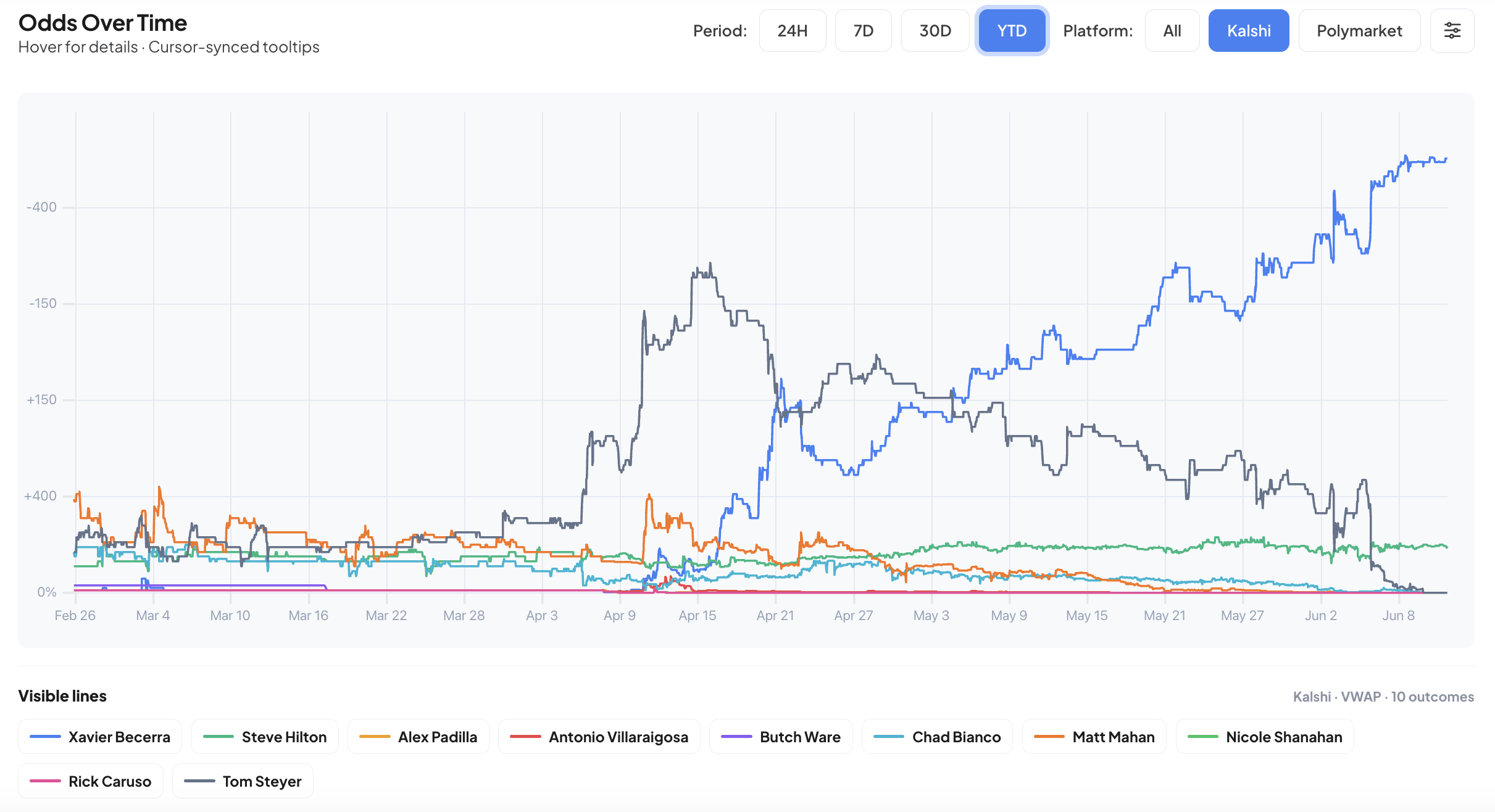
California Governor Race timeline / DeFi Rate Tracker
What November looks like
The first poll already confirms what traders are saying. Becerra starts with a clear edge over Hilton, 52% to 31%. That does not mean the fall campaign will be boring, because California gubernatorial races always carry enough noise, money, and national baggage to keep them active, but it does mean the basic frame is set.
Republicans got their finalist, Democrats got theirs, and now the race is moving into a phase where Becerra has to avoid mistakes more than he has to invent momentum.
Hilton’s job is simpler but still hard. He must make the race about change, make Becerra look like the continuation of a tired status quo, and hope the race tightens enough for a real opening.
That is a steep climb in a state like California, and the market knows it. The early pricing around 90% for Becerra says traders think the Democrat still holds the big structural advantage, even if the campaign itself has enough time to get sharper. And there is real volume on the markets, with Kalshi traders already pushing $46.5 million into the contract and Polymarket traders adding $38.7 million.
What’s next in California governor race
Prediction markets accurately saw the race develop in layers. Hilton emerged early as the Republican finalist. Becerra surged late to for the Democrats. Steyer remained the steady name near the top. Meanwhile, the general election contracts staying Democratic the whole way through.
That is the kind of sequencing prediction markets are good at, especially in a top-two system where the field can look chaotic until it suddenly isn’t.
Now the story shifts from nomination dynamics to November reality. Becerra looks like the clear favorite, Hilton has the uphill challenge, and California appears headed toward the kind of governor’s race where the market has already told you the basic answer. Now, the campaign still has to spend months proving it.
 Polymarket Promo Code Rate: $25 Bonus for Chiefs vs. Seahawks SNF
 Kalshi Promo Code RATE: $55 Bonus for Packers vs. Lions
 Polymarket Promo Code Rate: $25 Bonus for Bengals vs. Ravens
 Kalshi Promo Code Rate: $55 Bonus for Ole Miss vs. Texas CFB