


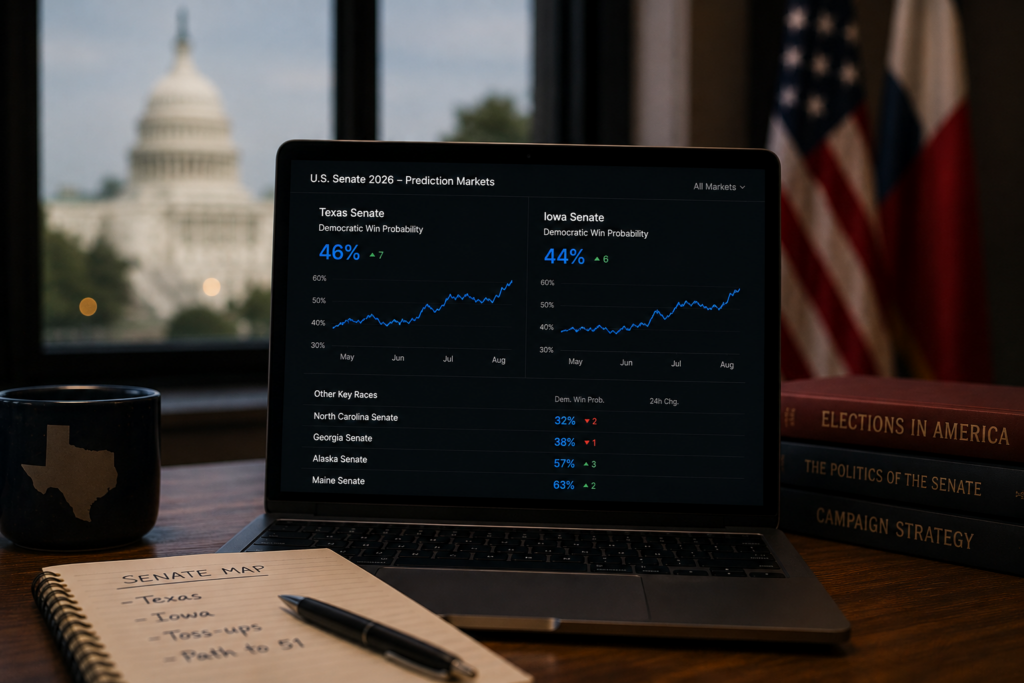


Tuesday’s Iowa primaries are still primaries first, even if prediction markets are already running straight into November.
On the governor side, the market is clearly telling us that Rob Sand has become the Democratic outlier who can turn a red state race into a real general election problem for Republicans. Meanwhile, the Senate race is still being treated as a more traditional open-seat GOP hold with Sen. Joni Ernst retiring and Republicans starting from a structural advantage.
That split is what makes Iowa interesting. In one statewide race, the prediction markets are willing to price a Democrat as a strong favorite because Sand looks like a uniquely strong candidate. In the other, traders are not seeing the same flip energy they’re predicting in Republican-held Senate races like Ohio, Maine, North Carolina, and Alaska, where Democrats are already being treated as real threats to win in the 2026 midterm elections.
Traders are pricing Iowa differently. That suggests prediction markets are separating candidate quality from the partisan baseline rather than lumping the whole state into one category despite both being on one statewide ballot.
Iowa governor is the Sand story
The governor’s race is where the Iowa market excitement lives. Sand, the state auditor and sole Democrat in a statewide office, has built enough momentum that traders are treating him as more than just a decent Democratic nominee. Sand is over 99% to win Tuesday’s primary with $378K in volume on Polymarket, which also has the Democratic party as 66% likely to win in November. Kalshi has Democrats as a 64% favorite to win in November on $144K volume.
Sand is priced like the kind of candidate who can actually outrun Iowa’s strong Republican lean and make the general election competitive with his crossover appeal. The latest polling has only reinforced that view, with Sand showing up strong enough to make the top of the ticket look a lot more fragile for Republicans than it did earlier in the cycle.
That is why the market has been comfortable leaning Democratic in the governor race even though Iowa is still Iowa. It’s not that traders suddenly think the state has changed partisan identity. It’s that Sand has started to look like the kind of candidate who can force the issue anyway.
Iowa Senate is still a GOP open seat
The Senate race is a different animal. This is an open seat because Ernst is retiring, so the race is not about whether an incumbent can hold on through a tough cycle. It is about whether Republicans can keep the seat in a state where they still begin with the edge, and the markets are not yet treating Iowa like one of the Republican-held Senate seats most at risk of flipping.
That matters because the market has been willing to look at Republican-held Senate seats in Ohio, Maine, North Carolina, and Alaska and say, essentially, these can flip blue. Iowa is not getting that treatment, with Kalshi sitting at 61% to have a Republican Senate winner with $215,000 in volume and 62% on Polymarket with $117,264.
Meanwhile, polls suggest Democrats could make it competitive, especially with markets expecting such a strong showing for Sand in a statewide election on the same ballot. Perhaps the traders seeing the flips in other Red states have not made it to Iowa Senate race yet.
Why the prediction markets split exists
The clearest explanation is that the markets are treating Sand as a candidate-specific exception rather than a sign that Iowa is broadly shifting left. That is why the governor’s race can lean Democratic while the Senate race stays red.
Sand’s profile gives Democrats a shot to win above the state line. Traders, by contrast, are stilling measuring the Senate race, against the state’s Republican baseline. For whatever reason, traders aren’t including it in the blue-wave narrative that has shown up elsewhere.
That makes the Iowa story a little unusual, but not illogical. The market is essentially saying Sand can break the normal pattern in one race. Still, the Senate seat still belongs in the category of Republican seats that are safer than the vulnerable GOP seats in the bigger battleground states.
What Tuesday really tests
While markets are already looking at November, Tuesday is still about the primaries themselves. The governor primaries could tell us whether Sand’s coalition is real.
The Senate primary will tell us whether Republicans can nominate a candidate who holds the open seat. It could also tell us that it could turn it into an unnecessary fight.
Regardless, the markets are not saying Iowa is uniformly blue or red. Traders are saying Iowa governor is a Sand story. They also believe Iowa Senate seat is a Republican hold. Those two races are diverging because the governor’s race has a candidate who can outrun fundamentals, while the Senate race still sits inside the GOP’s structural lane.