






- ▸ Limitless Markets US, LLC has applied for CFTC approval to operate as a federally regulated derivatives exchange, the same designation used by prediction market operators including Kalshi, Crypto.com Derivatives North America, and Polymarket US.
- ▸ Limitless’ existing blockchain-based exchange has grown quickly on Base, with Dune analytics showing roughly $3.9 billion in total notional volume and about $1.66 billion in April alone.
- ▸ The filing positions Limitless as a crypto-native U.S. entrant with real offshore traction, but its confidential materials leave some key details unanswered.
Limitless Markets US, LLC, a U.S. entity tied to international blockchain-based prediction market Limitless Exchange, has applied to become a federally regulated derivatives exchange, putting another crypto-native operator in the Commodity Futures Trading Commission’s approval queue.
The CFTC posted the company’s designated contract market (DCM) application to its industry filings portal, listing Limitless Markets US, LLC as a pending DCM applicant with a May 1 filing date. The public filing package includes a Form DCM, governance exhibits, a core principles chart, and a proposed rulebook.
The application comes as Limitless’ existing exchange has seen a sharp increase in trading activity. Dune analytics show the platform at roughly $3.9 billion in total notional volume, including about $1.66 billion in April alone.
Limitless’ X bio describes the platform as offering “community-driven prediction markets on Crypto, Finance, Football, and Esports,” with more than $3.5 billion traded. The company has also promoted itself as the largest prediction market on Base, Coinbase’s Ethereum layer-2 network.
Limitless DCM application signals U.S. regulatory push
The public Form DCM identifies the applicant as Limitless Markets US, LLC, with planned business names Limitless US and Limitless Markets. The form lists the principal office address as George Town, Grand Cayman, and notes that Limitless Markets US does not currently maintain a physical U.S. office because employees work remotely.
If approved, DCM status would allow Limitless to operate a CFTC-regulated exchange for futures, options or event contracts. It is the same type of federal exchange designation used by prediction market operators like Kalshi, Crypto.com Derivatives North America, ForecastEx, and Polymarket US.
Limitless’ proposed rulebook is built around event-contract trading. It defines a binary contract as one that typically settles with two possible outcomes, usually Yes or No, while also allowing scalar contracts whose payout depends on the degree to which an outcome occurs.
The company’s core principles chart says Limitless would provide “an efficient, competitive, fair and transparent market” and maintain rules designed to “prevent abusive and fraudulent trading practices.” It also says the exchange would monitor trading in real time, using third-party regulatory service providers and internal dashboards to detect misconduct like spoofing, layering, wash trading and other potentially manipulative activity.
The filing also emphasizes compliance controls around access and clearing. Limitless says contracts submitted for clearing would be cleared through a CFTC-registered derivatives clearing organization (DCO), while the rulebook requires trader positions to be fully cash collateralized so members cannot take positions with exposure greater than deposited funds. The rulebook also prohibits trading by people with material nonpublic information about a contract’s underlying, or people who can influence the event outcome.
Limitless has grown quickly on Base
Limitless’ U.S. application comes as its existing blockchain-based exchange has reported a sharp increase in activity on Base. Dune analytics show Limitless at roughly $3.9 billion in total notional trading, with monthly volume rising rapidly over time. From September 2025 ($109M) to April 2026 ($1.66B), Limitless grew approximately 15x over that 7-month stretch. April 2026 marked a clear breakout, hitting $1.66B (nearly 3x March) and surpassing all prior months combined. The same dashboard shows about $348.2 million in May volume as of May 5.
Limitless Volume (Aug-April)
| Month | Volume |
|---|---|
| Aug 2025 | $5.7M |
| Sep 2025 | $109.4M |
| Oct 2025 | $127.5M |
| Nov 2025 | $103.8M |
| Dec 2025 | $128.6M |
| Jan 2026 | $204.9M |
| Feb 2026 | $372.8M |
| Mar 2026 | $538.5M |
| Apr 2026 | $1.66B |
Separate Dune dashboards tracking prediction-market notional volume across major platforms listed Limitless at about $3.97 billion in cumulative notional volume, behind Polymarket’s global platform, Kalshi and Opinion, but ahead of Predict, Crypto.com and Polymarket’s U.S. platform. The dashboards show Limitless with 5.6% of total tracked prediction-market notional volume in April, behind Kalshi (49.7%) and Polymarket’s international exchange (30.2%), but ahead of predict.fun, Polymarket’s U.S. platform, Opinion, Crypto.com and other tracked venues.
Limitless CEO points to finance as fastest-growing use case
CJ Hetherington, New York-based co-founder and CEO of Limitless Labs, highlighted the growth in a LinkedIn post Tuesday, touting Limitless reaching $3.9 billion in total trading and noting that the platform has seen 300% month-over-month growth.
In the post, Hetherington pushed back on the idea that prediction markets are defined mainly by sports, politics or culture. He said finance is the “fastest-growing use case” and pointed to Limitless’ 15-minute crypto markets and one-hour commodities markets as examples of how the platform is targeting short-term financial trading.
“People consistently form their own views on the market,” Hetherington wrote. “On Limitless, they can earn from their conviction by predicting an asset’s direction every 15 minutes.”
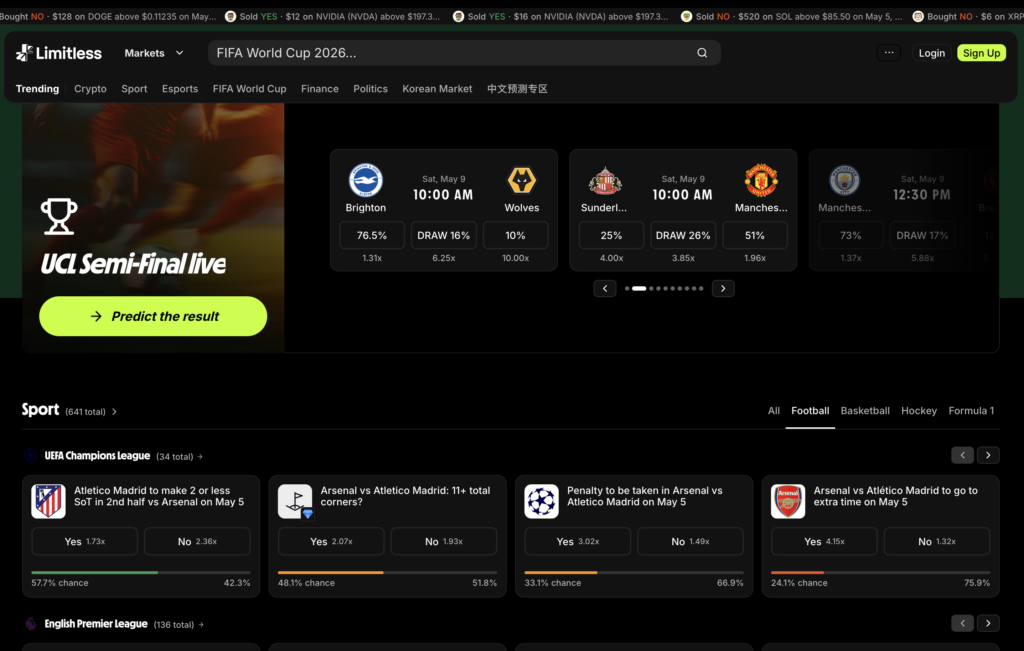
Limitless’ existing exchange offers a wide mix of prediction markets across crypto, finance, sports, esports and politics. Its sports markets include a wide range of international soccer contracts (including for the World Cup), plus basketball, hockey and Formula 1, while its esports section covers competitive gaming outcomes. The politics category includes markets tied to elections, government actions and public-policy outcomes. The platform also has China- and Korea-specific sections that include locally focused markets across areas like elections, finance and other regional events.
Venture-backed platform has raised at least $17 million
Limitless has raised at least $17 million across disclosed rounds since 2024.
Limitless Labs announced a $3 million pre-seed round in September 2024 led by 1confirmation, with Paper Ventures, Collider and Public Works also participating. That announcement described Limitless Labs as the R&D network behind Limitless and said the company was founded in December 2023 by Hetherington, Roman Mogylnyi, Dima Horshkov and Rev Miller.
In July 2025, Limitless announced a $4 million strategic round, bringing total funding to $7 million. The investor list included Coinbase Ventures and 1confirmation, as well as Maelstrom, Collider, Node Capital, Paper Ventures, Public Works, Punk DAO and WAGMI Ventures. The company said at the time that it had seen demand for short-term price markets on assets like bitcoin, attracting more than $250 million in volume soon after launch.
Limitless later announced a $10 million seed round in October 2025 led by 1confirmation, with participation from other returning investors, like Collider and Coinbase Ventures. The company said then that it had surpassed $500 million in total trading volume, cementing what it described as its position as the largest prediction market on Base.
What to watch
The filing adds Limitless to a growing list of firms seeking CFTC-regulated exchange status as prediction markets push further into the U.S. financial system. But unlike companies centered mainly on sports or politics, Limitless is coming from a crypto-native, blockchain-based platform that has already scaled meaningful volume on Base.
The key unanswered question is what that model would look like inside the U.S. regulatory framework. Limitless’ public rulebook outlines binary event contracts, clearing, collateralization, surveillance and member access rules, but much of the application remains confidential.
DeFi Rate reached out to Hetherington for comment on Limitless’ U.S. strategy. This story will be updated with his responses.
The public filing is an important signal, but not a full blueprint. Limitless is seeking a path into the CFTC-regulated exchange system after building one of the most active event contract trading venues on Base and one of the more competitive platforms, in terms of volume attracted, worldwide.
But the filing does not say whether Limitless would seek to bring its existing blockchain-based exchange into a U.S.-regulated structure or operate a separate U.S. venue with distinct users and liquidity, the approach Polymarket used after acquiring a CFTC-licensed exchange and clearinghouse.