






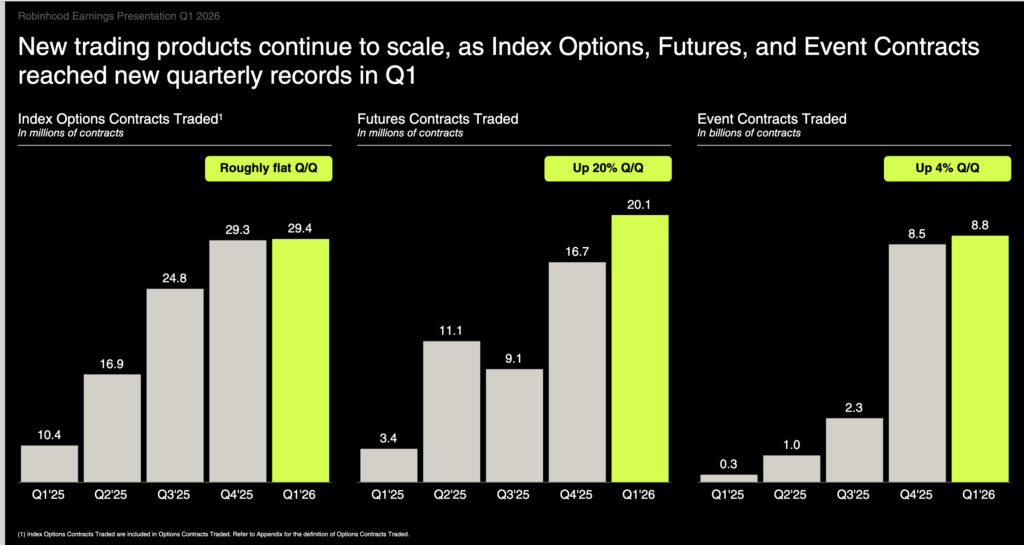
- ▸ Robinhood reported a record quarter for prediction markets, with 8.8 billion event contracts traded.
- ▸ The company is preparing to launch its Rothera exchange later in Q2, enabling it to list and clear contracts in-house rather than relying on third-party exchanges like Kalshi.
- ▸ April trading activity suggests prediction markets demand is holding steady into Q2, with volumes on track for roughly 3 billion contracts.
Robinhood reported first-quarter results Tuesday showing steady growth despite a sharp decline in crypto trading, as surging activity in prediction markets helped offset the slowdown.
Robinhood Markets posted $1.07 billion in revenue, up 15% year-over-year, with net income of $346 million and earnings per share of $0.38, both modestly higher from a year earlier. The results come as trading activity shifts across the platform, with crypto volumes falling significantly while newer products, including event contracts, continue to scale.
Crypto revenue dropped 47% year-over-year to $134 million, reflecting lower trading activity on the platform. In contrast, “other transaction revenue,” which includes event contracts, futures, and index options, surged 320% to $147 million, highlighting the growing contribution of newer trading products.
Robinhood also reported a record 8.8 billion event contracts traded during the quarter, reinforcing the continued expansion of its prediction markets business following strong momentum in late 2025.
Despite strong growth in prediction markets and other areas, according to Barron’s, shares of Robinhood fell about 9% in after-hours trading following the release, as investors focused on rising costs and the crypto slowdown. The company also said it expects to invest roughly $100 million tied to its role in the “Trump Accounts” program, part of an expense outlook that appeared to weigh on sentiment, according to Bloomberg.
Robinhood prediction markets remain resilient
Following the earnings release, Robinhood CEO Vlad Tenev and CFO Shiv Verma participated in a special earnings call presented on the patio of the company’s headquarters in Menlo Park, Calif., which Tenev said “may be the first ever outdoor earnings call in history.”
“As we continued shipping great products for our customers, in Q1, we saw record levels across prediction markets, futures, index options, shorting, and margin,” Tenev said during his opening remarks. “So our active traders were very active.”
Robinhood’s prediction markets business remained near peak levels in the first quarter, with 8.8 billion event contracts traded compared with 8.5 billion in Q4 2025.
Monthly data shows event-driven fluctuations within the Q1 activity. Event contract volume peaked at 3.4 billion in January, coinciding with the Super Bowl, before dipping to 2.4 billion in February and rebounding to 3.0 billion in March, around the time of the NCAA men’s basketball tournament. The pattern indicates that while big sporting events continue to drive spikes in activity, overall volume has remained resilient outside of peak moments.
During the earnings call event, Verma said that resiliency is continuing into Q2, with April event contract trading volume showing promising signs.
“It’s on track to be around 3 billion [contracts traded], and probably our second highest month ever,” Verma said. “So really strong engagement there.”
Rothera exchange expected to launch in next two months
Currently, Robinhood offers prediction markets primarily through Kalshi, while also routing a smaller share of contracts through ForecastEx.
That setup could begin to shift later this year as the company prepares to launch Rothera, its joint venture exchange with global trading and market-making firm Susquehanna International Group. The platform is being built through the acquisition of an existing CFTC-regulated exchange that holds both Designated Contract Market (DCM) and Derivatives Clearing Organization (DCO) registrations, allowing Robinhood to list and clear event contracts directly rather than relying on Kalshi or other exchanges.
“Today, Robinhood is the largest retail brokerage firm in prediction markets, and we’ve been one of the first to adopt the new asset class,” Tenev said. “Susquehanna is one of the largest market makers. And in the past, up until now, we’ve been relying on third-party exchanges.”
Robinhood said it is preparing Rothera for a Q2 launch and has already begun incurring costs tied to the buildout, with approximately $14 million in Q1 expenses related to Rothera and other initiatives. The platform is expected to give the company greater control over its event contract offerings over time.
“With the launch of Rothera,” the CEO said, “this vertical integration gives us a couple things. It really gives us end-to-end control of the customer experience, including product selection and pricing. So we’ll have more control over what products and what pricing we can offer to customers, which I think is going to be very, very nice.”
Robinhood is positioning itself to compete across multiple layers of the prediction market industry, combining its retail brokerage reach with exchange infrastructure and institutional liquidity through its partnership with Susquehanna. The company has more than 27 million funded accounts in the U.S., which Tenev pointed to as a key advantage as competition shifts toward distribution and pricing power.
“We believe that we not only have an advantage with retail, but also institutional as well,” Tenev said, referring to the Rothera joint venture. He added that the asset class remains “very, very early,” with increasing diversification beyond sports contracts, suggesting continued expansion even as the number of exchanges may ultimately shrink.
State actions escalate as federal regulators push back
Robinhood’s expansion in prediction markets is also unfolding against a rapidly intensifying legal battle between state and federal regulators over how the products should be classified and overseen.
Last week, Wisconsin filed lawsuits against multiple platforms, including Robinhood, Kalshi, Coinbase, Polymarket, and Crypto.com, alleging that sports event contracts constitute illegal gambling under state law and seeking to block the companies from offering them to residents. That dispute escalated further Tuesday, when the CFTC sued Wisconsin in response, arguing that prediction markets fall under federal derivatives law and that states cannot apply gambling statutes to products regulated at the federal level.
The Wisconsin cases are the latest in a series of state and federal clashes that could help determine whether sports contracts, a significant share of prediction market trading volume, can continue to be offered nationwide.
In response to an analyst question on the issue, Tenev showed some sympathy for the states’ cause, saying “it’s not irrational” for them to try to protect their sports betting frameworks. But, describing the situation as a “jurisdictional dispute,” he said that the company aligns with the view that prediction markets are exclusively overseen by the CFTC under federal commodities law. He said the outcome is likely to take time to resolve, noting, “this is something that’ll play out in the coming years.”
Robinhood also warned in its earnings materials that regulatory actions “could immediately or subsequently prevent us from offering, or continuing to offer, event contracts,” underscoring the uncertainty surrounding how broadly the products can be offered across the U.S.