





A newly formed advocacy coalition led by Mick Mulvaney, who served as President Donald Trump’s White House chief of staff during his first term, is escalating the political fight over sports prediction markets, arguing that contracts tied to game outcomes are illegal gambling dressed up as financial products.
The group, operating under the name Gambling Is Not Investing, is pushing for state and tribal gambling laws to apply to online prediction platforms currently regulated at the federal level by the Commodity Futures Trading Commission (CFTC). Mulvaney and allied critics contend that labeling sports wagers as “event contracts” allows exchanges to bypass the state-by-state licensing systems, tax structures, and consumer protection frameworks that govern traditional sportsbooks.
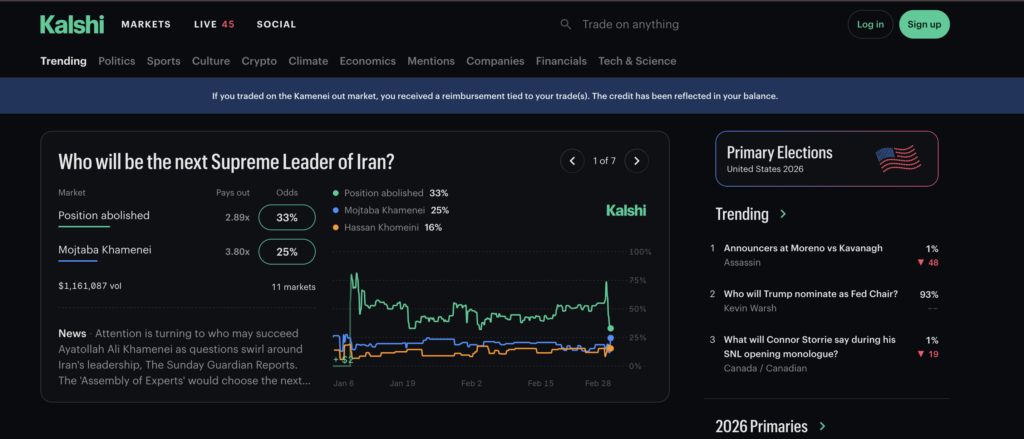
The effort adds new conservative opposition to an industry that has grown rapidly over the past year, with sports contracts accounting for the majority of trading volume on major platforms like Kalshi. Critics in both parties argue the products functionally mirror sportsbooks without being subject to the same regulatory obligations, while industry leaders insist they are offering federally regulated derivatives, not gambling products.
“If it looks like a sports bet, if it sounds like a sports bet, if it pays off like a sports bet, if it’s on a sporting event — it’s a sports bet,” Mulvaney told WIRED in an interview about the new organization.
Coalition argues sports contracts bypass state oversight
Mulvaney’s coalition is positioning itself as a states’ rights and consumer protection effort rather than an anti-gambling campaign. Gambling Is Not Investing includes center-right and libertarian-leaning organizations like Consumer Action for a Strong Economy and Frontiers of Freedom, according to Bloomberg. Its central argument is that sports contracts offered by exchanges are circumventing the policy decisions made by individual states.
“My legislature has decided sports gambling is against the rules in South Carolina,” Mulvaney told Bloomberg. Mulvaney previously represented South Carolina in Congress, and the state remains one of a handful that has not legalized sports betting. His point, as he framed it, is that when a state chooses to prohibit or tightly regulate gambling, it does so through licensing systems, tax structures, age limits, and oversight mechanisms tailored to that decision.
“Every state that legalizes casino gambling or online sportsbook gaming or the lottery, they make a decision, they create infrastructure, they create oversight and regulation,” Mulvaney said. “They do it properly. When you operate through a loophole, you get none of that.”
The coalition argues that prediction markets undermine those state frameworks by offering contracts tied to game outcomes nationwide, often to users 18 and older, even in states that either ban sports betting outright or restrict it to those 21 and over.
“Rebranding sports wagering as ‘trading’ or ‘investing’ or ‘predicting’ misleads consumers, undermines responsible gaming protections, and weakens the state and tribal systems built to protect the public and fund vital community services,” Mulvaney said.
Mulvaney says Trump administration will be ‘open-minded’ on restrictions
Mulvaney told Bloomberg he intends to make the case to the Trump administration that sports-based event contracts warrant “common sense regulation.” He said he plans to press the administration to reconsider what critics describe as an overly permissive federal stance on sports prediction markets.
“I helped create the environment that is their starting point, which is that the default position is going to be deregulation,” Mulvaney said. “But if you can make a case for common sense regulation, they will absolutely be open-minded.”
Under chairman Michael Selig, the CFTC has asserted that prediction market platforms are properly regulated and has stepped into active litigation to defend that position. In February, the agency filed an amicus brief in a Nevada case arguing that event contracts, including those tied to sports outcomes, fall under the federal definition of swaps and that the Commodity Exchange Act (CEA) preempts conflicting state gambling laws.
That filing came as part of a broader wave of state challenges. Regulators and attorneys general in several jurisdictions have brought legal actions contending that sports-based event contracts violate state gambling statutes and remain subject to traditional gaming oversight.
Conservative voices join Democratic pushback
The new coalition adds to a growing list of conservative figures taking public action against sports prediction markets. Former Republican New Jersey Governor Chris Christie, who is working with the American Gaming Association as a paid advocate on gaming policy, has criticized the federal approach and argued that sports event contracts undermine the state-regulated sportsbook system New Jersey helped establish after the fall of PASPA.
Utah’s GOP Governor Spencer Cox has also spoken out against allowing sports contracts to operate nationwide under CFTC oversight, pointing out that Utah prohibits all forms of legalized gambling and that event contracts effectively bypass state gambling prohibitions in jurisdictions that have not authorized sports betting.
Until recently, much of the formal pressure on prediction markets has come from Democratic officials. At the state and federal legislative level, efforts to restrict or clarify the status of sports prediction markets have been driven largely by Democratic lawmakers, including a proposal by Nevada Rep. Dina Titus to ban sports event contracts, and bills in states like Hawaii, Illinois and New York aimed at tightening gaming rules and consumer protections. In February, a group of 23 Democratic senators led by Adam Schiff and Catherine Cortez Masto urged Selig not to intervene in state lawsuits over sports event contracts.
Former acting CFTC chair disputes gambling framing
Besides Selig, there are other regulatory voices that disagree with Mulvaney’s framing. In a recently circulated clip from February’s Blockchain Applications Stanford Summit (BASS), former acting CFTC chair Caroline Pham, who left the agency in late December, offered a sharply different view of sports event contracts, arguing that the dispute hinges on statutory classification rather than optics.
Pham said event contracts are “retail binary options,” which qualify as swaps under the CEA.
“It is the occurrence or non-occurrence of an event associated with a potential financial, economic, or commercial consequence,” she said, describing the legal definition that brings such contracts under federal derivatives law. Under that view, she argued, the question is not whether a contract resembles a wager, but whether it satisfies the swap definition adopted in the Dodd-Frank amendments to the CEA.
Pham rejected the idea that sports contracts lack economic relevance. Sporting events, she said, carry “tremendous economic consequence” for cities, businesses and stadium operators, reinforcing the view that such contracts fall within the CEA’s scope. The CFTC, she added, has “exclusive jurisdiction over derivatives” in the United States.
That distinction — gambling versus swaps — now sits at the center of the growing political and legal fight. Mulvaney’s coalition is seeking to resolve it through pressure on lawmakers and the White House. Pham’s comments suggest the dispute may ultimately turn less on political rhetoric and more on how courts interpret the law.