





Arizona Attorney General Kris Mayes filed criminal charges against Kalshi on Tuesday, accusing the CFTC-regulated prediction market platform of operating an illegal gambling business in the state and accepting bets on Arizona elections. It’s the first time any state has brought criminal charges against the company, and a significant escalation from the cease-and-desist letters and civil injunctions that have defined the state vs. Kalshi fight until now.
The 20-count complaint, filed in Maricopa County Superior Court, names both KalshiEx LLC and Kalshi Trading LLC. The charges allege Kalshi accepted wagers from Arizona residents on professional and college sports, player props, and whether the SAVE Act would become federal law. Four counts are tied specifically to election wagering, including contracts on the 2028 presidential race, the 2026 Arizona gubernatorial race, the 2026 Arizona Republican gubernatorial primary, and the 2026 Arizona Secretary of State race.
“Kalshi may brand itself as a ‘prediction market,’ but what it’s actually doing is running an illegal gambling operation and taking bets on Arizona elections, both of which violate Arizona law,” Mayes said in a statement. “No company gets to decide for itself which laws to follow.”
Arizona law prohibits operating an unlicensed wagering business and also bans election wagering. The charges are misdemeanor-level, carrying potential penalties of $20,000 per sports bet and $10,000 per election contract.
The escalation comes less than a week after Kalshi preemptively sued Arizona on March 12 following a series of warnings from the state dating back to May 2025. A spokesperson for the AG’s office confirmed the Kalshi platform remains available in Arizona.
Update (March 17): Following the filing, Judge Liburdi denied Kalshi’s TRO request and ordered Kalshi to show cause why the federal court shouldn’t abstain entirely. Also, CFTC Chairman Mike Selig called the criminal charges “entirely inappropriate” and signaled the agency is evaluating its options for potentially intervening. Details below.
Arizona vs. prediction markets background
The legal friction between Kalshi and Arizona has been building for nearly a year. Arizona Gaming Director Jackie Johnson sent Kalshi a cease-and-desist in May 2025 after the platform began offering sports event contracts to state residents, alleging unlicensed betting. It was the seventh state to send such a request to the CFTC-regulated exchange. That September, Johnson warned existing Arizona gaming licensees that offering event contracts, or even allowing prediction market activity out-of-state, could jeopardize their Arizona wagering licenses.
Back in December, Arizona pulled Underdog’s DFS license for offering prediction markets in partnership with Crypto.com, proving its threats were not empty.
Rather than exit the state or seek a licensing accommodation, Kalshi went to federal court. On March 12, five days before today’s charges, the company filed a preemptive lawsuit against Arizona officials seeking a permanent injunction. Kalshi’s filing claimed Mayes had previously assured the company it would not pursue enforcement without advance notice, and argued that any state enforcement would violate the Commodity Exchange Act. That set up today’s countermove from Mayes.
“Kalshi is making a habit of suing states rather than following their laws,” she said. “In the last three weeks alone, the company has filed lawsuits against Iowa and Utah, and now Arizona. Rather than work within the legal frameworks that states like Arizona have established, Kalshi is running to federal court to try to avoid accountability.”
Sports betting companies avoiding Arizona wrath
When DraftKings launched Predictions in December 2025 across 38 states, Arizona was explicitly a “no-go” zone, alongside Illinois, Nevada, Ohio and Pennsylvania. FanDuel followed the same playbook, only offering sports event contracts in states where online sports betting is not yet legal. The company also noted as new states legalize sports betting, FanDuel Predicts would cease offering sports contracts there.
Both DraftKings and FanDuel hold both fantasy sports and sports wagering permits in Arizona, making them the only companies with that dual license in the state. Their tactic to not offer prediction markets in states where they offer online sports betting has paid off so far.
CFTC weighs in
Within hours of the charges being filed, CFTC Chairman Mike Selig weighed in, making the federal government’s position unmistakable. Calling it “entirely inappropriate as a criminal prosecution,” Selig said the agency is “evaluating its options,” the first time a sitting CFTC chair has publicly responded to a state enforcement action against one of its registered exchanges.
The Arizona Attorney General today filed criminal charges against one of our registered exchanges related to prediction markets. This is a jurisdictional dispute and entirely inappropriate as a criminal prosecution. The @CFTC is watching this closely and evaluating its options.
— Mike Selig (@ChairmanSelig) March 17, 2026
Arizona framed the new criminal charges as a simple matter of state law enforcement, which Selig’s statement directly challenges. Every prior Kalshi-vs.-state case has operated on the assumption that this is a jurisdictional dispute to be resolved by courts. Arizona’s criminal charges rejected that framing, treating Kalshi’s CFTC registration as irrelevant to state criminal law. Selig’s tweet is a direct rebuttal of that premise, and “evaluating its options” signals the CFTC is unlikely to stay on the sidelines.
What comes next
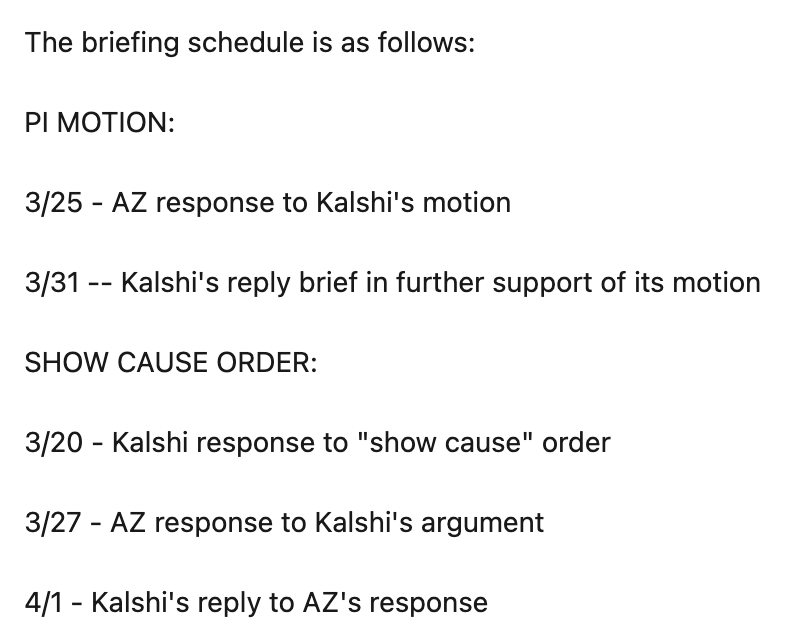
The picture shifted dramatically within hours of the criminal charges being filed. Judge Michael Liburdi, the Trump appointee and former Snell & Wilmer partner whose assignment to Kalshi’s federal civil case had initially appeared favorable to the company, denied Kalshi’s motion for a temporary restraining order against the Arizona AG and issued a pointed show cause order, gaming lawyer Daniel Wallach reported on LinkedIn. Kalshi must explain by March 20 why the federal court shouldn’t abstain from hearing the case entirely, given that criminal charges are now pending in state court.
This is a reference to the Younger abstention doctrine, a legal principle that generally bars federal courts from interfering with ongoing state criminal proceedings. By filing criminal charges today, Arizona may have deliberately forced this question, converting Liburdi from a potentially favorable judge into one who now has to decide whether he has any business getting involved at all.
The briefing schedule runs fast. Arizona responds to Kalshi’s show cause argument on March 27, Kalshi replies April 1, and both the abstention question and Kalshi’s still-pending motion for a preliminary injunction go before Liburdi on April 3 at 1 p.m. PST in Phoenix. From Wallach’s post:
If Liburdi abstains, the federal civil case stalls and the state criminal case in Maricopa County becomes the primary arena. That would be a significant reversal from where things stood before the criminal filing. If he doesn’t abstain and rules on the preliminary injunction, the split record across other federal courts (wins for Kalshi in Tennessee and New Jersey; losses in Nevada, Massachusetts, Maryland, and Ohio, all on appeal) makes the outcome genuinely unpredictable.
Younger abstention has a narrow bad faith exception, but courts have almost never applied it. Kalshi’s more viable argument is that a sitting federal regulator’s jurisdiction is directly under attack, making this the kind of case a federal court shouldn’t hand off to state court. That argument gets considerably stronger if the CFTC moves from a tweet to a formal filing. The April 3 hearing will test whether Arizona’s criminal filing successfully moved this fight to state court, or whether the federal case proceeds regardless.
Either way, Arizona is now a major focus in the ongoing battle over prediction markets’ jurisdiction.