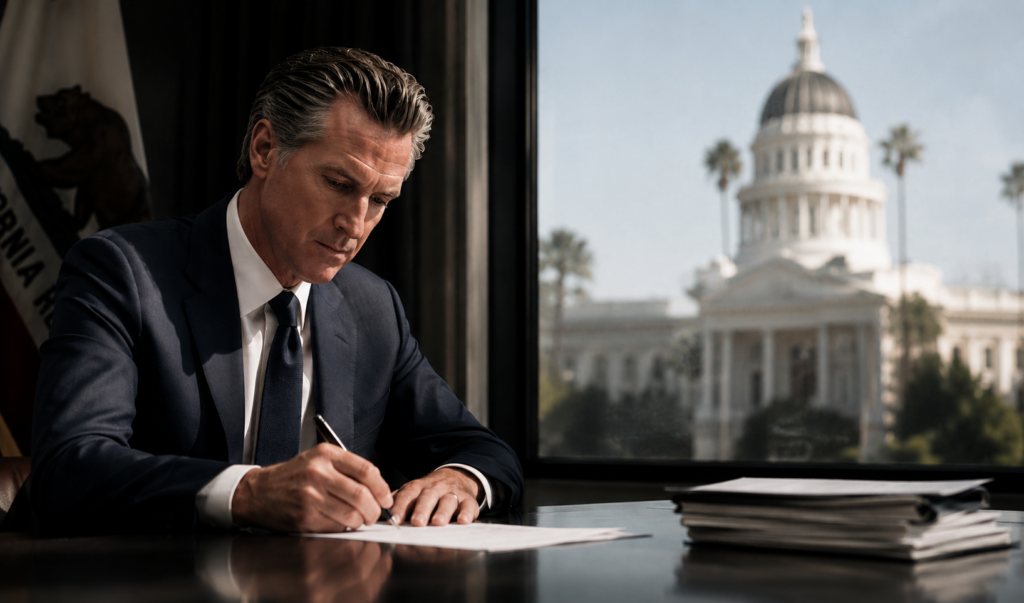








With Gavin Newsom wrapping up his tenure as California’s governor (and 88% odds to run for the Democratic presidential nomination in 2028), all eyes are turning to his successor. And right now, the political prediction markets are backing U.S. Congressmember Eric Swalwell, despite a recent controversy around his eligibility to run.
Rep. Swalwell, 45, has represented California’s 14th congressional district since 2023 (having represented its 15th district a decade prior). On Jan. 19, Swalwell tweeted out a screenshot of the Kalshi market showing his current odds at 50% to be the next governor of the Golden State.
For better or worse, Swalwell’s post is the latest reminder that prediction market odds can serve as both a signal and a catalyst for momentum. And while the prediction markets provide a helpful check on sensational headlines and narrative noise, interpretation of the odds should always be approached with caution.
Swalwell’s rise to CA governor frontrunner
Swalwell, a Democrat, announced his intention to run for governor on the Nov. 21 episode of Jimmy Kimmel Live!, joining a packed field that includes former representative Katie Porter, former state controller Betty Yee, former State Assembly Speaker Antonio Villaraigosa, billionaire Tom Steyer, current Superintendent of Public Instruction Tony Thurmond and former U.S. Secretary of Health and Human Services Xavier Becerra.
With less than five months until the primary, California governor prediction markets are projecting Swalwell as the clear frontrunner, though it may be early to read too much into that. Kalshi’s market on “Who will be the next governor of California? (Person)” has over $1.26 million in cumulative trading volume since opening Nov. 6, and currently puts Swalwell at a 47% (48¢) chance of winning. The next closest candidate is Matt Mahan priced at 22¢. Mahan is the current Democratic mayor of San Jose and has yet to declare his gubernatorial campaign.
Polymarket currently lists Swalwell at 65% to win the Democratic primary for governor, and 45% to be the “California Governor Election Winner. Notably, Polymarket does not have Mahan listed as a strike (trading option) as of Jan. 20. Swalwell’s odds have remained steady on Kalshi, hovering around 50% since the start of December, despite a recent claim that he doesn’t meet the eligibility requirements to run for the office.
Eligibility challenge barely impacts Swalwell’s odds
California’s 2026 Primary Election takes place on June 2. The primary qualifications to run for Governor are:
- Be a U.S. citizen.
- Be a registered voter and otherwise “qualified to vote for that office at the time that nomination papers are issued.”
- Don’t be “convicted of a felony involving accepting or giving, or offering to give, any bribe, the embezzlement of public money, extortion or theft of public money, perjury, or conspiracy to commit any of those crimes.”
- Not have already served two terms in the office.
- Make sure the Secretary of State has two copies of every income tax return in the five most recent taxable years.
Online conservative personality Joel Gilbert filed a lawsuit challenging Rep. Swalwell’s eligibility, according to ABC 10. Gilbert is a conservative filmmaker who has appeared on Alex Jones’s InfoWars as a guest and host. He’s produced conspiracy films about former President Barack Obama and Trayvon Martin (as well as conspiracy documentaries about Elvis Presley and Paul McCartney, which Gilbert later classified as “mockumentaries”).
In his lawsuit, Gilbert alleges that Rep. Swalwell owns no California property, that his permanent residence is in Washington, D.C., and that he listed a Sacramento office building as his home address on his candidate intention form. Gilbert accuses Rep. Swalwell of not being a California citizen and thus, ineligible to run for governor.
“Because of the thousands of death threats the Congressman has received, it is perfectly legal to list a campaign office as the address for his legal filings,” Swalwell’s campaign responded in a statement.
“This nonsense claim comes from a MAGA blogger who made a film claiming Elvis is alive,” reads the statement. “We look forward to beating him in court. Swalwell has represented his Congressional district since the 2012 election, and before that, he was on the Dublin City Council and the planning commission. It is perfectly normal for campaigns to list their treasurer’s or lawyer’s address on these types of forms.”
Despite the challenge, Swalwell’s odds have only dipped a few points over the past day. His odds have fluctuated more over time on Polymarket, but have slipped just a couple points, down to around 45% in the wake of the eligibility challenge. The scenario is a good example of prediction markets serving as a gauge on media narratives. The lack of significant market reaction hints that the eligibility challenge may not hold water, at least at this point.
Kalshi: A political kingmaker? Or buyer beware?
Swalwell is clearly pro-prediction markets, and also understands the potential power of Kalshi as a campaign tool. Many believe that prediction markets do not just provide helpful forecasts, but they can also be reflexive, influencing public perception or opinion. The market odds in Swalwell’s tweet portrayed him as the heavy favorite ahead of the primary, which could in turn boost his momentum and standing in voters’ minds.
Tweeting about market odds is not against the rules. However, a previous candidate for the same office, Kyle Langford, pulled a similar stunt back in May 2025, but his actions did cross a line. Langford placed a $100 bet on himself and tweeted about it, but it was a clear breach of the exchange’s trading prohibitions on the market.
With over $1.2 million in volume (and over 20k contracts invested in “Yes” on Swalwell), some might see this as a legit measure of the race. On the other hand, Kalshi is not limited to California voters. And the market can flip at a moment’s notice, especially with over 280 days to go before the election. In June 2025, ahead of the Democratic primary, an Emerson Poll was the first to show Democratic Socialist Zohran Mamdani (52%) trending ahead of Cuomo (48%). Later that day, Cuomo’s odds on Kalshi cratered. Mamdani proceeded to climb from 18% to more than 50%, while Cuomo’s odds fell from 70% to 46%. Mamdani, as we know, went on to complete the “upset” to win the primary and eventually, the mayoral race.
The signal in the noise
Swalwell’s swagger, the recency of the lawsuit, and the fact that the primary is still five months away are likely factors in his odds not taking a larger hit from the aforementioned eligibility challenge. Or it could be a signal that the markets don’t think the challenge will be successful. Either way, traders should be aware of the signals and the noise that can move the odds in real time, and take heed of the Cuomo-Mamdani poll flip from last year.
If he does become the next governor, Swalwell’s enthusiasm for prediction markets might be a good sign for prediction market investors in California. Meanwhile, New York—where Kalshi famously had a Times Square billboard monitoring the odds between future Mayor Mamdani and his challengers—wants to shut down the platform’s operations in the state, per Gothamist.