The Fed held rates steady on Wednesday, and while prediction markets nailed the outcome, the reaction was anything but neutral.
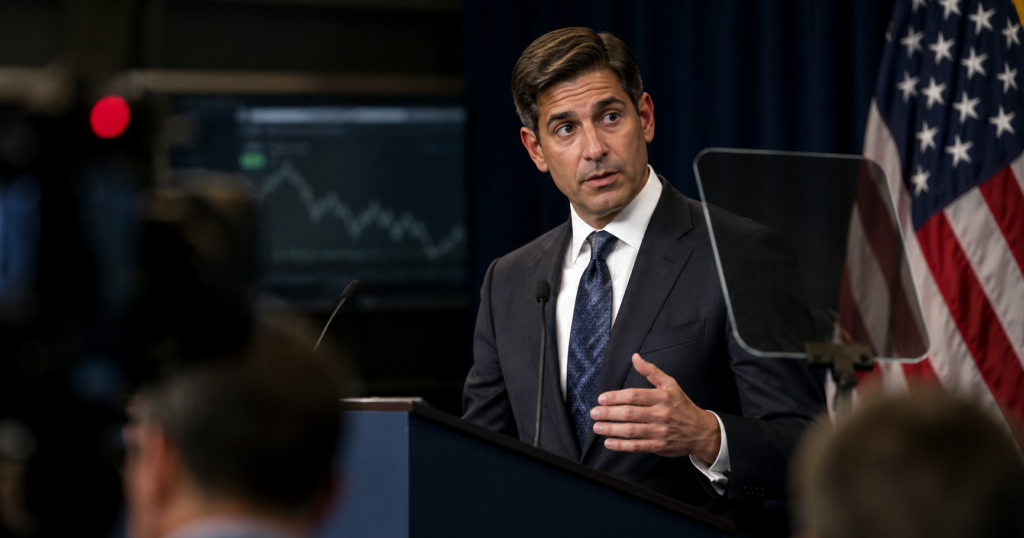
The business world had already braced for a pause, yet the decision still landed like a credibility test for new Chairman Kevin Warsh, with stocks wavering and bonds selling off as traders reassessed how committed the new Fed chair really is to fighting inflation.
Now, heading toward the September meeting, traders are already throwing down on September Fed rate predictions. And, similar to ahead of Wednesday, they’re less sure of a hike than the general public.

No change to Fed rate in July
The Federal Open Market Committee kept the target range at 3.5% to 3.75% in a 9-3 vote, and the statement said the committee was holding policy “in support of the Federal Reserve’s dual mandate.”
The statement also noted that inflation remains elevated and that “the Committee will deliver price stability”. Three officials, Beth Hammack, Neel Kashkari, and Lorie Logan, dissented in favor of a 25 basis point hike. That dissension made the hold look less like consensus and more like a warning shot.
That split is the part markets are still digesting. The bigger problem for Warsh is that the no-hike decision did not calm anyone down. The post-meeting commentary framed the move as a credibility shock, with the bond market selling off and investors questioning whether the Fed is already behind the inflation curve.
Prediction markets before the meeting
Heading into the decision, prediction markets were already leaning toward a hold, but not by a landslide in the more active contracts. Kalshi had no change at 74% and a 25 bps hike at 26% on more than $54 million in volume, while Polymarket was at 97% for no change on $152 million. That was enough to make a hike a tail risk
The subtlety was in the longer-dated pricing. Traders were still assigning meaningful odds to a hike later in 2026, which meant the real debate was never just about July. It was about whether Warsh was setting up the market for a tighter fall.
That’s why the no-hike outcome felt like a surprise to some people even if the probabilities pointed that way.
Traders looking toward September rate predictions
Now prediction markets traders have moved straight to September. Kalshi is already showing $1.3 million in volume on the September decision, with a 25 bps hike priced at 53%, which is the first clear sign that traders think the Fed’s next move may be up rather than down.
While traders don’t seem sold on a September hike, most media analysts suggest that fate is all but sealed.
That shift makes sense given the tone of the Fed statement and the reaction after it. The statement kept emphasizing elevated inflation and price stability, and the market’s response suggests investors are treating that as a setup for a more hawkish fall rather than a one-off hold. The hold was expected, but the path after it still looks like a live policy fight.
For now, Warsh did not raise rates, but he did not win over the market either. And once traders start pricing a September hike above 50%, the Fed’s next meeting stops looking like a routine checkpoint and starts looking like the real decision.