

President Donald Trump and the prediction markets both missed in the Iowa Republican governor primary.
Last Friday, Trump endorsed Randy Feenstra, who had long been polling as the favorite to win the Republican primary in the Iowa governor’s race. Heading into this week, prediction markets gave Feenstra an 80% chance to win while eventual winner Zach Lahn was a 7.6% underdog as of May 30 and around 19% on the eve of the primary.
Throughout this primary cycle, Trump’s endorsements have carried weight, leading to multiple wins across the country. However, Feenstra’s endorsement might have been a shift for Trump under pressure from establishment Congressional Republicans, as Lahn carried the support of MAHA and Turning Point USA.
Instead, voters showed up on Tuesday, and Lahn pulled the upset with media outlets calling the race 38% to 37.2%. So far, however, prediction markets are still showing November’s general election as a likely win for Democrat Rob Sand.
A rare double miss
Lahn’s win is notable for a different reason than a normal primary upset. This is the first time in this cycle that both Trump’s backing and the market’s confidence appear to have fallen flat on the same race.
The margin was narrow, but the result still matters because the race had looked settled enough that a surprise was not really in the cards. Trump’s endorsement also might have come a little too late to sway the conservative base from one side to the other in the state.
It wasn’t until a poll earlier this week that anyone seemed to pick up on the potential for an upset. The findings from that poll also suggest Trump endorsed a candidate who went against his own MAGA base.
During the 2026 midterm primaries, markets have been quick to price in late shifts, especially in a low-volume race. This one, however, still ended with the underdog coming out on top. It’s a reminder that even a strong favorite can be vulnerable when turnout, timing, or late movement breaks the wrong way.
Why Iowa governor result matters
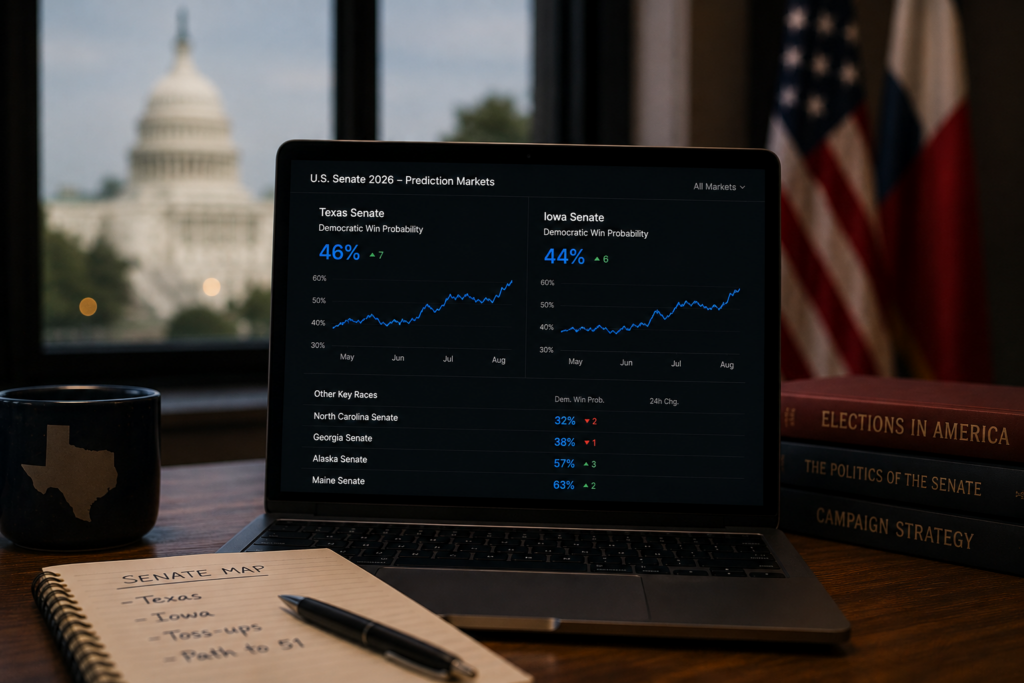
The Iowa primary loss also lands in a larger political context. Prediction markets already had the state leaning Democratic in the governor’s race, with Rob Sand sitting around 60% on Kalshi.
The Republican switch has not radically changed the November board, at least as of yet. But it does reinforce the sense that Republicans are not getting clean traction in a state where they need more certainty, not less.
That matters because the primary result was supposed to be a sign of strength, not weakness. Instead, it exposed a gap between what Trump’s endorsement could still do and what traders thought it would. The market expected one outcome, the endorsement pointed in the same direction, and the vote still broke the other way.
The Iowa governor prediction markets volume problem
One reason the miss may not have been fully baked in is that volume heading into the week was fairly low. That does not excuse the miss, but it does help explain why the market may have been slower to detect the late shift.
In a thinly traded race, the consensus can look firmer than it really is right up until votes are counted.
That is especially true in primary contests where turnout is the whole game. A race can look stable on paper, then move sharply once actual voters show up and the electorate’s composition turns out to be different from what traders expected.
What’s next for Iowa governor prediction markets contracts
Iowa was a bad result for both Trump and the markets. It was not a blowout. But it was a real miss on a candidate whom the media and traders treated as a heavy favorite. It also could leave the general election picture looking a little less predictable than it did before the votes came in.
Prediction markets can still be wrong in places where the crowd thinks the outcome is already in hand. Iowa showed that clearly.
The favorite lost, the endorsement failed to carry the race, and the result only adds to the sense that Democrats remain in a strong position heading into November.