





- ▸ Prediction markets price Ken Paxton as the slight favorite over John Cornyn (~mid-50s vs. mid-40s), even as polls still show a near toss-up.
- ▸ Polling shows James Talarico competitive or even leading in general matchups, but markets still favor a Republican win (~54–65%).
- ▸ A volatile runoff, no Donald Trump endorsement, and shifting odds have driven $30M+ in trading: exactly the kind of uncertainty markets tend to price more decisively than polls.
The Texas Republican Senate race has done what prediction markets love. It has flipped and then flipped again, turning a conventional incumbency narrative into a true battle for the Republican nomination.
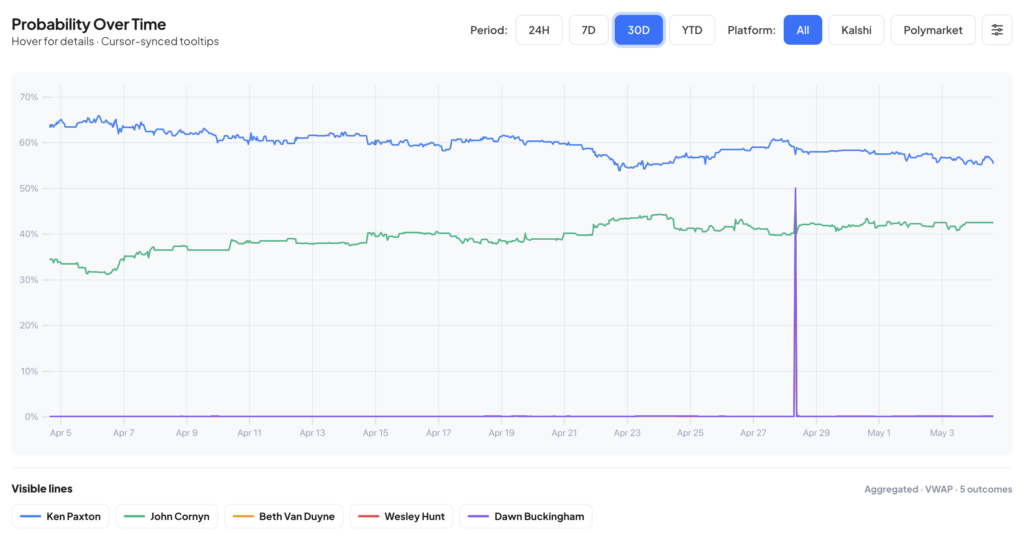
The polls still show a competitive landscape, but the markets now price Texas Attorney General Ken Paxton as the slight favorite to clear incumbent Sen. John Cornyn in the May 26 Texas Republican Senate runoff.
Prediction markets also still see Republicans as favorites in the Texas Senate general election, even as polls show Democrat James Talarico leading both potential GOP nominees. Traders have poured more than $30 million into the various Texas Senate contracts available on Kalshi and Polymarket.
The primaries and the runoff setup
Cornyn and Paxton advanced to a May 26 runoff after neither topped 50% in the crowded Texas GOP Senate primary earlier this year, forcing the state’s establishment‑favorite senator into a high‑stakes race to November. President Donald Trump has neglected to neglected to endorse either candidate as the national media calls the race a “mess.”
On the Democratic side, Talarico, a state representative, locked up the nomination, giving Texas the unusual dynamic of a Trump‑shy runoff in the GOP race paired with a fresh‑faced and hyped Democrat waiting for whoever emerges.
That configuration is exactly the kind of mess that prediction markets thrive on. It’s a binary Republican primary election race with two very different candidates, and a general election opponent whose numbers look surprisingly strong for a Democrat in Texas.
How the prediction markets have flipped
In March, Cornyn’s odds cratered from his lead into the low teens after the primary, only to rebound once the runoff forced the race open again.
Since then, the market has rotated back and forth, with Paxton generally trading as the marginal favorite and Cornyn stabilizing as the live underdog.
Kalshi’s Texas Republican Senate nominee market now prices a Paxton nomination as slightly more likely than not, with Paxton’s odds in the mid‑50s and Cornyn in the mid‑40s, while Polymarket’s Texas Republican Senate Primary Winner contract sits at Paxton 56% and Cornyn 43%.
That’s a clean tilt. The markets treat Paxton as the runoff favorite, even as the official decision day is still weeks away.
The “no‑Trump” gap for Texas Senate
The divergence from the polls is where the story tightens. The New York Times’ Texas Senate polling page still shows a complex race, with various polls painting the Republican runoff and the general election as competitive but not yet a Paxton‑upset scenario. The two most recent polls from April have Cornyn favored by 1%.
Yet inside the markets, Paxton’s margin has held up even as Cornyn’s profile has recovered post‑primary, which suggests traders are pricing in the sheer difficulty of a Cornyn comeback in a Trump‑absent environment.
Trump has not endorsed either Cornyn or Paxton, and that lack of a clear signal from the party’s national brand seems baked into the math. The market’s read is that the party’s base is more aligned with Paxton’s brand of hard‑right, Trump‑adjacent conservatism than with Cornyn’s traditional Washington posture.
The Talarico twist: Markets vs. Fox‑7 poll
Against that backdrop, a poll from Fox7 Austin and Texas Public Opinion Research throws an extra layer of friction into the calculus. The poll shows Talarico leading Cornyn 44–41 and Talarico beating Paxton 46–41, with the Democrat pulling double‑digit margins among Black, Latino, and college‑educated voters, constituencies that are growing but still outweighed in raw head‑count by a conservative‑leaning electorate.
The polls are suggest Talarico can flip the state. The markets are say it’s Paxton’s race to lose.
Kalshi’s Texas Senate winner contract and Polymarket’s Texas Senate Election Winner both still price Republicans as the higher‑probability outcome, with the GOP somewhere around 54–65% depending on the platform and the exact contract, while Talarico sits in the mid‑40s.
A Texas case study
The Texas runoff is a perfect illustration of three things traders can watch for:
- Markets that flip: The Paxton‑Cornyn market has already rotated from Cornyn‑dominant to Paxton favorite, with the pendulum stopping in a place that current polls still treat as less certain.
- Trump‑free races that traders still price: Even without a Trump endorsement, the money is pricing a clear Paxton-heavy lean, which is essentially a bet that the GOP base will follow the Trump political lane.
- Polls love Democrats, markets love Republicans: The Talarico‑leading poll is a generous headline for Democrats, but the market structure still treats this race as a Republican‑favored Texas seat, just not a fully safe one.
Prediction markets are betting on a Paxton GOP primary win and then a Republican‑leaning general election. That comes even as the polls and media float a Texas‑might‑flip story.