


Prediction markets let you trade on crypto outcomes — Bitcoin price targets, ETF approvals, airdrop valuations — with platforms like Kalshi, Polymarket, and Gemini offering hundreds of active contracts.
Why these markets matter: These markets aggregate thousands of traders with millions on the line, producing probability estimates that have in the past beaten analyst forecasts on major events. Close to 10M is traded every 24 hours across prediction markets, with Polymarket dominating this niche.
The big picture: You can trade on whether Bitcoin hits $150K, whether a Solana ETF gets approved, or what a new DeFi token will be worth at launch. This page covers where to trade, how contracts work, and what actually moves the odds.
Available prediction markets
| Feature | Kalshi | Polymarket | Gemini |
|---|---|---|---|
| Regulation | CFTC DCM | CFTC-licensed | CFTC DCM |
| Availability | US only (50+ states) | Global + US rolling out | US only (50+ states) |
| Crypto markets | BTC, ETH, SOL, XRP, DOGE, SHIBA | BTC, ETH, SOL, XRP, DOGE + DeFi | BTC, ETH, SOL, XRP, ZEC |
| # of markets | 40-50 | 160-180 | 8 |
| DeFi/airdrop markets | Yes | Yes | No |
| 15-min markets | Yes (BTC, ETH, SOL) | Yes (BTC, ETH, SOL, XRP) | No |
| Contract format | Threshold (“above $100K”) | Threshold (“above $100K”) | Range (“$89K-$93K”) |
| Fees | ~2% | 0-3% | TBD |
| Funding | Bank/debit/crypto | USDC | Gemini balance |
Kalshi crypto markets
Kalshi is a CFTC-regulated exchange available in 50+ US states. You can fund with bank transfer, debit card, or crypto, and you’ll get 1099s for taxes.
The platform offers Bitcoin, Ethereum, Solana, XRP, Dogecoin, and Shiba Inu price thresholds across 15-minute, hourly, daily, weekly, monthly, and yearly timeframes. You’ll also find bracket-style “How high will Bitcoin get?” markets, plus ETF approvals and enforcement actions.
Kalshi does offer DeFi-native markets and airdrop speculation, though orders are easier to fill on Polymarket.
Fees run about 2%. Kalshi uses CF Benchmarks for settlement, the same methodology as CME Bitcoin futures, which aggregates prices across major exchanges.
Polymarket crypto markets
Polymarket is built on Polygon, so funding requires USDC on that network. You can bridge from Ethereum or swap on a decentralized exchange if you’re already holding other tokens. New users can sign up with Google or email, or connect an existing wallet. The platform acquired CFTC-licensed entities in 2024, allowing it to offer regulated US access through a centralized, compliant system separate from its global crypto-settled platform.
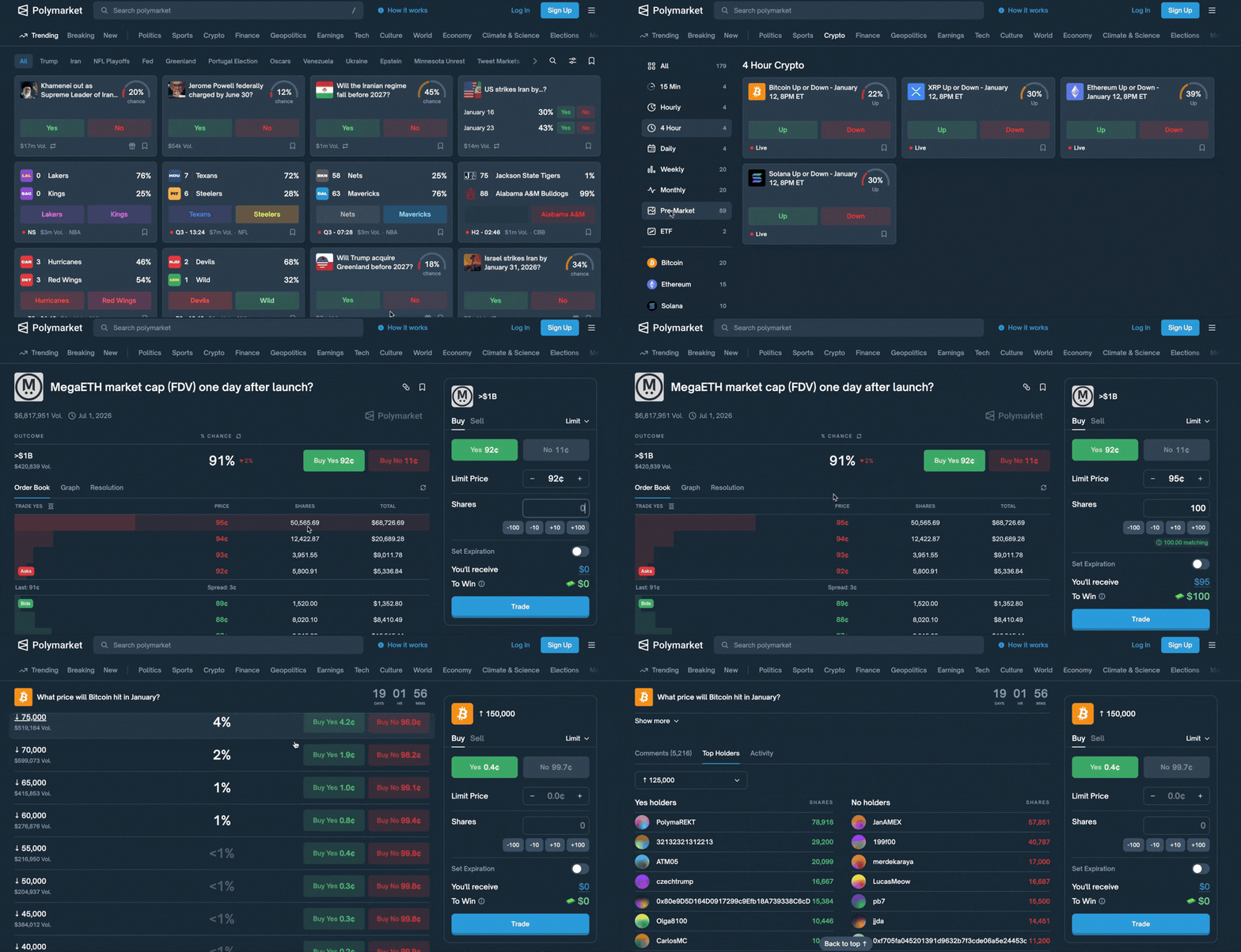
It offers similar crypto price markets to Kalshi, plus a few DeFi markets that don’t exist over there: airdrop speculation, token launch valuations, and protocol governance outcomes. The platform organizes markets by timeframe — 15-minute, hourly, 4-hour, daily, weekly, and monthly — plus a “pre-market” category with 89 markets for tokens that haven’t launched yet.
Fees are 0% on most markets, with one exception: up to 3% taker fees on 15-minute crypto markets, added in January 2026 to combat bot arbitrage. (More on that below.)
Gemini crypto markets
Gemini became the first crypto-native exchange to receive CFTC approval for prediction markets when its subsidiary Gemini Titan was registered as a Designated Contract Market in December 2025. If you already trade on Gemini, predictions are built into the same interface with no separate account or funding needed.
The platform offers range-based contracts for BTC, ETH, SOL, XRP, and Zcash. Instead of “Will Bitcoin hit $100K?” you pick a price bracket: “BTC $89,000 to $93,000 on …”. Multiple brackets are available per asset, typically in $4K increments for Bitcoin, and markets resolve to specific dates rather than “anytime before” deadlines. Settlement uses Kaiko’s Bitcoin Reference Rate, a price index that aggregates data across major exchanges.
Beyond crypto, Gemini offers Sports, Economics, Economy, and Politics categories.
All Crypto price markets (US and Global)
The table below includes all prediction markets with crypto betting as of January 2026. DraftKings, FanDuel, Fanatics entered the market in late 2025 and route trades through partner exchanges. Liquidity on these newer platforms is significantly lower than on Kalshi and Polymarket.
| Platform | Markets Available | Exchange | Availability | Notes |
|---|---|---|---|---|
| Kalshi | BTC, ETH, SOL, XRP, DOGE, SHIBA | Own (DCM) | US only (45+ states) | Deepest liquidity, 1099s issued |
| Polymarket | BTC, ETH, SOL, XRP, DOGE + DeFi | Own (CFTC-licensed) | Global + US rolling out | Only platform with airdrop/FDV markets |
| Gemini | BTC, ETH, SOL, XRP, ZEC | Own (DCM) | US only (50+ states) | Range-based contracts, integrated with exchange |
| DraftKings Predictions | BTC, ETH + financials | CME Group | US only (38 states) | Acquired Railbird exchange for future use |
| FanDuel Predicts | BTC, ETH + financials | CME Group | US only (5 states, expanding 2026) | Same CME order book as DraftKings |
| Fanatics Markets | Sports, Finance | Crypto.com | US only (24 states) | Pricing powered by Crypto.com |
| Robinhood | Via Kalshi integration | Kalshi | US only (45+ states) | Acquired MIAX Derivatives Exchange |
| Coinbase | Kalshi Integration | Kalshi + own | TBD | Acquiring The Clearing Company |
Between the lines: DraftKings and FanDuel both route through CME Group, meaning they share the same order book and pricing. A bet placed on DraftKings can be filled by a FanDuel user. The apps are effectively different interfaces to the same underlying market, which fragments liquidity compared to trading directly on Kalshi or Polymarket. For more information, check out our prediction market apps to compare fees, spreads, promotions and liquidity.
Learn more: How prediction market fees work
Types of crypto markets
Price thresholds are the most common format. These are simple YES/NO contracts on whether an asset hits a price by a specific deadline. “Will Bitcoin hit $100K by March 31?” or “Ethereum above $4,000 on February 1?” All markets offer these, though timeframes vary from 15-minute to yearly and the ability to fill orders is vastly different.
Kalshi tends toward cleaner bracket-style markets. Polymarket offers more granular timeframes and deeper altcoin coverage including XRP, Solana, and Dogecoin markets. Gemini uses range contracts with price brackets rather than single thresholds — you’re betting Bitcoin lands between $89K-$93K, not just “above $89K.”
- Directional race markets ask which outcome happens first. “Will Bitcoin hit $80k or $150k first?” lets you bet on direction without picking a specific price. These often generate significant volume — the $80k vs $150k market traded over $876K as of our last update.
- Comparative performance markets pit assets against each other. “Bitcoin vs. Gold vs. S&P 500 in 2026” — which will have the highest return? Currently, Bitcoin leads at 42%, Gold at 37%.
- All-time high markets offer longer-term speculation: “Will XRP hit its all-time high by June 2026?” or “Solana all-time high by March?” These tend to have lower odds (4-19%) and smaller volume.
- Regulatory and policy markets are where prediction markets shine. Current active contracts include Solana ETF approval odds, whether the US establishes a Strategic Bitcoin Reserve in 2026, “Will China unban Bitcoin by 2027?” (currently 4%), and potential SEC enforcement actions.
- Institutional flow markets let you bet on daily ETF activity. “Bitcoin ETF Flows on January 13?” — Positive or Negative. These create short-term trading opportunities tied to institutional behavior rather than price.
- Novelty and speculation markets cover edge cases like “Will Satoshi move any Bitcoin in 2026?” (6%) — low probability but high interest.
The most popular market from a liquidity point of view is Bitcoin price predictions for 2026. This market is betting on whether or not Bitcoin will reach a specific price by December 31.
Airdrop and token launch markets
Airdrop and token launch markets exist on Polymarket and Kalshi. These markets speculate on what new DeFi protocols will be worth when their tokens launch or the total value if all tokens were in circulation.
Current active markets include Sentient FDV ($200M at 99%, $309K volume), Gensyn FDV ($400M at 55%, $307K volume), and token launch timing markets like “Will ETHGAS launch a token by June 2026?” (69%, $171K volume).
Settlement depends on accurate launch data and UMA oracle interpretation, which adds risk compared to price markets with cleaner data sources.
Other prediction categories: Political — Sports
How to trade on BTC, ETH prices
On Kalshi: Create an account, complete KYC, and fund via bank or debit. You can start trading with as little as $1, buying YES or NO contracts on any market.
On Polymarket: Sign up with Google, email, or connect an existing wallet like MetaMask, Coinbase Wallet, or Phantom. To fund your account, you’ll need USDC (a stablecoin pegged to $1) on the Polygon network. The easiest path: buy USDC on Coinbase, then send it to your Polymarket wallet address and select Polygon as the network. Polymarket also supports direct card deposits in some regions. There’s no set minimum trade, but small positions under $10 often aren’t worth the transaction costs.
If you’re holding USDC between trades, you can put it to work through DeFi lending protocols while you wait for the right market.
On Gemini: If you already have a Gemini account, navigate to the Predictions tab and fund trades with your existing balance. Pick a price range and buy YES or NO.
Crypto prediction markets offer real-time, money-backed probability on prices, regulations, and DeFi events. For forecasting, check these odds against analyst models for disconnects. For trading, start with longer-term price markets where research provides an edge. Choose Kalshi for simplicity, Polymarket for DeFi depth, or Gemini if you’re already trading there and want predictions in the same interface.
How crypto contracts work
Every prediction market contract is binary — settles at $1 (YES happens) or $0 (NO happens).
Example: “Will Ethereum hit $5,000 by June 30, 2026?” trades at YES = $0.38. Buy 100 contracts for $38. If ETH hits $5K, you receive $100 — profit of $62. If not, you lose your $38.
You don’t have to hold until settlement. If bullish ETH news breaks and odds shift from $0.38 to $0.55, you can sell and pocket $0.17 per contract regardless of the final outcome.
This continuous price movement is what makes prediction markets function like a market rather than a bet. For a deeper dive, see our how prediction markets work article.
Settlement check
Settlement methodology matters, especially during volatile moments when exchange prices diverge.
Kalshi uses CF Benchmarks’ Bitcoin Real-Time Index (BRTI), settling on a 60-second average — resistant to single-exchange manipulation. The rules explicitly warn that Coinbase or Google prices may differ from settlement prices.
Polymarket uses Binance BTC/USDT 1-minute candle data for monthly price markets, with UMA (a decentralized oracle protocol where tokenholders vote on outcomes) for final resolution. For 15-minute markets, it’s simpler: did price end higher than it started, based on Binance data? The tradeoff is speed versus robustness — if Binance has a flash crash that other exchanges don’t, your Polymarket contract settles on that price.
Gemini settles against crypto currency index as published by Kaiko at the time stated for settlement.
How the 15-minute markets work
Polymarket and Kalshi both offer 15-minute crypto markets.
At the start of each 15-minute window, a new market opens asking “Will Bitcoin be up or down?” You buy YES (price goes up) or NO (price goes down). At the end of the window, Chainlink oracles check the price against Binance data, and the winning side pays $1 per share. The losing side pays $0. Markets run continuously, with new windows opening every 15 minutes for BTC, ETH, SOL, and XRP.
In any binary market, YES + NO should equal $1. If YES trades at $0.60, NO should trade at $0.40. The price reflects the market’s collective probability estimate — 60¢ YES means traders think there’s a 60% chance the price goes up.
The bot problem and Polymarket’s solution
These markets have become dominated by arbitrage bots. Retail traders can create temporary mispricings. When YES trades at $0.48 and NO at $0.50, buying both costs $0.98 — but one side will pay $1 at settlement. That’s a guaranteed $0.02 profit per share, regardless of outcome. (see more examples by using our arbitrage calculator).
One bot highlighted by Dexter’s Lab reportedly turned $313 into $414,000 in a single month trading 15-minute BTC, ETH, and SOL markets with a 98% win rate. The bot doesn’t predict direction — it exploits the lag between spot price moves on Binance and Polymarket’s odds updating.
Another well-known bot, “gabagool,” used a variation: buying YES when it gets temporarily cheap, then NO when sentiment flips, accumulating balanced positions below $1 combined cost. Analysis of a single 15-minute window showed gabagool spending $1,237 on balanced YES/NO positions at $0.966 combined cost, netting $58.52 profit — about 4.7% in 15 minutes.
Polymarket responded in January 2026 by adding taker fees up to 3% specifically on 15-minute crypto markets. The fees fund rebates for market makers, aiming to improve liquidity while making pure arbitrage less profitable.
The longer-term crypto markets — daily, weekly, monthly — don’t have the same bot dynamic. Price movements are slower, mispricings are rarer, and the edge goes to traders with better information rather than faster infrastructure.
Crypto markets vs. forecasting
Search “Bitcoin price prediction” and you’ll find Changelly, CoinCodex, and analyst models. Prediction markets offer something different: probability backed by money rather than just analysts and opinions.
Analyst forecasts are opinions. Prediction market prices reflect where traders are willing to put money. The two often diverge — when they do, one of them is wrong.
Zoom in: If Changelly predicts $180K but Polymarket prices that outcome at 8%, the disconnect is worth investigating. Either the model is wrong, or the market is mispricing.
- Directional trading is the simplest approach: buy YES if you think an outcome happens, NO if you don’t. This works best when you have a differentiated view the market hasn’t priced.
- Hedging lets you protect downside without selling. If you hold BTC and worry about a drop below $80K, you can buy NO contracts on “Bitcoin above $80K.” If BTC drops, the contracts pay out and offset your spot losses.
- Arbitrage exploits price differences between platforms. When the combined cost of YES on Kalshi and NO on Polymarket is under $1, you’re guaranteed profit regardless of outcome. These opportunities are fleeting, though, and typically require automation to capture.
- Traders looking to stay productive with idle funds can compare returns against crypto lending rates or ETH staking yields
The limitation is that markets give probability, not price targets. They answer “26% chance BTC hits $150K” — not “BTC will be worth $X.” For specific price predictions, you still need analyst models.