




Prediction markets continue to rack up an impressive list of legitimate institutional partners against a current backdrop of serious public trust and industry optics issues. The Associated Press — the 180-year-old wire service that called U.S. elections with 99.9% accuracy across nearly 7,000 races in 2024 — announced on Monday it would license its live vote count data and official race calls to Kalshi for the 2026 midterms. For an industry that has spent two years arguing it belongs in the same sentence as financial derivatives and economic forecasting tools, not slot machines and sportsbooks, the deal is a boon.
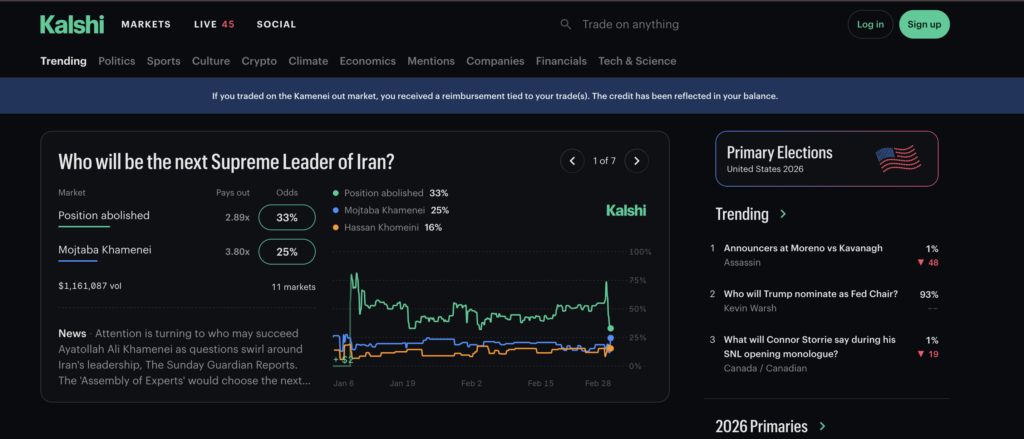
The announcement also came within hours of a former Trump White House chief of staff launching a campaign calling prediction markets a scam. And followed in the immediate aftermath of another market resolution controversy, this one on a market that the public considers to be war-related (“Ali Khamenei out as Supreme Leader”).
That is the week prediction markets are having right now. And it tells you almost everything about where the industry actually stands. It also helps contextualize the bombast of negative reactions to the AP news. But first, what will this new data deal mean?
The AP deal with Kalshi, explained
Starting with the 2026 primary season, Kalshi users will have access to AP’s real-time vote tallies, race projections, and polling close times integrated directly into the platform. The AP, which licenses (i.e. sells) its elections data to thousands of newsrooms globally and doesn’t do exclusive deals, framed it as expanding the reach of trusted information to audiences already following elections through market activity.
“We’re pleased to be working with Kalshi as we work to expand the reach of AP’s trusted elections data, meeting audiences where they are,” said AP Vice President for Elections David Scott.
The deal is part of a deliberate expansion. AP stood up a standalone business unit, AP Elections, in 2025 “to help grow its elections business following a record year in 2024, with a 30% increase in customers over the last presidential cycle,” according to the AP press release.
For Kalshi, the value is obvious. The AP’s election-calling infrastructure is about as credible a data source as exists in American civic life. Integrating it into election markets does two things at once: it improves the user experience on election night, and it signals to anyone paying attention that an established institution considers Kalshi a serious platform. Kalshi announced the partnership on X, and called itself “the premier destination to experience elections” in the press release.
The Kalshi Election Hub is live
— Kalshi (@Kalshi) March 2, 2026
On top of live trades, we’ve added real-time voting data by @AP
Follow every race, every trade, and every vote all on Kalshi pic.twitter.com/vNwkZZOxIE
There is also a practical resolution question the press release doesn’t address directly: will Kalshi resolve its election contracts on AP calls? Given that the AP is now the platform’s official data partner for vote counts and race declarations, the logical implication is yes — which would be a meaningful improvement in resolution clarity. One of the persistent criticisms of prediction market election contracts is ambiguity about what triggers resolution, as well as lag time between election results and market resolution. Tying election market resolution explicitly to AP, a known and neutral arbiter, would address that concern in a way platforms have struggled to do consistently. That answer deserves a clear, public statement.
The deal follows a pattern that has accelerated sharply over the past year. CNN and CNBC both have exclusive integrations with Kalshi. Dow Jones and Yahoo Finance have partnered with Polymarket. In February, a Federal Reserve working paper found that Kalshi’s macroeconomic markets rival or outperform traditional forecasting tools on Fed rate decisions and headline CPI — a finding Kalshi CEO Tarek Mansour called “incredible” and highlighted as industry validation. Bloomberg Businessweek put the industry on its March cover. By any institutional measure, prediction markets have arrived. But not everyone is pleased about their arrival.
Trust issues in the background
Here is what else happened on March 2. Mick Mulvaney — Trump’s former White House chief of staff, a self-described “big pro-gambling guy” and former South Carolina congressman — launched a coalition called Gambling Is Not Investing, with the explicit goal of pressuring state and federal officials to treat sports prediction market contracts as gambling. “If it looks like a sports bet, if it sounds like a sports bet, if it pays off like a sports bet, if it’s on a sporting event — it’s a sports bet,” he told WIRED.
Mulvaney was candid about his strategy: “This is a PR campaign, not a legal campaign.” That admission signals he’s not trying to win in court, where the battle over sports markets jurisdiction is already playing out on multiple fronts. Mulvaney is more focused on winning in public opinion, because he believes public opinion is already on his side.
And he may be right.
Also on March 2, Columbia economist Rajiv Sethi published “Trading on Violence”, a pointed analysis arguing that Kalshi’s resolution-at-last-trade approach to the Khamenei market controversy doesn’t actually solve the problem. The Khamenei market dispute — in which Kalshi and Polymarket listed functionally identical contracts that resolved entirely differently after Khamenei’s death, leaving arbitrage traders with unexpected losses — had already generated significant backlash. Sethi’s argument goes further: someone with advance knowledge of a violent outcome can still move prices before the event and bank substantial profits, regardless of how resolution is structured. The incentive problem doesn’t disappear with better contract design.
That analysis, and the rest of the fallout of the Khamenei market resolution ordeal, landed on the same day Kalshi announced a partnership with the institution most associated with election integrity in the United States.
Reactions to the AP deal
Many reactions on social media are overwhelmingly negative and reflect mainstream perception, not technical objection to the data licensing mechanics. Negative reactions including “Why?” “Gross,” and the like followed Katie Robertson’s tweet announcing the deal. And the Trump Jr. connection surfaced prominently in comments across X.
Doesn’t Don Jr. sit on Kalshi’s board? Another conflict of interest that nobody bats an eye at. FFS
— The Crazies Will Not Prevail! (@CmonPeopleNow) March 2, 2026
For many, the tension between Kalshi’s quest to “financialize everything” has no place in mainstream news or election coverage. Those folks will certainly not be pleased to see Kalshi odds embedded into election night (and lead-up) coverage on CNN and CNBC this fall. The AP deal runs in the opposite direction. AP’s official election data will be supplied to Kalshi, which the exchange will presumably use to determine direction of resolution, i.e. whether contracts on Yes or No pay out.
Kalshi’s Head of Politics Jaron Zhou touted the use case of election markets in the press release: “Kalshi’s election forecasts help campaigns and everyday citizens track market expectations for election outcomes, and integrating AP’s live vote count data enhances Kalshi’s election night experience by bringing together real-time vote tallies and market activity.”
While prediction markets have historically proven useful as a real-time barometer of election forecasts, much of the public is not ready to accept them, especially given current public perception of the industry.
Among Kalshi’s strategic advisors is Donald Trump Jr., who said his family used the platform on election night 2024 to know they’d won “hours ahead of the fake news media.” Outperformance of traditional forecasting for the 2024 election was a pivotal moment for prediction markets.
The irony in the AP-Kalshi deal is worth pointing out. The AP is currently fighting a pending First Amendment lawsuit against the Trump administration over White House press access, and just licensed its election-calling authority to a platform where Trump Jr. holds a paid advisory role. Kalshi’s ties to the Trump family are not lost on mainstream observers, and are not helping the industry’s optics problem.
The credibility-trust gap is growing
Prediction markets have a legitimacy problem that is the inverse of what you might expect. They are not struggling to earn institutional credibility: they are accumulating it faster than almost any financial product in recent memory. The Fed paper, the AP deal, the CNN integration and more are not superficial endorsements. They reflect real utility.
What they are struggling to earn is public trust.
Institutional legitimacy flows through formal channels: regulatory approval, data partnerships, academic validation, media integration. Public trust flows through the news cycle. Right now that cycle includes potential insider trading on military strikes, market structures that academic critics argue create financial incentives around political violence, resolution controversies that required a CEO to publicly defend his platform against charges of enabling assassination markets, and a political coalition led by a Trump-era insider calling the entire enterprise a consumer protection failure.
The Mulvaney coalition is telling precisely because it is, by his own description, a PR campaign. He’s not trying to win in court. He’s trying to win in public, because he understands that public perception is the battlefield that matters most right now for the future of prediction markets. The AP deal is a legitimacy play for exactly the same reason. Both moves, from opposite sides, acknowledge the same underlying reality: the trust gap is real, it is widening, and institutional deals are not closing it.
What could actually close the gap
The Fed study and the AP partnership suggest prediction markets have earned a place at the table. The question is whether the industry is doing the work to deserve to stay there.
That means resolution rules published before markets open on sensitive events, with market naming and promotion that accurately reflects settlement rules and intentions. It means insider trading enforcement that goes beyond press releases naming small-time violators. It means transparency about what is and isn’t allowed in terms of market types and trading on non-public information.
And for the AP deal specifically, it means a clear, public answer to a straightforward question: if AP calls a race, does Kalshi resolve on that call? Clarity on these resolution rules for upcoming primaries and elections will be crucial for earning back some trust that has been eroded.
The broader regulatory picture isn’t settled either. The CLARITY Act remains a live legislative question. State legal battles are ongoing. The Mulvaney coalition is, by design, a pressure campaign aimed at the same public opinion that the AP deal is trying to shift. On the other side, the Coalition for Prediction Markets is working on the industry’s image, and the CFTC is actively intervening in the courts on behalf of prediction markets.
Prediction markets built their credibility case by being right when everyone else was wrong. Now they need to be right about something harder: that an industry can survive accumulating institutional legitimacy while public trust runs in the opposite direction. The AP deal, the Fed paper, and the Bloomberg cover say the institutions have decided. The rest of the news cycle, and the comment sections on new partnership announcements, says the public hasn’t.