









The Georgia 14th House District special election is heading to a runoff Tuesday, and there is a lot of noise for what prediction markets are suggesting will not be a close race for Marjorie Taylor Greene’s old seat.
A Trump-endorsed Republican, Clayton Fuller, is far outpacing Democratic challenger Shawn Harris, with a 98% chance to win on Kalshi. But pundits are closely watching the margin in the Georgia House race as a measuring stick of support for Trump ahead of the 2026 midterms.
The Kalshi GA-14 special election winner market includes live tracking of percent of votes counted with over $1.8 million in trading volume so far. Polymarket traders are less enthused about the storyline, with just under $300,000 in volume.
Why the Georgia House seat matters
Greene vacated the seat in January after breaking with Trump over the Epstein files. The special election is to fill the remainder of the term through Jan. 3, 2027.
Georgia’s 14th is one of the state’s most conservative districts. Trump carried it by nearly 70 points in 2024, which is why the GOP is still heavily favored even with a runoff in play.
The first round produced a runoff between Fuller and Harris after neither cleared 50% in the March 10 special election. Fuller emerged as the Trump-backed nominee, while Harris remains the Democrat’s best shot at making the race even a little competitive.
What the prediction markets say
Like Kalshi, Polymarket offers a clear signal of trader sentiment. Its election market prices Fuller at 97.8% and Harris at 2.4%. That’s a strong Republican edge, but the more interesting part is how modest the market is relative to the race’s political theatrics: the money is there, but not in the kind of size you’d expect if traders thought this was a true upset possibility.
Along with the strong odds of a Fuller victory, Kalshi is also offering a margin-of-victory market. Traders expect a win of at least 10% to 15%, trading at a 35% chance. A larger 15% to 20% win is next at 28% implied probability.
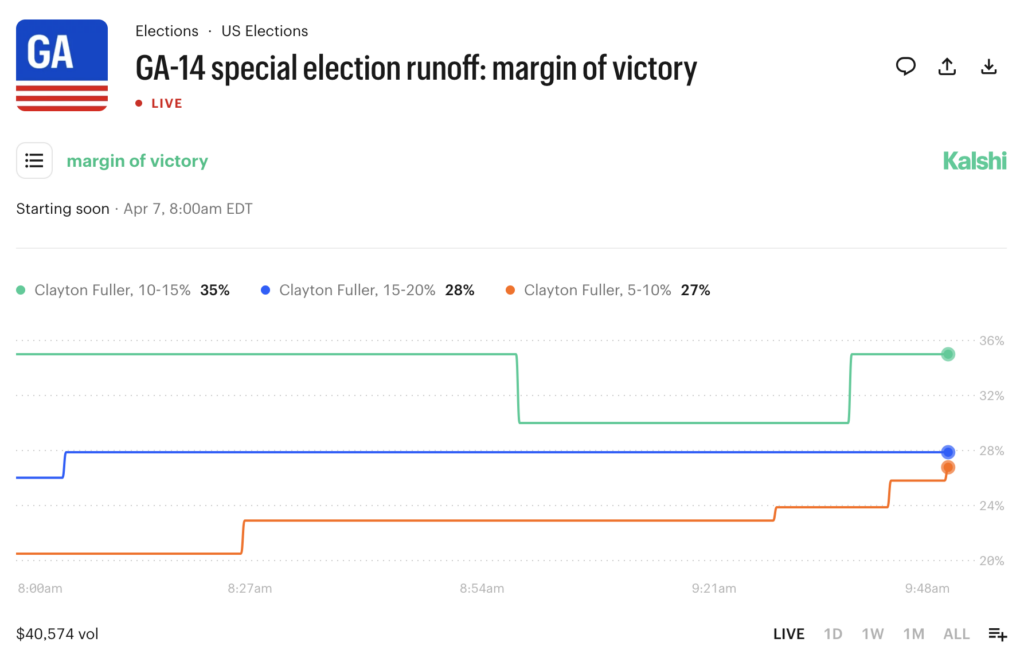
The structure suggests traders are treating the race as a procedural, low-drama Republican hold rather than a genuine test of the district’s partisan ceiling.
Georgia’s broader political context
The special election matters politically because it briefly put an open House seat in play in a district that should be safe GOP territory, and because it gives Trump one more endorsement test in a year when his backing has mattered in primaries and runoffs.
But in prediction market terms, GA-14 is not behaving like a marquee contest; instead behaving like a heavily Republican seat where the only real question is whether the GOP consolidates quickly or spends too much energy on internal politics.
The race has all the ingredients for attention: Marjorie Taylor Greene’s seat, Trump involvement, runoff politics, and a Democratic challenger with military credentials, but the odds boards are telling a much quieter story.
