









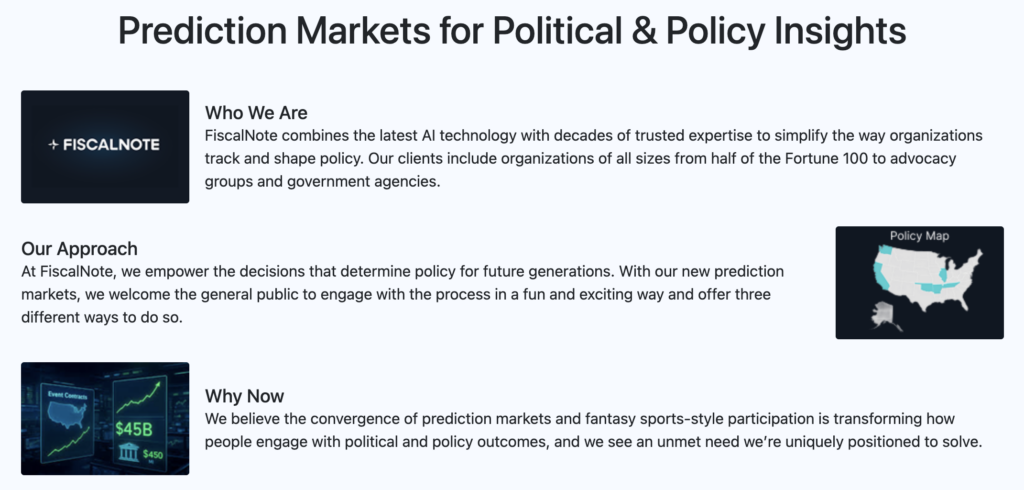
Political prediction markets captured mainstream attention during the 2024 election cycle, and the institutional interest that followed hasn’t slowed down. FiscalNote, the publicly-traded policy intelligence platform best known for its AI-driven legislative tracking and regulatory data tools, is the latest to make a move, announcing plans to bring its policy data expertise into the prediction markets space.
The company unveiled a preview experience at PoliticalPredictions.com, entered into a strategic non-binding memorandum of understanding with prediction technology partner 365Prediction, and named veteran market strategist Dr. Laila Mintas, founder and CEO of 365Prediction, as a strategic adviser. According to the news release announcing the move, the initiative will leverage FiscalNote’s policy expertise, proprietary datasets and forecasting insight to help users anticipate and engage with outcomes relevant to politics and public policy.
FiscalNote’s core business centers on providing legislative tracking, regulatory monitoring and policy analytics tools to corporations, trade associations, law firms and advocacy organizations. Clients use its software to monitor bills, assess regulatory risk and anticipate political developments that could affect their operations.
“Prediction markets are rapidly emerging as a powerful new way to understand, anticipate, and engage with outcomes across a wide range of domains,” FiscalNote CEO Josh Resnik said in the release. “As public interest in politics and policy decisions accelerates, this category is poised to reshape how political insight is formed, shared, and acted upon, extending well beyond traditional audiences.”
Policy data meets prediction markets: FiscalNote’s institutional play
The announcement was followed by a Feb. 18 investor-focused web presentation, where executives and strategic advisers outlined a phased approach to engagement with prediction markets, beginning with insight-driven products and experimental “fantasy league” tools before any direct operation of markets. Company leadership emphasized that regulatory developments will play a key role in shaping the timing of any deeper entry into prediction markets.
Materials from the presentation were formally disclosed in a Feb. 20 SEC Form 8-K, reflecting the company’s view that the initiative is relevant to investors.
By framing prediction markets as an extension of its existing policy intelligence business rather than a pivot away from its core offerings, FiscalNote is offering one of the clearest examples to date of prediction market data being positioned as a decision-support resource for institutional audiences.
“What it boils down to is that the way people consume, evaluate, and act on information is changing very rapidly. And we view that shift as an opportunity because it’s opening up new markets and use cases for what we do best,” Resnik said during the presentation. “FiscalNote’s assets are valuable and differentiating enough that we have a meaningful role to play in emerging opportunities like this. And we start with a very strong foundation.”
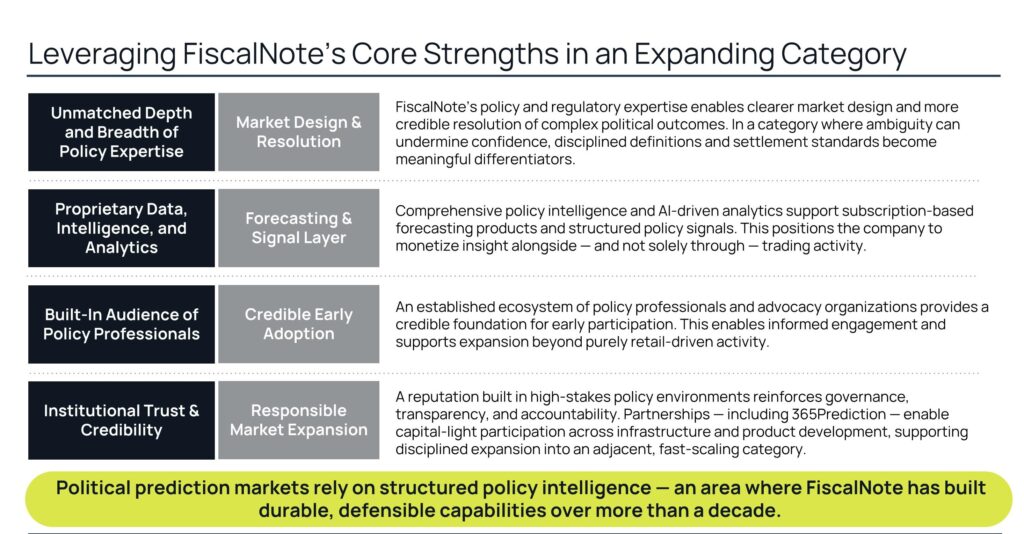
Resnik said that expanding into political prediction markets is a natural extension of FiscalNote’s foundation.
“In many ways, it’s an evolution of what we’ve been doing for years,” he said. “We’ve been identifying key political and policy issues, applying our data and human expertise to anticipate outcomes, and helping our audience understand what those outcomes mean once events unfold. Prediction markets represent just another endpoint where that same blend of data analysis and expertise can be valuable and engaging.”
FiscalNote explores advocacy-backed market models
The most concrete product concept FiscalNote has put forward isn’t a trading platform, but rather a model that could redefine how advocacy organizations engage with prediction markets entirely.
FiscalNote Chief Product Officer Can Babaoglu, who previously worked on AI-driven legal technology at Casetext, a legal research software company later acquired by professional data giant Thomson Reuters, used the Feb. 18 presentation to outline how the company is approaching prediction markets. Rather than immediately launching a trading platform, he said the focus is on credibility, accessibility and policy-focused use cases that build on FiscalNote’s existing data and intelligence business.
One area the company is exploring involves advocacy organizations. Babaoglu said some policy professionals remain hesitant to participate in prediction markets because they are sometimes perceived as betting products. FiscalNote is evaluating models where advocacy groups could sponsor markets tied to policy issues, allowing participants to trade on outcomes while also potentially supporting causes connected to those issues. The concept builds on FiscalNote’s existing relationships with advocacy groups and government affairs professionals who already use its policy data tools.
“We believe political prediction markets could be a tool to raise awareness and fundraise for advocacy organizations,” Babaoglu said. “Take an issue like social media controls for minors — advocacy groups on both sides, parents’ organizations who want more controls and online freedom groups, are already working to influence the outcome here. We envision them sponsoring these related markets, presenting their case as to why a particular outcome is more beneficial to support society, and participants being able to not only trade, but also donate a portion of their trade value or their winnings to an organization that they choose.”
Political markets emerge as a major growth driver
FiscalNote’s expansion also brings experience in betting and prediction markets into the mix. Dr. Mintas spent more than two decades working in iGaming, sports data and prediction markets, including senior roles at Sportradar and advisory work with global and regional soccer governing bodies FIFA and CONCACAF. FiscalNote said she will help guide market design, regulatory strategy and go-to-market planning as the company develops its political prediction initiatives.
During the Feb. 18 presentation, Mintas emphasized that while sports event contracts often dominate headlines, political prediction markets also represent a meaningful share of overall activity.
“Prediction markets have seen explosive growth over the last years, with global trading volume surging,” she said, adding that political markets, including both election and non-election contracts, accounted for about $7.2 billion in trading volume in 2025. “We will see that volume grow in this year and the coming years, for sure.”
Political contracts tend to draw larger amounts of capital even though there are fewer individual events, which can translate into stronger market liquidity, Mintas said. She also noted how much the market has changed in recent years. Earlier prediction markets were often fragmented, heavily crypto-focused and largely retail-driven. Today, she said, the environment is more structured, better capitalized and attracting wider institutional interest.
Fantasy-style formats may come before exchange
One question left open by FiscalNote’s announcement is whether the company ultimately intends to operate its own regulated, consumer-facing prediction market platform. While the preview experience at PoliticalPredictions.com signals interest in deeper market participation, executives indicated the near-term focus is on insight products, partnerships and experimental engagement formats rather than launching a full event contract trading venue.
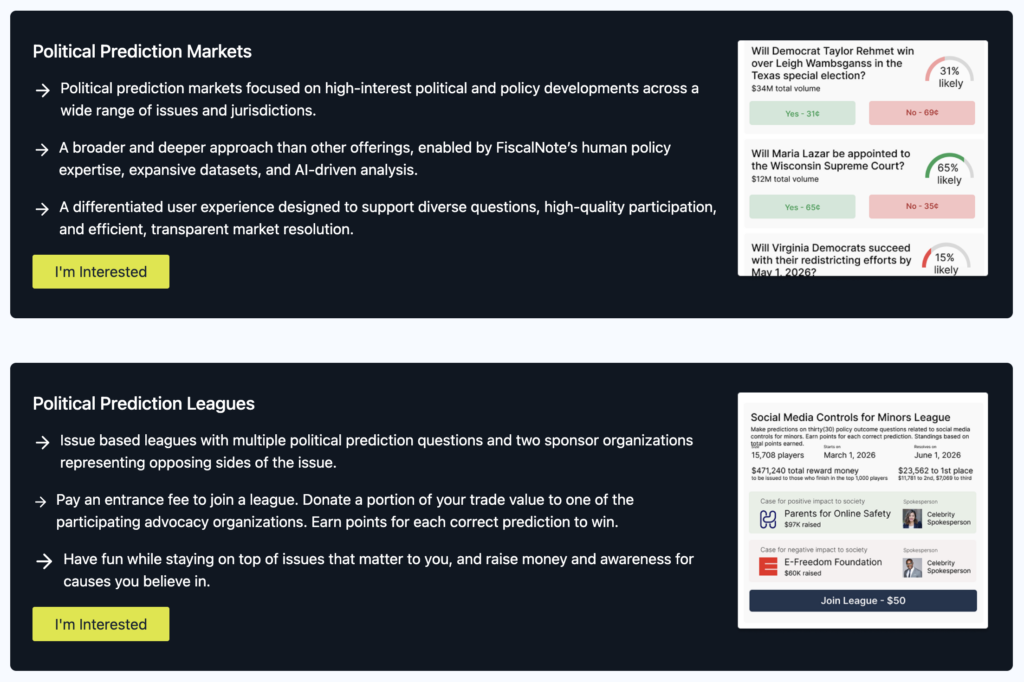
Babaoglu said one early area of experimentation involves fantasy sports-style experiences built around political outcomes.
“The regulatory environment around ‘fantasy leagues’ is even more relaxed than prediction markets,” he said, adding that the company wants to explore those formats as it develops its broader approach.
There is no public record of FiscalNote filing an application with the Commodity Futures Trading Commission that would allow the company to operate a regulated event contract exchange in the U.S. Babaoglu said prediction markets themselves would come later “based on our learnings … as well as the regulatory process.” The phased approach indicates the company is moving cautiously as it evaluates market demand and regulatory clarity.
Note: FiscalNote did not immediately respond to a request for comment on its long-term prediction platform plans. This story will be updated if the company provides additional details.
Prediction markets gaining institutional credibility
FiscalNote’s measured entry into the space comes as prediction market data is increasingly being evaluated as a decision-support tool. Recent Federal Reserve research has examined how market-based probabilities can complement conventional economic forecasting, while financial exchanges, data providers and institutional investors have begun experimenting with incorporating prediction market signals into risk analysis and policy outlooks.
That shift suggests prediction markets are increasingly being viewed not just as trading venues, but also as sources of actionable information. Political event contracts in particular have begun drawing attention from analysts seeking real-time signals on policy and macroeconomic developments that can be difficult to capture through traditional polling or forecasting alone.
FiscalNote’s approach fits squarely within that emerging use case. By positioning prediction market data as an extension of its policy intelligence platform rather than a standalone trading product, the company is effectively testing whether those market forecasts can become another layer of institutional policy analysis.
Whether FiscalNote ultimately files with the CFTC and competes directly with Kalshi and Polymarket, or carves out a data and intelligence lane of its own, the direction of travel is clear: the institutional case for prediction markets as a policy analysis tool is being made in board decks and SEC filings now, not just on trading dashboards. For a category that has spent years fighting for legitimacy, that may matter more than any single platform launch.
