






Are you ready for Government Shutdown 2: Electric Boogaloo? As Congress scrambles to avoid another shutdown by a funding deadline of Friday at midnight, prediction markets are showing confidence levels of nearly 80% that the government is going to close, again.
In the wake of Immigration and Customs Enforcement’s (ICE) tactics in Minneapolis — which includes the fatal shootings of Rene Good and Alex Pretti — Senate Democrats seem adamant to not pass the $1.2 trillion funding package that cleared the House of Representatives last week, unless funding for the Department of Homeland Security is cut. And this has prediction market traders pricing a high level of certainty that a second shutdown within in five months is coming.
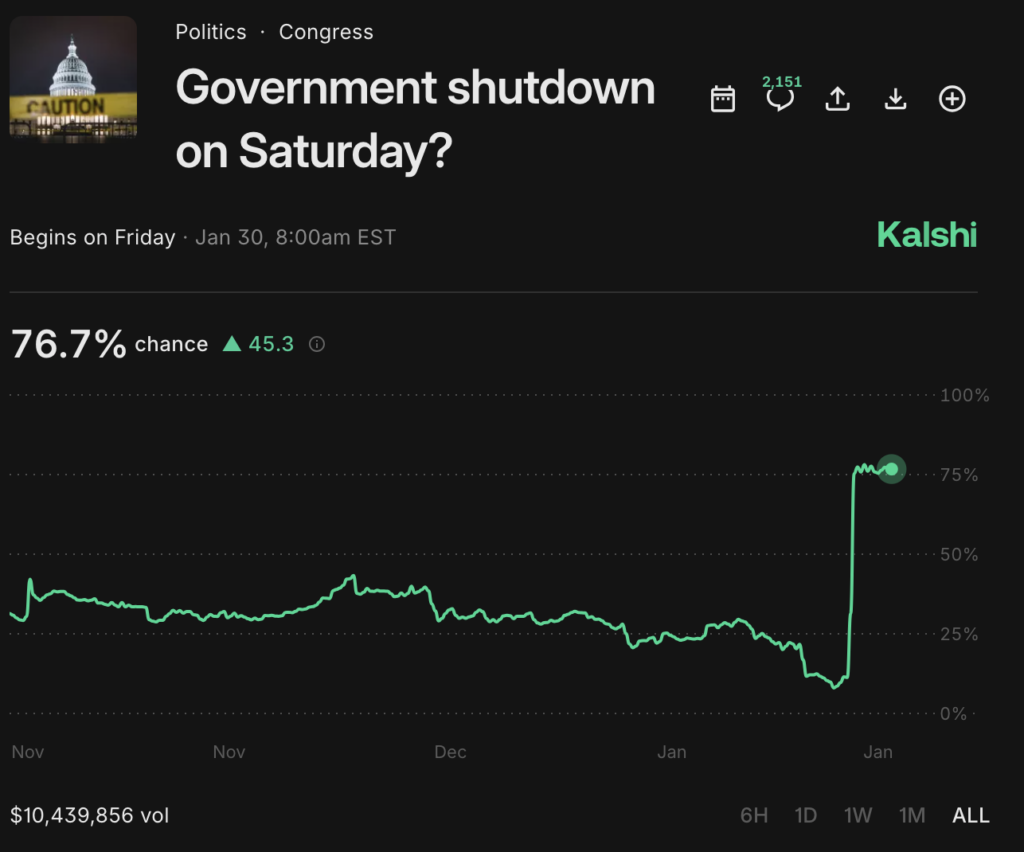
As of Tuesday evening (Jan. 27), Polymarket’s odds of a shutdown happening were hovering around 78%. The “US Government Shutdown Saturday?” market had over $12.1 million in trade volume. The market would resolve “Yes” if the U.S. Office of Personnel Management (OPM) announces another federal government shutdown due to a lapse in appropriations by January 31, 2026, 11:59 PM ET. Otherwise, this market will resolve to “No.” Meanwhile, Kalshi’s shutdown market (“Government shutdown on Saturday?”) was trading around 77% in favor of a shutdown with $10.4 million already traded and $3 million in open interest on the market.
With so many conflicting headlines on the subject right now, we take a look at what the prediction markets are telling us about a potential shutdown.
Another government shutdown? Check the prediction markets
A similar Polymarket question — “U.S. Government Funding Lapse on January 31?” — is trading at 90% for Yes as of Tuesday evening. A “funding lapse” would entail President Trump “failing to sign the relevant bill(s) extending government funding by January 30, 2026, 11:59 PM ET.”
Polymarket also offers a market on how long this potential second shutdown would last. There is currently optimism that it wouldn’t go as long as the last, which closed the government for 43 days. Current projections include:
- 79% of it going 1+ days ($157k vol.)
- 74% odds that it would last 3+ days ($66.9 vol)
- 54% odds it would go over a week (7+ days)
- 28% odds it would last longer than a fortnight
More than a month and more than two months are trading at 15% and 3%, respectively.
One might consider prediction markets as good weathervanes for potential governmental changes and political odds. For most of January, Polymarket odds of a shutdown were decreasing, to be expected as the funding deadline got closer. In fact, they were as low as 9% on the morning of Jan. 24. But, twelve hours later in the wake of a second protester killed by ICE in Minnesota, the odds had skyrocketed to 80%, where it has hovered ever since.
Will Willard of The Oracle Substack noticed that Polymarket user @semi (aka @slight-) was the top holder of “Yes” for the shutdown market, which was trading at 22% when he took up the position three weeks before the spike. When Willard asked the trader about the bet, the user replied, “I don’t feel that strongly about it. To be honest, it just seems like a good price.” The same trader later told The Oracle:
“ICE is so controversial among Dems, and they’re going to have to vote to specifically authorize it. Trump is being so aggressive in so many different areas right now. There are so many ways that Dems could just explode and not want to fund ICE.” The trader also determined that since “ICE is so controversial among Dems” and that they were “policing so many different places at once,” he figured that the odds of “something really weird happening” and provoking a shutdown were “pretty high.”
“The Democrats’ concrete demands are: ICE needs to stop wearing face masks, a full independent investigation, civil liberties protections, and never detain US citizens,” said @semi. “This is a multi-week negotiation. It just doesn’t seem like something that happens in one week.”
It’s true. The issue is time—and timing. This trader’s timing was strong as the value of that initial investment has already multiplied by nearly 4X.
Why a shutdown is looking so likely at this point
The Republican-controlled House of Representatives passed a multi-bill funding measure on Jan. 22 with a razor-thin margin, 220-207. The vote was predominantly along party lines, with seven House Democrats joining Republicans to pass the bill. The funding allocated another $10 billion for ICE on top of the $76 billion the agency is supposed to receive over four years, thanks to President Donald Trump’s “One Big Beautiful Bill.”
Two days later, the fatal shooting of Alex Pretti, a 37-year-old intensive care nurse, took place. Voters irate that the House Dems crossed lines to vote with Republicans two weeks after the shooting of Renée Good were incensed, and the Senate was listening.
“Senate Democrats will not allow the current DHS funding bill to move forward,” Senate Minority Leader Chuck Schumer said in a statement on Jan. 25. “The appalling murders of Renee Good and Alex Pretti on the streets of Minneapolis must lead Republicans to join Democrats in overhauling ICE and CBP to protect the public. Senate Republicans must work with Democrats to advance the other five funding bills while we work to rewrite the DHS bill.”
Any changes to the funding package require it to be sent back to the House of Representatives for another vote. And the House is currently in recess. Add there was just a huge snowstorm in D.C.
To avoid a shutdown, the Senate would have to pass its measure, get Speaker Mike Johnson (who never seems in a rush to get anything done) to recall the House and vote on that bill — all within a few days.
How this shutdown would differ from the last one
This shutdown will be different than the last.
Trader @semi thinks that eventually, the Democrats will “start thinking about the coming midterms and cave, like last time. But it will take multiple weeks.”
But things are different than last time. This time around, Congress has already passed, and President Trump has signed into law, six of the 12 full-year-appropriation bills. This time, the Departments of Justice, Commerce, Agriculture, Interior and Veterans Affairs, as well as the legislative branch, would stay open, according to NBC News. SNAP Benefits would also be unaffected, unlike in the last shutdown.
The majority of the $1.2 trillion in these remaining appropriations bills are designated for the Defense Department ($831 billion). The Pentagon and DHS would shut down, along with the Departments of State, Treasury, Transportation, Health and Human Services, and Housing and Urban Development (HUD).
The Federal Emergency Management Agency (FEMA), the Transportation Security Administration (TSA), and the Coast Guard would still operate, but their employees would not be paid.
The 2025 Government Shutdown lasted for 43 days, the longest in U.S. history. Eight Senate Democrats eventually caved, siding with Republicans to pass a funding deal without renewing the health care subsidies of the Affordable Care Act. We will soon find out whether the Dems will stand their ground, and if so, for how long. In the meantime, prediction markets will continue to provide useful forecasts around likelihood of another government shutdown, as well as how long it could last.