





Kevin Warsh’s official nomination as Federal Reserve chair on Wednesday will close out one of the most heavily traded prediction markets in the industry’s history. Although President Trump informally announced on Jan. 30 his intention to nominate Warsh, today’s White House submission makes it official. While Polymarket has settled based on the submission, Kalshi’s market won’t settle until the nomination is also formally received by the Senate, as verified by the Library of Congress.
Warsh was nominated to two distinct roles: Chairman of the Board of Governors for a four-year term, and as a Board of Governors member for a separate 14-year term beginning February 1, 2026. That detail affects confirmation timing, which is of interest to traders forecasting Warsh’s confirmation.
The formal Senate transmission brings a multi-month market cycle to resolution, one that generated a combined $806.9 million* in trading volume across Kalshi ($209.5 million) and Polymarket ($597.4 million), making the Fed chair nominee market among the largest single political contracts either platform has ever hosted. DeFi Rate’s next Fed Chair odds tracker show markets had already been pricing Warsh at near-certainty odds in recent days, with aggregated probability reaching as high as 98%. Now traders turn to number of rate cuts in 2026 and when Warsh will be confirmed as the next Fed chair.
Note: Total market volume figures as reported by Kalshi and Polymarket. Contract volume reflects shares traded at $1 face value, not actual dollars exchanged.
Who is presumed next Fed Chair Kevin Warsh?
Warsh, 55, served on the Federal Reserve’s Board of Governors from 2006 to 2011 under Presidents George W. Bush and Barack Obama. He was one of the youngest governors in the central bank’s history at the time of his appointment. He came up through Morgan Stanley’s M&A division, moved into economic policy work in the Bush White House, and was a finalist for the chairmanship in 2017 before Trump ultimately selected Powell. Based on his résumé, he fits the bill. The Block has a solid background profile on Warsh’s positioning heading into the nomination.
Since leaving the Fed, he’s been a senior fellow at Stanford’s Hoover Institution and a consistent critic of what he calls the central bank’s “mission creep,” the expansion of the Fed’s footprint into areas well beyond its dual mandate of price stability and maximum employment. He has long argued for unwinding the Fed’s mortgage-backed securities portfolio and returning to a leaner, Treasury-only balance sheet. He is also a longtime skeptic on qualitative easing (QE).
According to analysts, Warsh is credible enough to satisfy financial markets, hawkish enough on the Fed’s scope to energize Republican critics of the Powell era, and recently on record supporting rate cuts in 2026. Essentially, Warsh threads the needle between Trump’s desire for lower rates and the institutional credibility the White House needs in its Fed pick. Experts are split on what a Warsh Fed ultimately means for rates and markets, with the debate centering less on whether he’ll cut in 2026 than on whether his hawkish instincts reassert themselves once he’s in the chair.
How the odds moved: From horse race to runaway favorite
This market opened as a genuine multi-candidate contest, and for most of late 2025 and early January, that’s what it looked like. Warsh and National Economic Council Director Kevin Hassett were running in a near-deadheat on both Kalshi and Polymarket, with Christopher Waller and BlackRock fixed-income chief Rick Rieder pulling enough volume to keep things interesting.
The first break came January 16, when Trump publicly said he wanted to keep Hassett in his NEC role. After Trump spoke, Kalshi traders pushed Warsh to 60%, compared to just 16% for Hassett and 14% for Waller. It marked the first time Warsh was the clear frontrunner for the nomination.
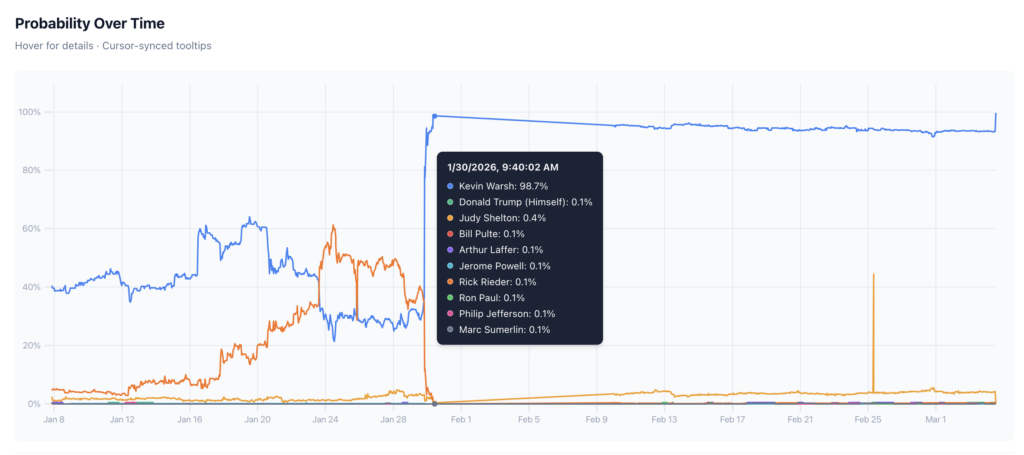
The decisive move came January 29. That evening, reports surfaced that Warsh had met with Trump at the White House. Warsh’s odds on Kalshi jumped from 31.2% to 81% overnight, and climbed to nearly 99% by the next morning. By the time President Trump announced the pick the following morning, the market had already called it. The official announcement via Truth Social January 30 was largely a formality for anyone watching the contracts.
Trump said of Warsh at the time: “I have known Kevin for a long period of time, and have no doubt that he will go down as one of the GREAT Fed Chairmen, maybe the best. On top of everything else, he is ‘central casting,’ and he will never let you down.”
Late-breaking doubt: Judy Shelton’s brief surge
Despite Warsh sitting above 95% for most of February, a thread of uncertainty crept back into the market in the final weeks before today’s Senate transmission. Judy Shelton, the economist and Trump ally known for her advocacy of gold-standard monetary principles, climbed to as high as 5% in recent days, briefly drawing attention from traders watching for any White House second-guessing.
Shelton had been on the original shortlist and retains genuine backing among hard-money conservatives in Trump’s orbit. Her late bump reflected a combination of factors: the gap between Trump’s January 30 announcement and today’s formal Senate submission, the confirmation complications introduced by Republican Senator Thom Tillis, and the basic willingness of prediction market traders to hold small positions on low-probability alternatives as long as the resolution event hasn’t occurred.
Before the official submission surfaced on Wednesday, Warsh was trading around 93% on both Kalshi and Polymarket, with trades still pouring in. Between the narrative doubt and Trump’s reputation for changing course on nominations, prediction market traders had ample opportunity to buy discounted contracts on Warsh. Many other traders took a flyer on long-shots like Shelton, essentially betting on the off-chance that Trump would pull a reversal.
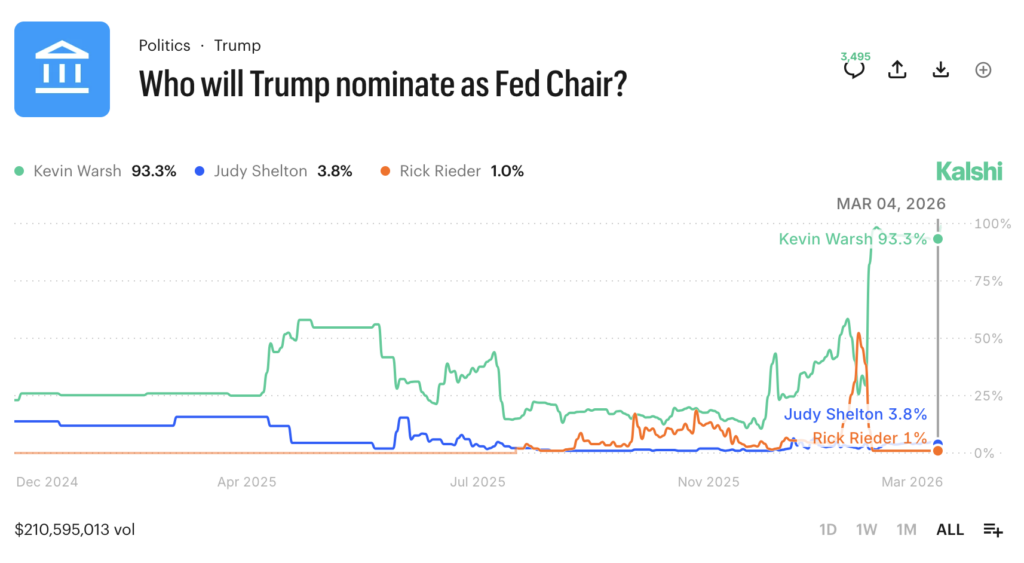
Today’s White House announcement settles that question, but confirmation is still to be determined. Additionally, Kalshi’s fed chair nominee market has yet to resolve. According to Kalshi’s market rules, “The nomination must be formally transmitted to and received by the Senate.”
$807 million in volume: A real-time barometer on monetary policy
The combined trading figures point to market pricing efficiency that produces useful live signals. When Warsh’s odds jumped overnight on January 29, hours before Trump or mainstream news had confirmed the pick, traders with real money at risk had already moved prices based on the White House meeting reports. It’s a real world example of information aggregation at speed that makes many prediction markets useful tools for traders and observers alike.
It’s also the kind of data point the Federal Reserve itself deems useful. A recent working paper published through the Fed’s Finance and Economics Discussion Series analyzed Kalshi’s macro event contracts covering inflation, GDP, unemployment, and rate decisions and found they often match or outperform traditional forecasting tools including Fed funds futures and professional forecaster surveys. The researchers described prediction markets as “a high-frequency, continuously updated, distributionally rich benchmark” valuable to both researchers and policymakers.
The Fed chair nominee market was exactly the kind of high-stakes, information-rich environment that supports useful, real-time forecasts. And traders continue to price related macro expectations.
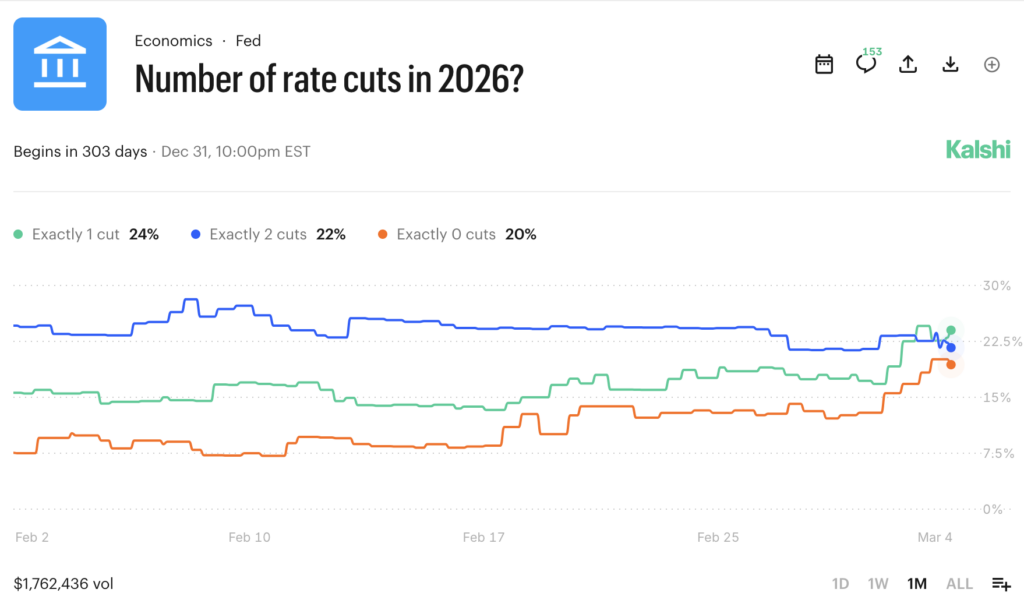
Prediction markets have reached 98% consensus there will be no fed rate cut in March. However, since Warsh’s official nomination today, Kalshi’s number of rate cuts in 2026 odds have shifted slightly. While “exactly 2 cuts” has led for most of the past month, with “exactly 3 cuts” briefly taking the lead, traders are now pricing in the real possibility of “exactly 1 cut” — the current leader at 24%. This market shows shifting expectations but even more so, it confirms current uncertainly.
What’s next: Confirmation markets and the Senate timeline
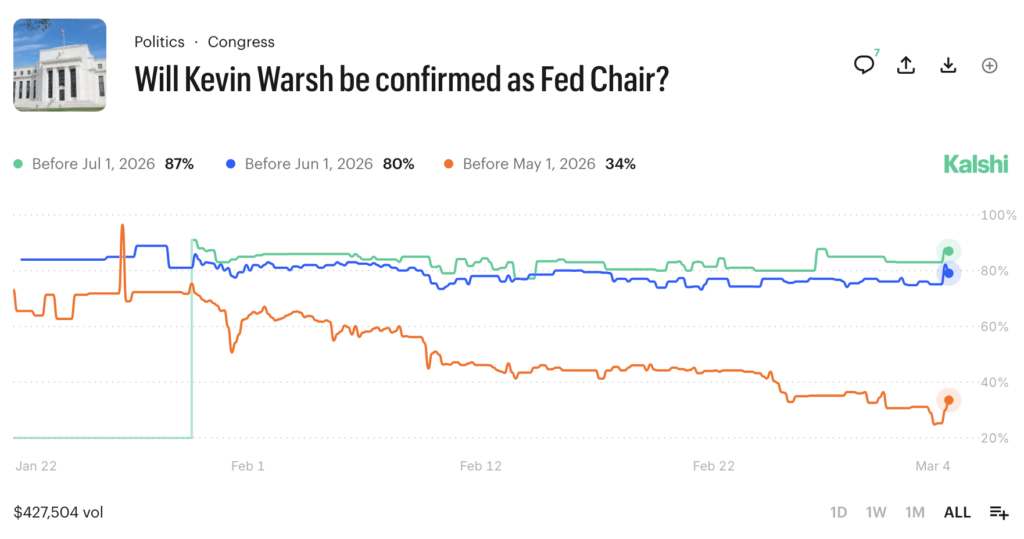
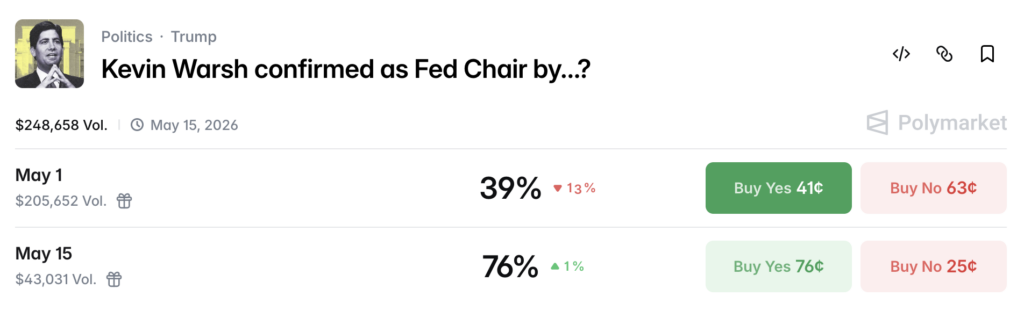
With the formal nomination submitted, the next market question is timing. Both Kalshi and Polymarket have active contracts on Warsh’s confirmation as Fed chair, and traders are well aware of the complications. Traders are pricing between a 34% and 39% chance he will be confirmed before May.
A key obstacle comes from Republican Senator Thom Tillis of North Carolina, who has threatened to block Fed nominees until the Trump administration’s criminal investigation of Powell is resolved. Democratic Senator Elizabeth Warren has staked out a similar position from the other side of the aisle. Meanwhile, Senate Banking Committee chair Tim Scott said he “looks forward to leading a thoughtful, timely confirmation process.”
Today’s White House submission covers two distinct nominations: Warsh for Stephen Miran’s Board of Governors seat (a 14-year term beginning February 1, 2026) and separately for the chairmanship (a four-year term). By law, those require two separate Senate confirmations, and they don’t have to happen simultaneously. By design, Warsh would need to clear the Board seat confirmation first, which makes him a sitting Fed governor before Powell’s chairmanship expires on May 15, then follow with the chairmanship vote. Miran holds the seat as a holdover until his successor is confirmed.
The catch is that both confirmations run through the same Senate Banking Committee, and the same Tillis bottleneck. If confirmation hearings drag through March and into spring without resolution, the June 16–17 FOMC meeting becomes the earliest clean date for Warsh to chair a policy decision.
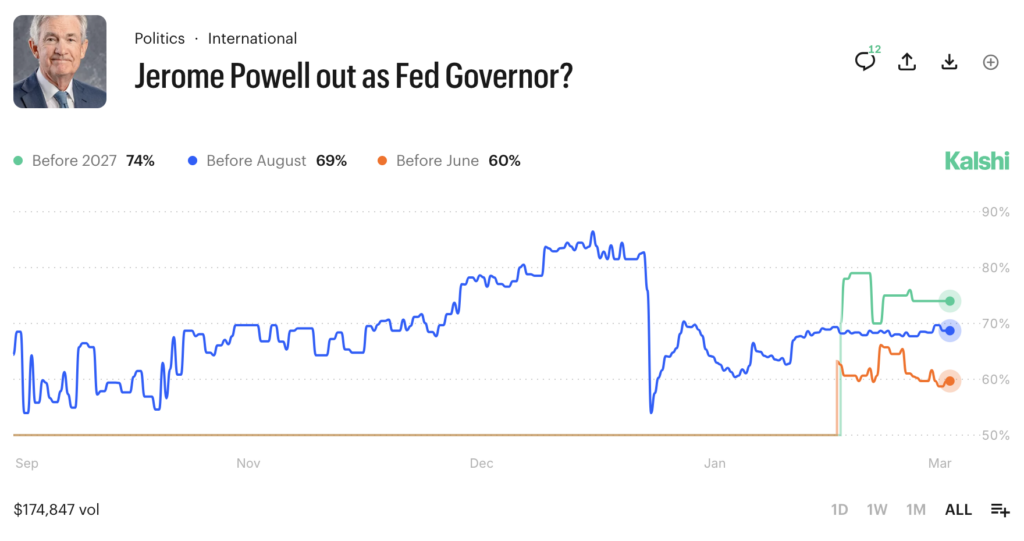
Powell adds another variable: his Board of Governors term runs through 2028, and he hasn’t said whether he’ll stay on as a governor once the chairmanship passes. Prediction markets are pricing in better than chance that he will leave the Board of Governors before his term runs out. That question carries real implications for the balance of power on the Board.
More on Federal Reserve