





Federally-regulated prediction market platform Kalshi is stepping up market integrity initiatives as the broader prediction market sector faces renewed scrutiny over alleged insider trading and market manipulation.
The company announced on Thursday a major expansion of its surveillance and enforcement framework, including a new independent advisory committee, external analytics partnerships and a dedicated head of enforcement. The moves come amid growing debate about whether prediction markets can maintain investor trust as trading volumes and public visibility increase.
Kalshi founder and CEO Tarek Mansour touted his platform’s latest efforts in an X post in which he outlined how suspicious trading activity is monitored and investigated. In his tweet, Mansour confirmed that “Kalshi bans insider trading,” explaining that “Insider trading erodes trust. When people believe a market is unfair, they stop trading.”
Kalshi’s market surveillance infrastructure additions
Kalshi said it has formed an independent Surveillance Advisory Committee that includes Daniel Taylor, director of the Wharton Forensic Analytics Lab, and Lisa Pinheiro, a managing principal at Analysis Group specializing in data-driven market manipulation analysis. The committee will produce quarterly reporting on flagged trades, investigations and enforcement actions.
“Market integrity is one of the pillars of Kalshi’s growth strategy,” Taylor said in a news release. “I am pleased to advise Kalshi on further processes and safeguards to detect and deter insider trading and market manipulation.”
The company also brought on Brian Nelson, former U.S. Treasury under secretary for terrorism and financial intelligence and now a partner at Cooley, to advise on financial compliance, trading surveillance and market integrity strategy.
Kalshi additionally appointed Robert DeNault as head of enforcement. DeNault joined the firm late last year after working in the global white-collar crime practice at White & Case, where he advised clients on securities fraud investigations, regulatory enforcement matters and internal compliance reviews.
Alongside the personnel moves, Kalshi announced a surveillance partnership with Solidus Labs, whose technology is designed to detect and investigate market abuse across financial and crypto trading venues. The company said the partnership is intended to supplement its existing internal monitoring systems as trading volumes continue to grow.
Kalshi launches consumer resource hubs
Kalshi also launched two new consumer-facing resources on its website aimed at improving transparency around trading safeguards. The Market Integrity hub focuses on how the exchange is regulated, how trading activity is monitored and what types of behavior are prohibited under its rules. It is positioned as an educational overview of how federally regulated markets operate and how surveillance and enforcement processes work.
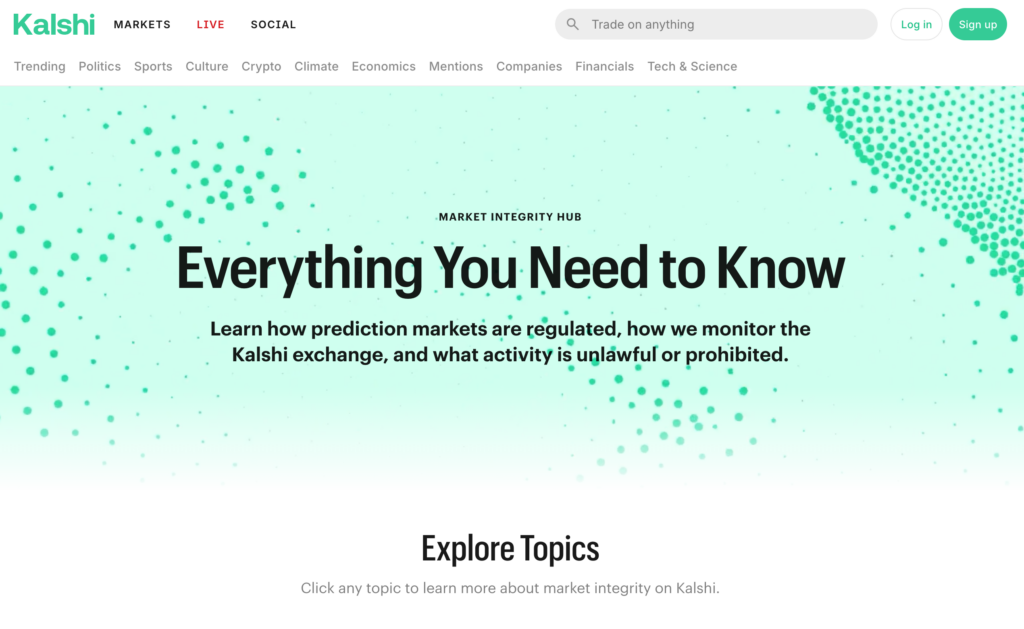
A separate Responsible Trading hub centers on consumer protection tools, including voluntary trading breaks, self-exclusion options, and personalized funding caps designed to help users manage risk and maintain control over their trading activity. The company said the hubs are intended to consolidate information about consumer protections and regulatory oversight as prediction markets attract a broader retail audience.
“Detect, investigate, enforce” framework emphasized
Mansour said Kalshi’s integrity strategy centers on what he described as a “detect, investigate, enforce” approach to suspicious trading activity, with continuous market monitoring designed to flag irregular patterns and escalate potential issues through formal review channels.
“In the past year, we ran over 200 investigations and froze relevant accounts,” Mansour wrote. “Of these, over a dozen have become active cases and several have been referred to law enforcement.”
Other Kalshi officials also chimed in about the stepped-up integrity efforts. The company’s Head of Crypto, John Wang, wrote on X that the newly-announced initiatives will foster trust among participants.
Recently formed industry trade group the Coalition for Prediction Markets, which has made safety and compliance cornerstones of its lobbying efforts, echoed Wang’s comments about trust and said such steps will help the industry continue to grow.
‘Insider trading’ scrutiny has been heightened recently
The integrity push comes amid heightened scrutiny of prediction markets following several high-profile insider trading allegations, including trading tied to the U.S. capture of Venezuelan president Nicolás Maduro. An anonymous trader reportedly made more than $400,000 after placing large bets on Polymarket shortly before the announcement of the operation, prompting questions about whether non-public information influenced trading activity.
The episode became a flashpoint for policymakers and media observers, with lawmakers raising concerns that prediction markets could create financial incentives for leaking sensitive geopolitical information. Similar scrutiny has emerged around bets tied to military activity and corporate announcements on offshore platforms where identity checks and surveillance standards can vary. Kalshi has come out in support of federal legislation seeking to forbid insider trading via prediction markets amid what Sportico dubbed a “compliance PR tour.”
Kalshi leaders have repeatedly argued that these incidents largely stem from offshore platforms rather than federally regulated exchanges, which many read as a subtle swipe against main competitor Polymarket’s international site, which is not available in, nor regulated by, the U.S. Mansour has emphasized that insider trading has been prohibited on Kalshi since launch and framed new legislation as primarily targeting “unregulated, offshore” activity that risks damaging the sector’s credibility.
Integrity push may influence regulator, sports league prediction market perception
Kalshi’s expanded integrity framework arrives as state regulators and gaming stakeholders continue arguing that prediction markets lack safeguards comparable to licensed sportsbooks. Officials in several states have warned that event contract exchanges can resemble sports betting while operating outside traditional licensing protocols that require responsible gaming controls, advertising restrictions and integrity monitoring.
Sports leagues have voiced similar concerns. The NFL has taken a cautious stance regarding prediction markets, with commissioner Roger Goodell previously saying that the league wanted to see stronger consumer protections and clearer regulatory guardrails before embracing prediction markets.
Recent comments suggest that posture may be evolving. NFL executive vice president Jeff Miller recently described prediction markets as “innovative” and said the league is “interested” while still emphasizing caution and the need to evaluate safeguards.
Kalshi’s new surveillance partnerships, enforcement initiatives and responsible trading tools could help address some of those concerns, particularly as federally regulated markets seek broader acceptance among regulators, leagues and other partners. Whether those efforts translate into formal league engagement remains uncertain, but credibility around market integrity increasingly appears central to the sector’s next phase of growth.